






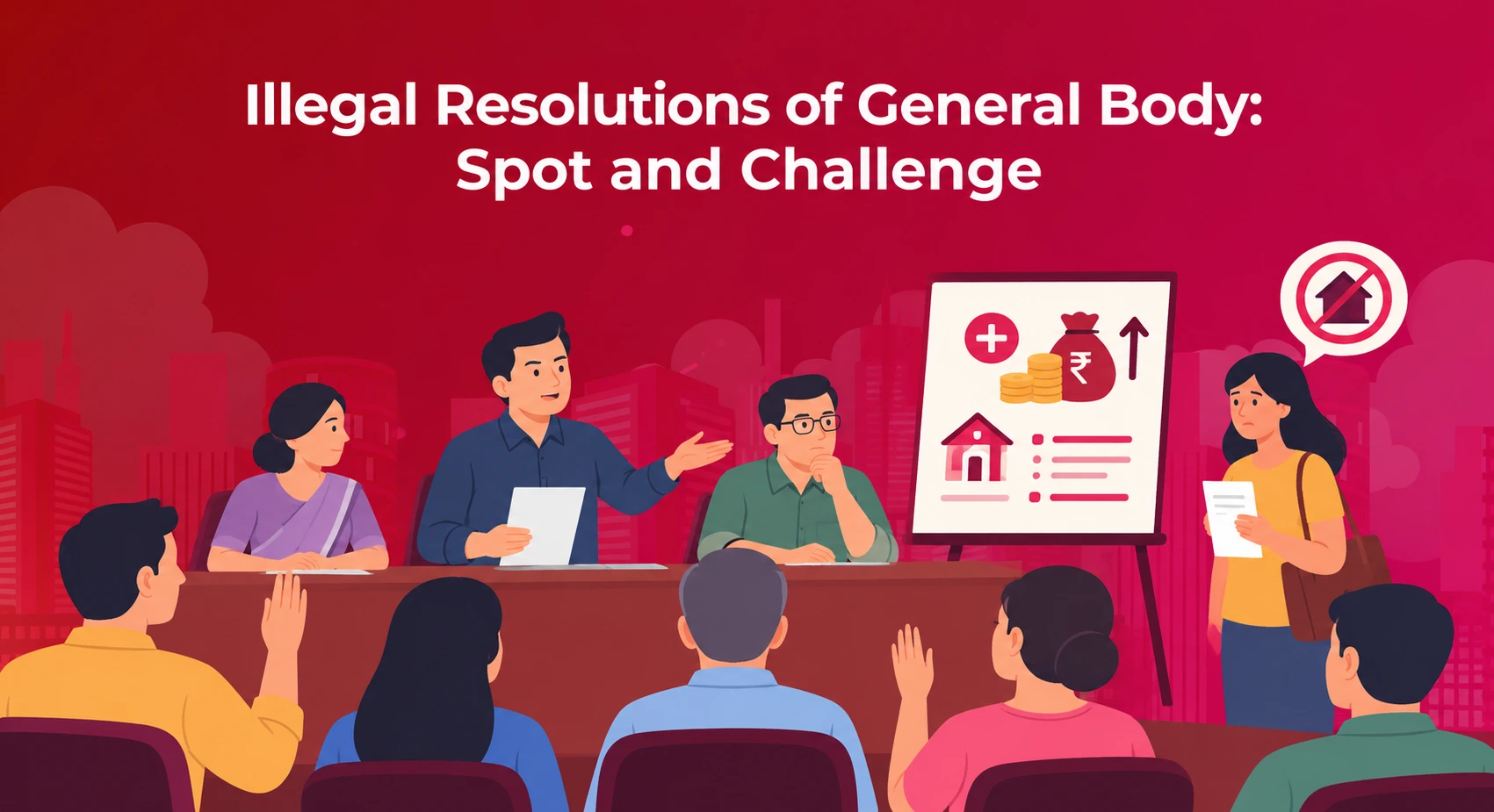


Every housing society runs on resolutions passed at its general body meetings, from maintenance rates to redevelopment approvals. But a resolution is only as strong as the process and the authority behind it. When a decision breaks the registered bylaws, skips mandatory notice, or has no rational basis at all, it counts among the illegal resolutions of general body meetings that members can lawfully challenge and reverse. This piece walks through what makes a resolution illegal, how long a society must wait before altering one, and the practical steps residents can take when a decision does not hold up.

What Makes a General Body Resolution Illegal?
The general body is the highest decision-making authority in a cooperative housing society. That power is wide, but it is not unlimited. Courts in India have repeatedly held that a majority vote cannot make a wrongful act lawful. Here are the four situations where illegal resolutions of general body meetings usually show up:
1. Decisions that are arbitrary or unreasonable
A resolution has to have a rational basis behind it. A society cannot pass a rule only because enough members wanted it on that day.
A well-known example is maintenance charges. The Bombay High Court struck down a society resolution that changed maintenance from a flat rate to a per square foot basis. The Court held that the resolution was arbitrary and unreasonable. It had no rationale or source of power. Both lower courts had also treated the resolution as invalid and inoperative. A 3BHK owner does not use the lift, the water pump or the security gate three times more than a 1BHK owner, so the differential has to be justified by actual service usage, not floor area alone.
2. Resolutions that break the bylaws or the Act
Registered bylaws work like the constitution of your society. They regulate membership, meetings, elections, maintenance charges, penalties and dispute mechanisms, and societies may adopt customised bylaws only so long as these do not conflict with statutory provisions. Anything passed against them is void from the beginning. Common examples include:
- Inventing a new charge such as "development charges" for incoming members without amending the bylaws.
- Cutting off water, lift access or power for members with pending dues. Recovery has to go through legal channels, not through pressure tactics.
- Blocking a tenant or buyer on the basis of religion, food habits, marital status or community.
- Non-occupancy charges above the legal cap.
Read also: Can Society Cut Water Supply of a Member for Not Paying the Maintenance Charges?
3. Procedural lapses during the meeting
A resolution can be challenged if the required procedure was not followed. This includes cases where the mandatory notice period was not given to every member, quorum was not established, or the agenda item was not circulated in advance.
This matters more than most committees realise. If expulsion, redevelopment or a heavy penalty was never on the circulated agenda, members can argue they had no chance to prepare or object.
4. Decisions beyond the society's authority
A resolution can also be challenged if the general body acts beyond its legal powers. It cannot take away a right granted by law. It also cannot create a penalty that the bylaws do not allow. Similarly, it cannot give the managing committee powers that the Act does not provide.
How Illegal Resolutions Affect Every Resident?
Most residents notice a general body resolution only when a bill goes up. By then, the decision is months old, and money has already been collected. One invalid resolution can create years of friction:
- Members may stop paying, leading to more recovery cases.
- Society funds may be spent defending a decision that is later found to be invalid.
- Disagreements can divide neighbours and make AGMs difficult to manage.
- Redevelopment and major contracts may get delayed by legal disputes.
Identifying an illegal resolution early can help the society avoid bigger problems and costs later.
Can a Resolution Passed in an AGM Be Altered?
Yes. A resolution can be changed, reversed or cancelled, but only by the general body itself, in a properly convened meeting, after the waiting period in the bylaws.
The six-month rule
Model bylaw 109 of the Maharashtra framework is direct about it. A general body cannot cancel a previous resolution immediately. At least six clear months must pass after the original resolution. Only then can members propose a resolution to cancel it. Older 1984 model bylaws carried the same rule as bylaw 110. So if your AGM in April approved a security contract, a fresh resolution to cancel it cannot be tabled before October.
What the managing committee cannot do?
The committee executes decisions. It does not overrule them.
- The managing committee cannot alter, ignore or quietly drop an AGM resolution on its own.
- If it does, that action is illegal and can be taken to the Registrar or the Co-operative Court.
- A committee resolution can never override a general body resolution.
The one exception worth knowing
The waiting period applies to a valid resolution that members simply changed their mind about. It does not protect an unlawful one. If a resolution is void for illegality or a procedural defect, members do not have to sit out six months before raising it.
Read also: Housing Society AGM Meeting Rules
When Are the Resolutions Passed at AGM Void?
The resolution passed at AGM are void or non-binding in the following cases:
1. Minutes were never confirmed properly
Draft minutes are meant to be circulated within 15 days of the meeting and finalised within three months. If the society misses this, the resolution loses its binding force.
2. Notice or quorum failed
Skipping the mandatory notice period, usually 14 clear days, or running the meeting without quorum, invalidates the proceedings.
3. The decision contradicts law
Anything against the Co-operative Societies Act, the model bylaws, or public policy is null and invalid from the very start.
4. Meeting records were altered
Altered minutes, missing attendance sheets or manipulated voting records are serious grounds for challenge.
5. The resolution is arbitrary
A decision with no rational basis and no source of power will not hold.
Whether the resolution passed at AGM are void depends on the circumstances. If none of the above issues applies, the resolution generally remains binding, even if some members disagree with it.
How to Challenge Illegal Resolutions of General Body Meetings?
If you believe an AGM resolution is illegal, start by checking the records and the applicable rules. These steps can help you understand the issue and choose the right route for raising it:
Step 1: Get the paperwork
Ask the Secretary in writing for a certified copy of the registered bylaws, the meeting notice, the attendance sheet and the minutes. Members have a statutory right to inspect records.
Step 2: Write a formal objection
Send a dated letter or email to the committee explaining exactly which bylaw, rule or section was breached. Keep a copy and an acknowledgement.
Step 3: Use the internal redressal route
Model bylaws from 2001 onwards include a complaints redressal chapter with escalation steps inside the society.
Step 4: Raise it at the next general body meeting
Get the item on the agenda through a member requisition and propose a corrective resolution. This is also how members formally record that the resolutions passed at AGM are void on a specific legal ground.
Step 5: Approach the Registrar
The Registrar of Co-operative Societies can act on procedural violations, election issues and non-compliance by the committee.
Step 6: File before the Co-operative Court
The Registrar generally cannot decide legal rights or formally declare a resolution illegal. For such a declaration, members can approach the Co-operative Court under the dispute provisions of the Act.
Act early when challenging a resolution. Delay can make the matter more difficult, especially if money has already been collected and spent.
Simple Ways Societies Can Prevent Illegal Resolutions
Prevention is far easier than dealing with legal disputes. A committee that follows these habits is less likely to face challenges:
- Circulate the agenda and notice with clear timestamps, not a last-minute notice board printout.
- Record quorum, attendance and vote counts for every single item.
- Read the bylaw aloud before voting on anything involving money or penalties.
- Circulate draft minutes within 15 days and confirm them within the timeline.
- Check whether an item needs a bylaw amendment rather than a plain resolution. Amendments need a two-thirds majority and Registrar approval.
- Keep a single archive of all past resolutions so new committees do not contradict old ones by accident.
Manage Society Complaints with NoBrokerHood Complaint Management System
A dispute can become harder to resolve when complaints are made verbally, sent across different WhatsApp groups, or left without a clear follow-up. Keeping each complaint documented gives the committee a better way to understand the issue, assign it for action and check its status.
NoBrokerHood’s complaint management system brings these requests into a centralised platform. Residents can raise complaints through the app, while the committee and concerned staff can manage and track them in an organised manner.
Key features include:
- Centralised Complaints: Keep resident complaints recorded in one place instead of relying on scattered messages or verbal requests.
- Complaint Assignment: Assign complaints to the relevant person or team for action and follow-up.
- Status Tracking: Track the progress of complaints from submission through resolution.
- Complaint History: Maintain previous complaint records for reference when similar issues are raised again.
A structured complaint process can make it easier to address concerns before they turn into prolonged disagreements. It also gives residents and committee members a clearer record of how an issue was raised and handled.
