






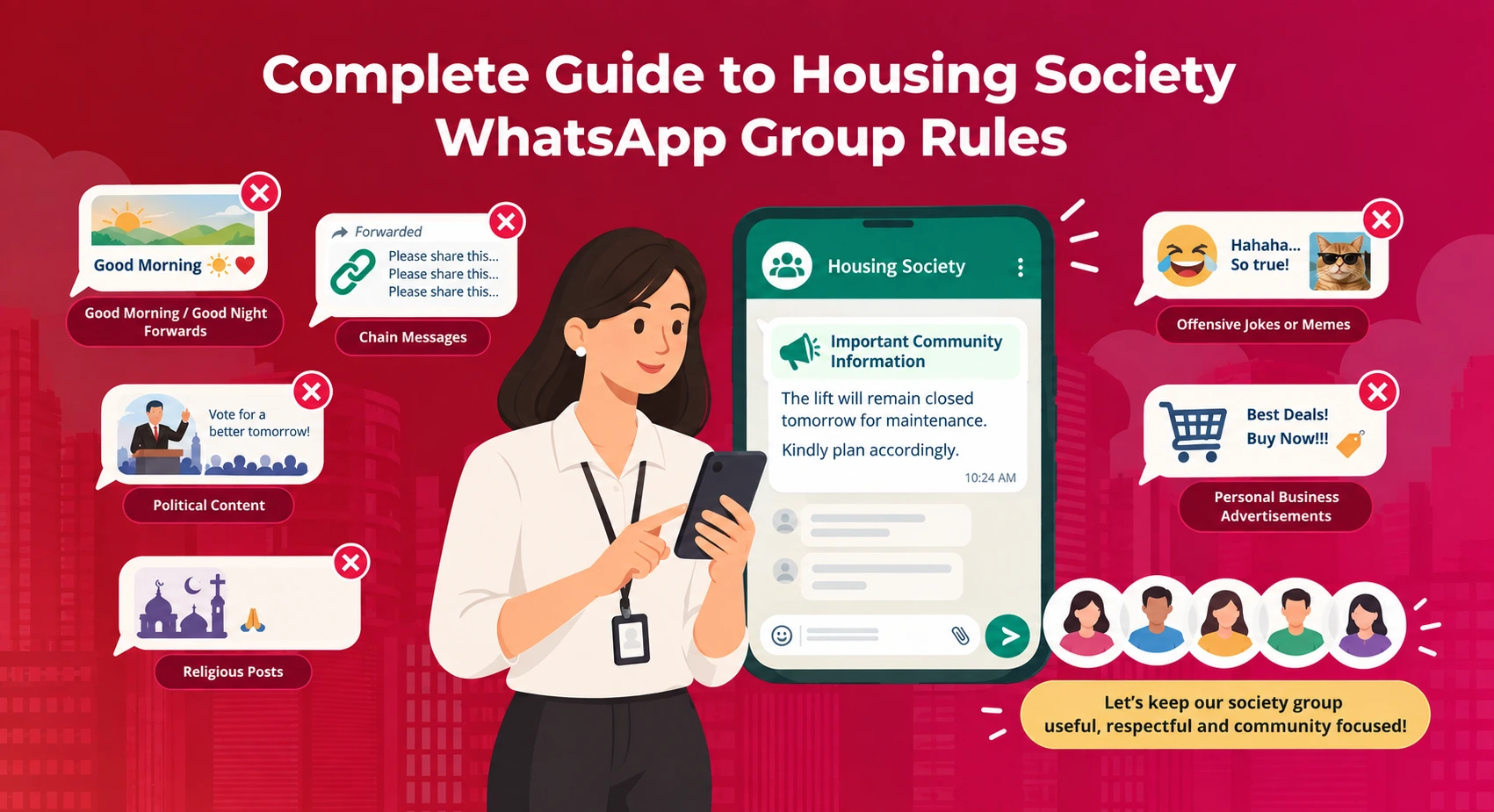


Housing society WhatsApp group rules keep resident chats focused on announcements, maintenance updates, and safety alerts, instead of spam, arguments, and forwards. This guide covers why these rules matter, what the group should and shouldn't be used for, and a practical set of WhatsApp group rules for society members covering privacy, respectful communication, and quiet hours. It also looks at how complaints should be handled, what role admins play in enforcement, and whether a WhatsApp message can ever replace a formal society notice.

Why Does a Housing Society WhatsApp Group Need Rules?
A society WhatsApp group is usually created to keep residents informed. Over time, it can become a place for maintenance complaints, parking arguments, event planning, personal conversations, advertisements and forwarded messages. This creates three problems:
- Important updates may get missed
- Disagreements can become public arguments involving several residents.
- Residents start muting the group entirely
A practical set of housing society WhatsApp group rules keeps the group focused without stopping residents from communicating with one another. The aim is not to control every conversation. It is to make sure the group remains useful for the community. For example, a message about tomorrow’s water shutdown is relevant to everyone. A long argument between two residents about a parking dispute is better handled privately or through the society’s complaint process.
What Should Be the Purpose of a Housing Society WhatsApp Group?
Residents should know why the group exists. A housing society WhatsApp group can be used for:
| Purpose | What the group can be used for |
| Society announcements | Meeting reminders, maintenance schedules, water supply updates and other community notices |
| Security alerts | Urgent information about suspicious activity, access issues or immediate safety concerns |
| Community updates | Festival arrangements, common-area closures, scheduled repairs and society events |
| Essential coordination | Short-term information that residents genuinely need to know |
The group should not become the only communication channel for every society activity. Formal notices, meeting records, resolutions and documents should continue through the channels required by the society and applicable rules.
Read also: Digital Notice Board for Society
What Are the Basic WhatsApp Group Rules for Society Members?
The following WhatsApp group rules for society members can be adapted into the group description or shared as a pinned message.
1. Keep messages related to the society
Posts should have a clear connection to residents, common facilities, security, maintenance or community activities. If a message would have no relevance to the majority of residents, it probably does not belong in the main group.
2. Communicate respectfully
Residents should not use vulgar language, personal insults, threats or abusive comments. Disagreements are normal in a residential community. Personal attacks are not. Discuss the issue, not the character of the person involved.
3. Keep politics and religion out of the group
Political debates, religious jokes and divisive discussions can quickly turn a community group into a source of conflict. Unless a message is about a society activity and suitable for the whole community, political and religious discussions should be kept out of the main group.
4. Respect everyone's privacy
Do not share another resident’s phone number, private conversation, photograph or screenshot without permission. This also applies to forwarding messages from the group outside the community. A message posted in a residents' group should not automatically be treated as content that can be redistributed elsewhere.
5. Avoid unnecessary commercial posts
Personal business advertisements, promotional offers, referral links and repeated service promotions can clutter the group. If the society permits residents to share local services or businesses, admins can create a separate group or set a specific day or format for such posts.
6. Verify information before forwarding it
Residents should verify information before passing on claims of thefts, security incidents, health scares, government orders or emergency situations. An unverified warning might cause unnecessary panic. If it's a real security concern, please contact the security team or society management directly and not just send a group message.
7. Keep messages concise
Sending one complete message is easier for everyone to follow than sending several short messages one after another. For example, instead of sending five separate messages about a society event, include the date, time, location and required action in one message.
8. Respect quiet hours
Unless there is an emergency, residents should avoid non-urgent messages between 9:00 PM and 7:00 AM. This is particularly useful in large societies where hundreds of residents may receive every notification.
Following these WhatsApp group rules for society members can keep communication clear, respectful and useful for everyone.
What Should Residents Avoid Posting in a Housing Society WhatsApp Group?
A clear group policy should also explain what does not belong in the chat. Common examples include:
- Good morning or good night forwards
- Chain messages
- Unverified news
- Political content
- Religious posts
- Offensive jokes or memes
- Personal business advertisements
- Fundraising requests without verification
- Large or repetitive video files
- Personal disputes between neighbours
- Screenshots of private conversations
- Panic-inducing claims about security incidents
The aim is to keep the group focused on useful updates and avoid content that can create unnecessary confusion or conflict.
Read also: Post your society’s announcements on our Digital Notice Board
How Should Complaints Be Handled in a Society WhatsApp Group?
One of the most important housing society WhatsApp group rules is to avoid turning the main group into a complaint register. Suppose a resident notices a leaking pipe in the basement. Posting a short alert such as “Basement pipe is leaking, please inform maintenance” may be useful. However, a long conversation involving the resident, plumber, facility manager and committee members can quickly fill the group with messages that most residents do not need to read. A better process is:
- Report the issue through the society’s official helpdesk or designated contact.
- Provide the location and relevant details.
- Attach photographs if required.
- Track the complaint through the official channel.
- Use the WhatsApp group only for a broader announcement when residents need to know about it.
This gives the complaint an identifiable record and makes follow-up easier. Personal disputes should also be moved away from the main group. If a parking disagreement involves two flats, publicly debating it with the entire society rarely solves the underlying issue.
What Role Should Society WhatsApp Group Admins Play?
Admins are not expected to monitor every sentence or settle every disagreement. Their main responsibility is to keep the group aligned with its stated purpose. Useful admin practices include:
- Share the group rules when a resident joins.
- Pin important guidelines where possible.
- Remove clearly inappropriate or irrelevant content.
- Give a warning before removing repeat offenders, where appropriate.
- Direct complaints to the correct society channel.
- Avoid taking sides in personal disputes.
- Share verified information during emergencies.
- Keep administrative decisions separate from personal arguments.
WhatsApp gives admins the ability to delete problematic messages and remove members who repeatedly break the group's rules. It helps to apply these measures consistently by giving a warning first, explaining the reason clearly and removing a member only if the behaviour continues. This way, members know what to expect rather than being caught off guard. Admins should also be careful not to use this authority to shut down legitimate questions. Residents should be able to raise concerns respectfully, even when the committee disagrees with them.
Read also: Keep your safety worries at bay with NoBrokerHood’s ‘SOS’ button
Are WhatsApp Messages Legally Valid as Society Notices?
No. A WhatsApp message should generally be treated as a convenient communication method, not automatically as a substitute for a formal society notice, AGM process, resolution or registered communication. For example, an admin can post:
“The lift will remain closed tomorrow from 10 AM to 2 PM for maintenance.”
This works well as a quick resident update. However, if the society needs to pass a formal resolution, issue a statutory notice or record an official decision, it should follow the procedure applicable to the society under the relevant state laws, rules and bylaws. This distinction is important because a message being visible to residents does not, by itself, determine whether a formal legal or governance requirement has been met.
Housing Society WhatsApp Group Rules Residents Can Copy
For societies that want a short version, the following can be pinned in the group:
- Keep messages related to society matters and community welfare.
- Use respectful language. No insults, harassment or vulgar content.
- Do not post political or religious debates.
- Do not share another resident's private information or screenshots without permission.
- No advertisements, spam or unverified fundraising requests.
- Verify news and security alerts before forwarding them.
- Avoid repetitive forwards, unnecessary media and chain messages.
- Keep personal disputes out of the main group.
- Raise individual complaints through the official society helpdesk.
- Avoid non-emergency messages between 9:00 PM and 7:00 AM.
- Remember that WhatsApp messages do not automatically replace formal society notices or statutory processes.
- Admins may remove content or members for repeated violations after appropriate warnings.
Can One WhatsApp Group Handle Everything? See How the NoBrokerHood Communication Management System Helps
WhatsApp can work well for quick conversations, but larger societies often need different channels for announcements, complaints and resident discussions. NoBrokerHood's communication management system provides separate tools for these everyday requirements. Its resident and admin features include notices, communication, complaint management and resident engagement, helping committees avoid putting every type of message into one chat.
For example:
- Digital notices: Committees can send society announcements to residents through the app instead of relying entirely on fast-moving group chats.
- Helpdesk: Residents can raise maintenance complaints with details and photographs and track their status.
- Resident communication: Community forums provide a space for resident discussions and questions.
- Emergency communication: The platform includes SOS and security-related communication features for urgent situations.
- Centralised information: Important announcements can remain easier to find instead of getting buried under hundreds of WhatsApp replies.
WhatsApp can still remain useful for quick updates and coordination. The main benefit of using a separate platform is that announcements, complaints and important community information have a more organised place, making them easier to manage and find later.
