





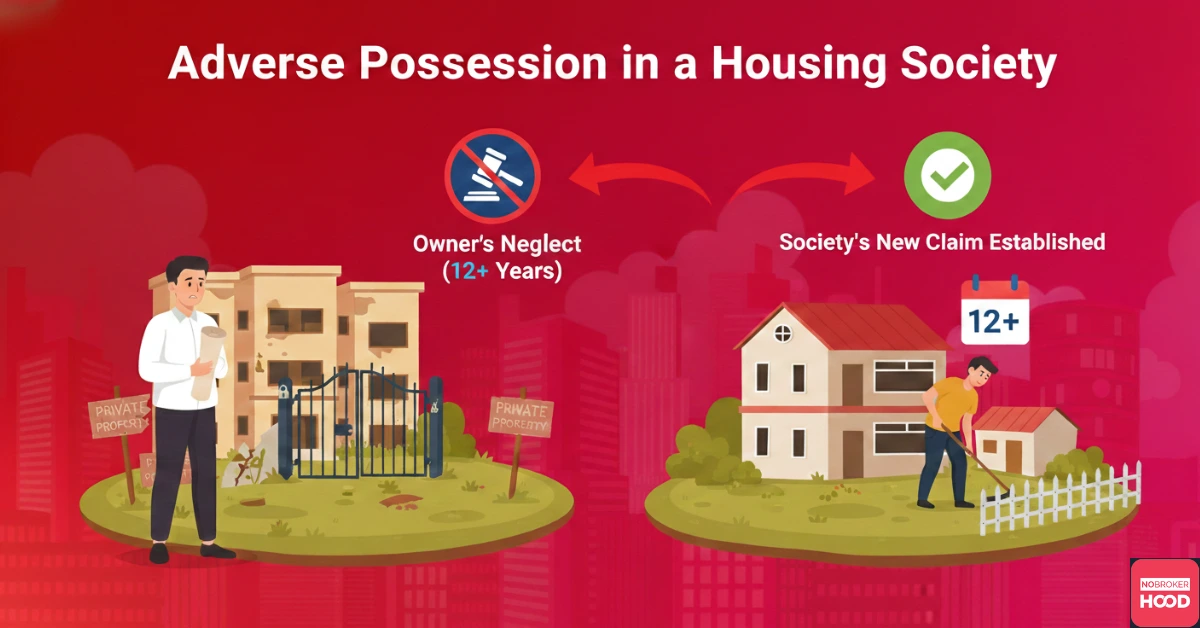


The adverse possession law in India allows a person to claim ownership of property if they possess it openly, continuously, and without the owner’s permission for 12 years for private land and 30 years for government land. The burden of proof is fully on the person making the claim. Housing societies must actively monitor and document property use to prevent such disputes.

What Is Adverse Possession in India?
Adverse Possession is a legal concept where a person who is not the legal owner of a property can become the owner after occupying it openly, continuously, and without the owner's permission for a fixed number of years, under certain strict conditions. The owner must also fail to take legal action within the limitation period. In India, the doctrine is particularly relevant to disputes involving land and other property that has remained unused or neglected for long periods.
This becomes especially relevant for housing societies, where open plots, terraces, servant rooms, parking areas, or storage corners are often left unused for years. For example, if a person occupies a society's unused land area, builds a structure, and uses it openly for many years without objection, they may later try to raise a claim under adverse possession of property in India. Many such adverse possession cases in India start from ignored encroachments. This is why societies must keep clear records and conduct regular inspections.
Law of Adverse Possession of Land in India
The adverse possession law in India mainly comes from the Limitation Act, 1963.
Key legal base:
- Article 65 of the Limitation Act sets the time limit for recovery of possession
- Section 27 says the owner’s right gets extinguished if no action is taken within the limitation period
The table below sets out the limitation period under the Adverse Possession Limitation Act for private and government property:
Private Property vs Government Land: Limitation Period
| Property Type | Limitation Period | Legal Provision |
| Private property | 12 years | Article 65, Limitation Act 1963 |
| Government land | 30 years | Limitation Act 1963 |
This means adverse possession under limitation act rules becomes an enforceable right once the period lapses, not merely a legal defence. The law of adverse possession of land in India focuses more on the conduct of possession than paperwork alone. Courts check behaviour, control, and intent.
What Are the 5 Requirements for Adverse Possession?
The doctrine of adverse possession in India works only when all 5 requirements below are satisfied.
Essential elements:
- Hostile possession, meaning without the owner's permission
- Open and visible possession, not secret or hidden
- Continuous possession, with no breaks over the full period
- Exclusive possession, where the claimant acts as the sole owner
- Statutory time period met, 12 years for private property or 30 years for government land
Courts also expect two things beyond the 5 core requirements: the claimant must show actual physical control over the property, not just a claim of control, and the real owner must have taken no legal action for the entire statutory period. Courts apply these conditions strictly in adverse possession cases in India.
How to Prove Adverse Possession in India?
Proof is the most difficult part. The burden is fully on the claimant to prove adverse possession in India
They must show:
- Date when possession started
- Nature of possession
- Proof that it was hostile to the owner
- Evidence of continuous use
- No permission was given
- The owner knew or should have known
- No legal interruption happened
Mere occupation or trespass is not enough under the adverse possession law in India.
Documents Needed for Adverse Possession in India
Common documents needed for adverse possession, which also help to prove adverse possession in India include:
- Property tax payment receipts
- Electricity or water bills in the claimant's name
- Old photographs of occupation
- Boundary wall or construction proof
- Witness statements
- Local authority records
- Mutation or survey records, if available
Courts check consistency across records when reviewing adverse possession of property in India.
Read also: Leave and License Agreement
How to Claim Adverse Possession in India?
Claiming adverse possession in India is not automatic. A legal process is required.
Typical steps:
- Continue possession for the full limitation period
- Maintain proof of open and hostile use
- File a civil suit claiming title by adverse possession
- Present documents and witnesses
- Prove all required legal elements
- The court evaluates facts and the owner's response
Without strong proof, most adverse possession cases in India fail.
Can a Tenant Claim Adverse Possession in India?
No, tenant possession is considered permissive, not hostile. Since they entered with the owner's consent, their stay does not qualify under the adverse possession law in India.
Only in rare cases where a tenant clearly denies the owner’s title through written notice and continues hostile possession for the full limitation period, a claim may be examined. Courts treat such claims very strictly.
Read also: Illegal Encroachment in Housing Society
What Is Adverse Possession Under the Law in India
Adverse possession refers to a situation where a person occupies and uses a property for a long period without the owner’s permission, in a way that goes against the owner’s legal rights, and treats the property as their own.
For a claim under adverse possession of property in India to succeed, the occupation must meet strict legal conditions. The possession must be open, continuous, exclusive, and without consent for the full limitation period. Courts carefully examine conduct, duration, and proof before accepting such claims.
Examples that may qualify as adverse possession include:
- Encroaching on land and fencing it as personal property for many years
- Constructing and occupying a structure without consent for the limitation period
- Publicly claiming ownership and acting as the owner
Situations that do not qualify as adverse possession:
- A tenant staying on rent
- A caretaker living with permission
- A friend or relative is allowed to use the property
Without meeting all legal conditions, an adverse possession claim cannot succeed.
Read also: Tenant Police Verification in Apartments
Adverse Possession of Land in India and Society Property Risks
Adverse possession of land in India creates real risks for housing societies, especially where:
- Open land is unused
- The boundary walls are broken
- Watchman records are missing
- Old staff quarters are abandoned
- Parking areas are loosely managed
Society prevention tips:
- Conduct annual property inspections
- Fence and mark all boundaries
- Keep occupation records
- Issue written notices for encroachments
- Use written permission letters for any temporary use
- Pass committee resolutions on space allocation
Active management reduces risk under the adverse possession law in India.
Read also: Step-by-Step Guide to Rental Agreement
Supreme Court Judgement on 12 Years Possession Case
Important adverse possession case law in India shows that courts do not favour casual claims. The Supreme Court has repeatedly said that adverse possession must be clearly proved and cannot be assumed.
In Ravinder Kaur Grewal vs Manjit Kaur, the Supreme Court held that a person who has completed 12 years of hostile, open, and continuous possession not only gets a defence against eviction. They can also approach the court as a plaintiff to protect that possession if they are later dispossessed. This remains one of the most cited examples of an adverse possession Supreme Court judgment in Indian property law.
Judgments stress:
- Hostile intent must be clear, and the owner's denial of title must be shown
- The claimant must establish the exact date on which possession began, and the owner must have had knowledge of it throughout
- Long possession alone is not enough without proof of intent and conduct
- Once perfected, adverse possession creates an enforceable right
- Claims are examined strictly, with strong documentary and behavioural proof required
Recent adverse possession cases in India confirm that courts expect this level of proof before accepting a claim. Housing societies should treat this Supreme Court judgment on adverse possession as a reminder that silence over encroachments, even informal ones, can eventually harden into a legal claim if left unchecked for years.
How NoBrokerHood Helps Prevent Adverse Possession Risks
NoBrokerHood helps housing societies reduce adverse possession risks through structured digital record-keeping and monitored access control. Common areas, facility allocations, and temporary permissions can be recorded with timestamps and approval trails, showing that the society actively manages its property.
It maintains centralised records of assets, notices, complaints, and space usage, which helps establish proof that the occupation was not unauthorised or unnoticed. App-based gate security ensures visitors, vendors, tenants, and staff enter only after approval, with every entry and exit logged.
With asset registers, inspection notes, and documented objections, societies can quickly flag encroachments and maintain evidence, which is useful in preventing long-term unauthorised occupation claims.
