





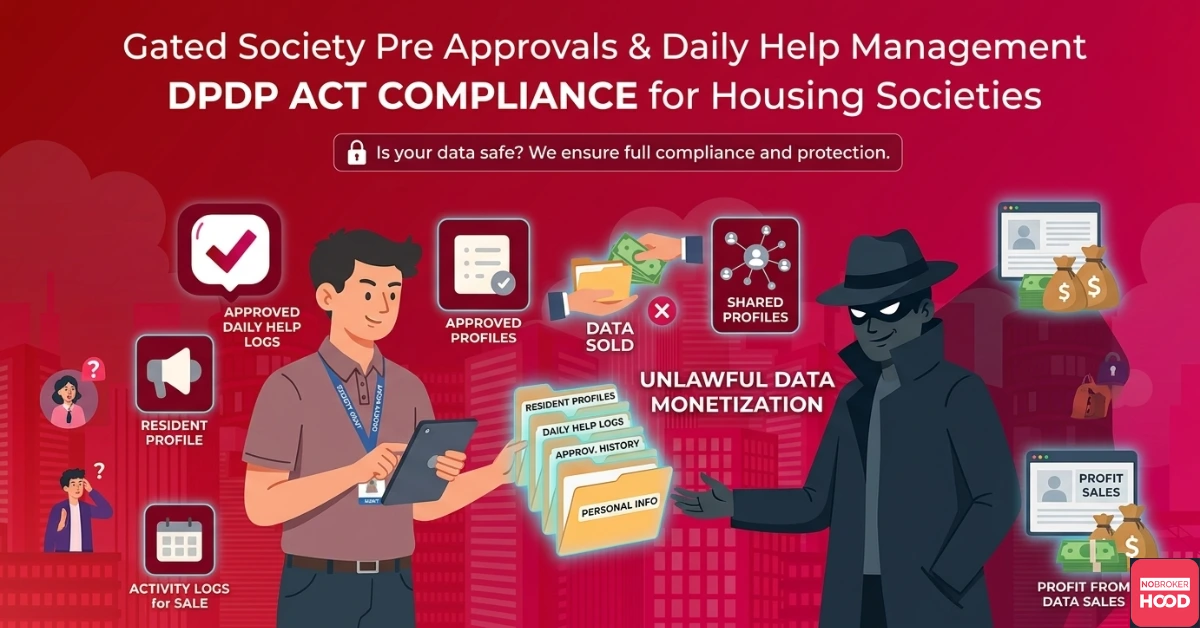


The Digital Personal Data Protection Act, 2023, is changing how housing societies handle resident data in India. From visitor logs to CCTV footage, societies manage sensitive information daily, making DPDP compliance essential. The law makes RWAs and management committees responsible for collecting only necessary data, taking consent, and keeping it secure, with penalties that can go up to ₹250 crore for serious violations like data breaches or misuse. Following the DPDP Act and rules helps societies avoid risks while building trust with residents.

What Is the DPDP Act and Why Does It Matter?
The DPDP Act, also known as the Digital Personal Data Protection Act, is India’s law that governs how personal data is handled. It applies to any organisation that collects or processes personal data, including housing societies. The law ensures that the people have control over their information while organisations use it responsibly.
For residential communities, this is important because societies regularly handle sensitive data like phone numbers, ID proofs, visitor logs, and even CCTV footage. The law ensures this data is used responsibly and only for valid purposes.
The DPD Act and rules also introduce strict penalties and clear responsibilities, making data protection a shared duty across society management. With increasing use of apps and digital systems, societies now need to think carefully about privacy, not just convenience.
Why Housing Societies Fall Under the Digital Personal Data Protection Act?
Housing societies regularly collect and manage residents’ personal data for daily operations such as security, communication, and facility management. Because of this continuous data handling, they come under the scope of the Digital Personal Data Protection Act, 2023 and must follow its rules.
Here is what that means in a societal context:
- RWA/MC = Data Fiduciary: Responsible for data collection and usage decisions
- Apps or vendors = Data Processors: They process data on behalf of society
- Residents = Data Principals: Individuals whose data is being collected
This classification under the Digital Personal Data Protection Act makes societies legally accountable for any misuse, breach, or improper handling of resident data.
How Does the DPDP Act Apply to Housing Societies?
Under the DPDP Act, RWAs and management committees are treated as Data Fiduciaries. This means they are directly responsible for protecting resident data.
This includes:
- Collecting only necessary information
- Using data only for society-related purposes
- Keeping data secure and updated
- Deleting data when no longer needed
For example, collecting phone numbers for emergency communication is valid. Using the same data for promotions without consent is not allowed under the Digital Personal Data Protection Act.
Key Rules Under the DPDP Act and Rules
The DPDP Act and rules focus on a few core principles that every housing society must follow:
1. Purpose Limitation
Data must be collected only for specific and necessary reasons, such as:
- Maintenance billing
- Security verification
- Communication
Using it for ads or promotions without consent is not allowed.
2. Consent Management
Residents must give clear and informed consent.
They can:
- Withdraw consent
- Ask for data deletion
- Request data access
3. Data Minimisation
Only collect what is required. For example:
- Do not collect unnecessary personal details
- Avoid storing data longer than needed
4. Data Security
Societies must protect:
- Visitor logs
- CCTV footage
- Resident records
5. Children’s Data Protection
- Extra care is required for residents under 18
- Parent consent is mandatory
6. Data Retention
- Delete data once its purpose is complete
7. Breach Reporting
Any data breach must be reported to the Data Protection Board of India within the required timeline.
These rules under the DPD Act are designed to keep data usage simple, transparent, and safe.
Read also: Here is how you can keep personal data safe while connected to the internet
Essential vs. Non-Essential Data: When is Consent Required?
Not all resident data carries the same weight under the DPDP Act. Understanding the difference helps RWAs collect only what's necessary and know exactly when explicit consent becomes mandatory.
| Data Type | Examples | Essential or Non-Essential | Consent Required? |
| Identity & Contact | Name, flat number, phone number, email | Essential | Implied consent for society operations (billing, communication) |
| Vehicle Details | Vehicle number, RC copy | Essential | Implied consent for parking/access management |
| Emergency Contact | Alternate phone number, next of kin | Essential | Implied consent for safety purposes |
| Visitor Logs | Visitor name, phone number, photo, purpose of visit | Essential | Implied consent for security, limited to that purpose |
| CCTV Footage | Video recordings of common areas | Essential | Notice required; consent implied for security use only |
| Government IDs | Aadhaar, PAN, Passport copies | Non-Essential (unless legally mandated) | Explicit consent required; must state exact purpose |
| Financial Information | Income, bank details, salary slips | Non-Essential | Explicit consent required |
| Family & Personal Details | Occupation, family members' details, date of birth | Non-Essential | Explicit consent required |
| Biometric Data | Fingerprints, facial recognition data | Non-Essential (high sensitivity) | Explicit, specific consent required |
| Directory Listings | Resident photos, contact info shared with all residents | Non-Essential | Explicit opt-in consent required |
| Marketing/Promotional Use | Any resident data used for ads or vendor offers | Non-Essential | Explicit consent required; separate from operational consent |
Risks Housing Societies Cannot Ignore
Ignoring DPDP compliance can lead to serious consequences for housing societies.
Here are the major risks:
- Heavy penalties: Fines can go up to ₹250 crore for serious violations
- Legal responsibility on committee members: MC members may be held accountable
- Data misuse through apps: Some apps use resident data for ads or third-party sharing
- Loss of resident trust: Data leaks can damage the community environment
Many societies are unaware that even basic tools like visitor apps or directories fall under the Digital Personal Data Protection Act.
Legal Roles in a Gated Community:
| Entity in Gated Community | Legal Status | Primary Accountability |
| Management Committee / RWA | Data Fiduciary (DPDP Act) | Decides why and how data is collected; holds ultimate liability for data breaches. |
| Security / ERP Apps (e.g., MyGate, ADDA) | Data Processor (DPDP Act) | Processes data only on the instruction of the RWA; cannot legally serve untracked ads. |
| Residents, Tenants, & Guests | Data Principal (DPDP Act) | Holds the right to access, correct, or erase their digital records from the society's databases. |
| Chairman | Office Bearer (Bye-laws/State Cooperative Act) | Presides over meetings, holds casting vote, represents the society officially. |
| Secretary | Office Bearer (Bye-laws) | Maintains records, minutes, correspondence; ensures statutory compliance and filings. |
| Treasurer | Office Bearer (Bye-laws) | Manages accounts, collects maintenance dues, prepares budgets and audit reports. |
| Managing Committee (as a body) | Trustee-like Body (Bye-laws) | Day-to-day administration, enforcement of rules, maintenance of common areas. |
| Builder/Developer (pre-handover) | Promoter (RERA) | Responsible for common area conveyance, defect liability, and handover compliance until RWA formation. |
| General Body (all members) | Supreme Authority (Bye-laws) | Approves budgets, amends bye-laws, elects committee via AGM/EGM resolutions. |
Practical Steps for DPDP Compliance in Societies
Achieving DPDP compliance does not have to be complicated. Societies can start with simple steps:
1. Audit Your Data
- What data is collected
- Where it is stored
- Who has access
- Remove unnecessary information
2. Update Privacy Policies
Clearly mention:
- What data is collected
- Why is it collected
- How long has it been stored
3. Take Fresh Consent
- Get explicit permission from residents
- Especially for directories and communication tools
4. Review Apps and Vendors
- Check if apps follow the DPDP Act and rules
- Avoid platforms that rely on ads or data sharing
- Choose tools focused on privacy
5. Secure Data Systems
- Restrict access to sensitive data
- Use passwords and access controls
6. Manage CCTV and Visitor Data Carefully
- Store only the required footage
- Delete data after its purpose is fulfilled
7. Train Committee Members
- Educate them about the Digital Personal Data Protection Act
- Assign responsibility for data handling
These small actions can significantly improve DPDP compliance and reduce legal risks.
Common Risks Societies Face Today
Many housing societies unknowingly violate the DPDP Act due to a lack of awareness.
Here are some common risks:
- Using free apps that share resident data for ads
- Publishing resident directories without consent
- Storing CCTV footage without proper safeguards
- Keeping old resident data without deleting it
These issues can lead to serious penalties and loss of trust among residents. Proper DPDP compliance helps avoid these risks.
Read also: CCTV Rules for Society
Rights of the Residents Under the DPDP Act
The DPD Act gives residents strong rights over their data:
- Right to Access: Residents can ask what data is stored
- Right to Correction: Incorrect data can be updated
- Right to Erasure: Data can be deleted when no longer needed
- Right to Withdraw Consent: Residents can stop data usage anytime
- Right to Grievance Redressal: Complaints can be raised with the authorities
These rights ensure that individuals remain in control of their personal information under the Digital Personal Data Protection Act.
Read also: Apartment Resident Rights
DPDP Act and Community Apps: What to Watch Out For
Many housing societies use apps for visitor management, billing, and communication. However, under the Digital Personal Data Protection Act, not all apps are safe. Apps that show ads or share data with third parties may violate the law. This is because they use resident data beyond its original purpose.
The DPDP Act clearly states that consent must be free and specific. If residents are forced to use an app that tracks or shares their data, it may not meet compliance standards. Choosing privacy-focused platforms is important for long-term safety.
How NoBrokerHood Supports Data Responsibility Under the DPDP Act
NoBrokerHood is a society management software that is designed to support societies working towards GDPR and DPDP compliance by aligning with both Indian and global protection standards. It ensures strong privacy practices for resident data by focusing on structured data handling, secure access, and transparency, helping RWAs manage resident data more responsibly under the Digital Personal Data Protection Act, 2023.
Key measures include:
- End-to-end encryption using TLS, securing data both in transit and at rest
- Role-based access control, ensuring users only see relevant information
- Secure cloud hosting on Google Cloud with 99.99% uptime SLA
- Independent audits by Big 4 firms for compliance and transparency
- CVE monitoring via NVD, helping identify and fix security vulnerabilities early
- WSQ Certified security practices followed by trained teams
These practices support housing societies in aligning with the Digital Personal Data Protection Act while keeping daily operations simple and secure.
All Solutions by NoBrokerHood:
