






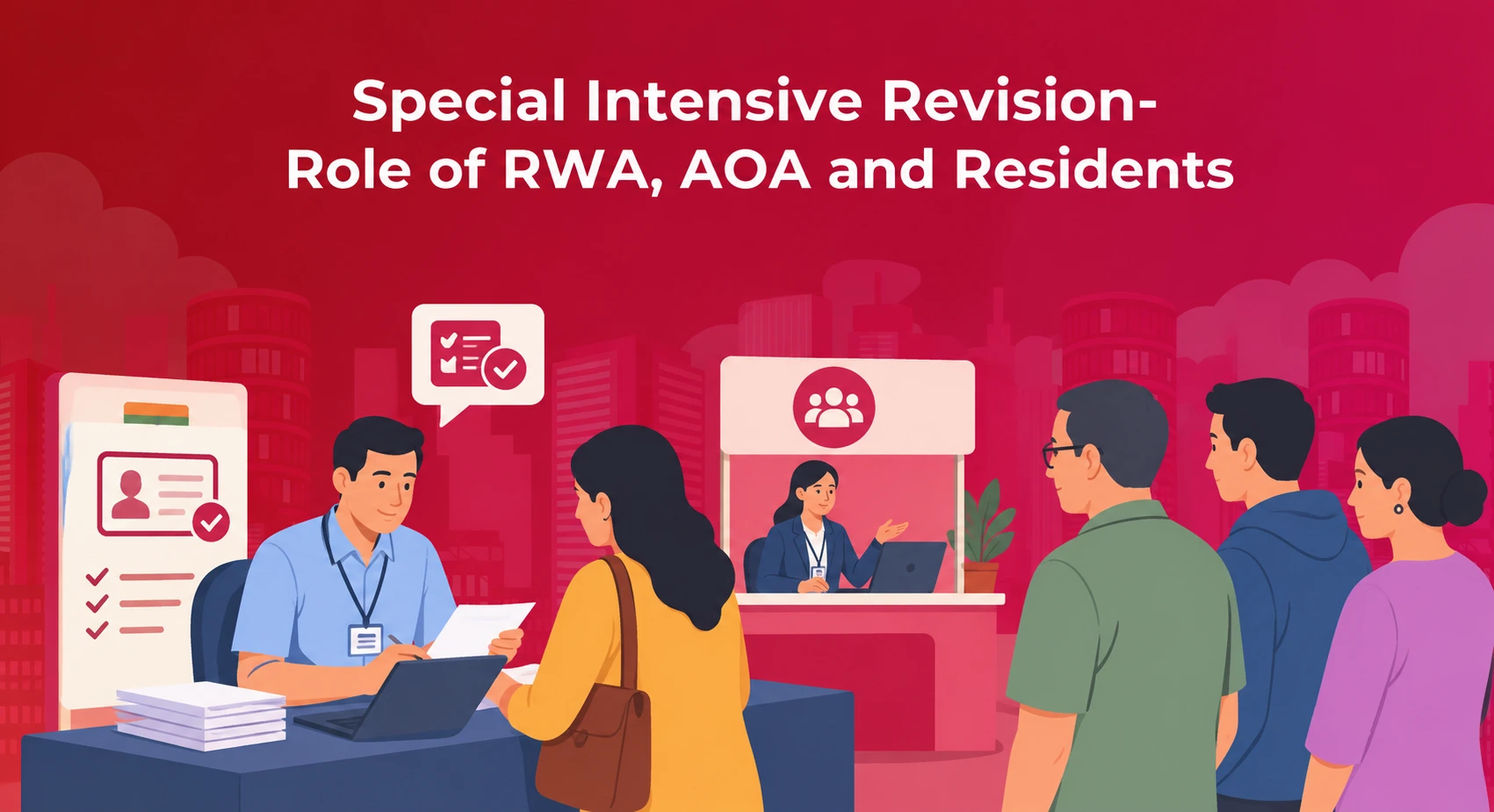


Voter verification can get complicated in large housing communities. Reaching out to every household may be a tough task for BLOs, as there are hundreds of flats, residents away at work and multiple towers with tight security. The Special Intensive Revision 2026 also asks questions of those residents living in redeveloped buildings or temporary accommodation. Here’s what residents and RWAs need to know about SIR, enumeration, voter records, polling stations and community-level coordination.

What Is Special Intensive Revision 2026?
The Special Intensive Revision 2026 is a full revision of the electoral rolls by the Election Commission of India (ECI). Officials go through existing voter records, flag mismatches, and try to make sure every eligible voter is actually on the list. Booth Level Officers (BLOs) do much of the groundwork by visiting homes. The ECI's voter services portal now provides SIR services too. You can fill enumeration forms there, look up older SIR rolls, submit documents in response to a notice, and search the electoral roll.
Cities are where this matters most because people shift between rented flats, owned flats and other states all the time. Migration, deaths, duplicate entries and changes in residence can make electoral rolls difficult to keep current.
The 2026 exercise comes out of the debate that started with Bihar's SIR in 2025. When the Supreme Court looked at the Bihar revision, it accepted that the ECI can carry out a special revision, as long as it stays within the legal framework and follows procedural safeguards.
For residents, the takeaway is simple. Special Intensive Revision is an electoral process, so residents should respond to official notices and verify their voter records rather than relying only on society-level information.
Special Intensive Revision 2026: Phases and State Timelines
The ECI is carrying out the SIR exercise in phases. Bihar was covered first in July 2025. The second phase ran from October 2025 to April 2026 across 12 states and Union Territories, including Tamil Nadu, Uttar Pradesh, West Bengal, Goa, Madhya Pradesh, Kerala, Gujarat and Rajasthan. Phase III covers the remaining areas, including Delhi. The exact schedule is different for each state. Some of the current timelines are:
- Karnataka: House-to-house enumeration took place from June 30 to July 29, 2026. The final electoral roll is scheduled for October 7, 2026.
- Delhi: The draft-roll and claims process has been extended up to October 30, 2026.
- Maharashtra: Enumeration and notice-related activities continue through October, with the final electoral roll scheduled for October 19, 2026.
The special intensive revision 2026 has also led to public and legal debate over changes to electoral rolls. The Supreme Court is examining issues related to the exercise, including the procedures followed by the ECI. Since schedules and instructions can change, residents should check their state Chief Electoral Officer's website for the latest information.
What Challenges Can SIR Create for Apartment Communities?
The SIR process can be more complicated in a large apartment complex than in a small residential street. One high-rise can have hundreds of flats, several towers, different polling parts, and residents who are rarely home during the day. Security gates add another hurdle for officials trying to reach individual doors. That's why SIR in apartments need some extra coordination between residents, the association and election officials. Here are the problems that come up most often:
- Residents are out when the BLO visits.
- New tenants or recent movers aren't sure what their electoral details are.
- Different towers fall under different polling arrangements.
- Residents don't know where their polling station or electoral part is located.
- Forms or notices are being missed because residents depend on informal society groups.
- Older residents need assistance with online searches or forms.
- Residents in redevelopment projects or temporary accommodation have doubts about their registered address.
These are a few coordination issues. The final decision on electoral registration remains with the competent election authorities.
What Role Can Apartment Associations Play During SIR?
An apartment association or Resident Welfare Association can make the process easier without interfering with the work of the ECI.
1. Create a clear communication channel
The association can share the official SIR schedule, BLO contact details, voter-service links and any instructions from the election authorities. In a large community, this helps a lot, since residents would otherwise be getting information from half a dozen unofficial forwards.
2. Coordinate with the BLO
If residents keep failing to reach their BLO, the association can set up one common point of contact. It can also offer the clubhouse, community hall or association office for an official voter facilitation event, provided the local election authorities allow it.
3. Set up a temporary helpdesk
A basic helpdesk can handle the questions people ask most:
- Where can I check my name?
- Who is my BLO?
- Where do I find the SIR form?
- What should I do if I get a notice?
- Where do I submit a claim or objection?
Volunteers should not check or collect residents' sensitive documents unless there's a clear official requirement and proper safeguards are in place.
4. Help residents who may need extra assistance
Senior citizens, persons with disabilities and people with long working hours may need some practical help getting to official services. The association can point them to the right election office, BLO or online service instead of attempting to decide their eligibility by itself.
5. Keep the exercise non-partisan
This is important for community management. The association's role should be limited to voter awareness and logistical assistance. It should not campaign for a political party, influence residents' choices, or collect political information under the pretext of SIR assistance.
How to Fill Out an SIR Enumeration Form?
Residents should use the official enumeration form and follow the instructions provided by the Election Commission or the concerned BLO. The basic process is:
- Get your form. Ask your BLO for it, or use the official ECI online service if it's available where you live.
- Look over the pre-filled details. Your name, address and other electoral information may already be there, so read through them carefully.
- Fill in what's missing. Add the requested information accurately, and match it to your official records wherever you can.
- Read and confirm the declaration. Take a moment to read it, then sign or confirm as required.
- Give it one last check. Look for typos, wrong addresses or anything you've left blank before you submit.
- Submit it the right way. Hand the completed form to your BLO, or use the official online option for your state.
- Hold on to your proof. Keep any acknowledgement or reference number you receive, in case you need it later.
If you are unsure about a field or the documents required, ask the BLO or check the instructions on the official ECI website. An RWA can help residents find the right information but should not fill in or alter their electoral details on their behalf.
How Should Residents Handle SIR Enumeration?
Even if the association is coordinating things, your electoral record is your own responsibility. Here's a short checklist that helps:
Step 1: Check your existing voter details
Go to the ECI's official voter services platform and search for your name and polling details. Look at:
- Name and spelling
- Age or date of birth
- Relative's name
- Address
- Assembly constituency
- Polling station
- Electoral part details
Having a voter ID card doesn't prove your name is in the current roll, so don't assume it does.
Step 2: Respond when the BLO contacts you
If a BLO comes to your door, give the required information through the prescribed process. If you won't be home, look up the instructions for your state. Don't ask the security staff to handle the form on your behalf.
Step 3: Check the SIR status after submission
Hold on to a record of what you submitted, and check your electoral roll again once the draft roll is out. The ECI portal lets you search the rolls and track applications.
Step 4: Act if your name or details are incorrect
If your name is missing or something needs fixing, use the form and process that fits your case. The ECI currently offers Form 6 for new registration, and Forms 7 and 8 for specified deletion, correction and related services. Don't wait for election day to discover there's a problem.
What Problems Can High-Rise Communities Face?
Life in SIR in apartments can look quite different from life in smaller neighbourhoods. Access is one issue. A BLO might reach a gated community and still have to work through multiple towers, security protocols and hundreds of households. Availability is another. Plenty of apartment residents are working professionals, and they may be travelling or simply unreachable during normal visiting hours. So good internal communication really counts. A society could put up a simple notice like this:
"SIR voter verification is underway. Please check your electoral details through the official ECI portal and respond to your BLO when contacted."
The notice should send people to official sources. It shouldn't ask them to email voter documents to the RWA. Reports from Pune show apartment communities and resident groups pitching in to help neighbours finish the process. Other communities can take the same lesson: a bit of organised effort stops people from missing something important.
What About Residents Living in Redeveloped Buildings?
Redevelopment adds its own complication. Residents may be living elsewhere for a while but still have ties to their original property. The issue has drawn attention in Maharashtra during SIR 2026. Mumbai authorities have let certain redevelopment-affected residents stay enrolled at their original address, subject to conditions and an undertaking that they intend to return. Some other districts have been asking for clarity on similar cases. So don't assume that shifting to transit accommodation automatically means your old electoral address has to go. If your building is being redeveloped:
- Read the instructions from your local election authority.
- Keep your redevelopment and transit-accommodation papers handy.
- Talk to your BLO or Electoral Registration Officer if your address is questioned.
- Follow the official procedure for claims, objections or corrections.
The exact rule can differ depending on the instructions that apply in your area.
Can Large Apartment Communities Request a Polling Station?
Yes. An apartment association can submit a representation asking for a polling station inside a large community, subject to the ECI's polling-station rationalisation guidelines. It makes the most sense where a large number of electors live in one place.
The Bangalore Apartments' Federation (BAF) is one example. In August 2026, it issued guidance urging eligible Apartment Owners' Associations and RWAs to send representations to the District Election Officer. It pointed in particular to communities with big elector populations, including senior citizens, persons with disabilities, women and working professionals. If your association is thinking about this, here's what to do:
- Work out how many registered electors live in the community.
- Check the current polling-station arrangement.
- Go through the rationalisation guidelines that apply.
- Prepare the representation on the association's letterhead.
- Submit it to the right election authority within the stated period.
A polling station is not automatically granted because an apartment complex makes a request. The election authorities decide the matter based on the applicable criteria and feasibility.
What Should RWAs Do After Enumeration?
The job isn't over once the forms are collected. A post-enumeration checklist keeps things on track:
- Share the official draft-roll publication date with residents.
- Tell residents where they can search for their names.
- Remind everyone to check their own records.
- Share the official process for claims and objections.
- Keep the contact details of the concerned election officials accessible.
- Give senior citizens and residents needing assistance information about available facilitation centres.
- Take down outdated notices once the deadline has passed.
The RWA should also resist building its own voter database full of personal information it doesn't need. Its role is to help people communicate, not to keep a private electoral register.
Read also: RWA Election Process
Manage SIR Communication in Apartments with NoBrokerHood Communication Management System
SIR-related information can easily get missed in a large apartment community, especially when residents rely on different groups or physical notices for updates. An organised communication system can help associations share important information with residents and make it easier for people to stay updated.
NoBrokerHood’s communication management system brings different ways of communicating within the community into one platform. Associations can use these features to share relevant SIR updates, while residents can interact with neighbours or find important community information in one place.
Key features include:
- Forum: Residents can participate in community discussions, share their views and ask questions on topics relevant to the community.
- Chat with Fellow Community Members: Residents can connect with neighbours one-on-one when they need information or want to discuss a community-related matter.
- Instant Notifications: Send timely alerts and reminders to residents when an important update needs their attention.
- Digital Notice Board: Associations can share society meetings, important updates, notices and other information with residents digitally.
For SIR in apartments, these communication tools can make it easier to circulate official updates and keep residents informed. The association can support communication and coordination, while residents should continue to verify their electoral details and follow instructions from the official election authorities.
