





A balcony may seem like a private extension of your home, but its use comes with certain responsibilities. From railing height and weight limits to structural changes, fire safety and everyday activities, there are several things residents should keep in mind. This guide explains the key balcony rules for apartment buildings, including enclosure permissions, ownership regulations and common society restrictions, to help residents use their balconies safely and avoid disputes.

What Do Apartment Balcony Rules Cover in India?
Apartment balcony rules come from three layers, and all three apply to you at the same time.
- Municipal bylaws: Your city or development authority decides what can be built, closed or altered.
- National Building Code (NBC 2016): It sets safety basics such as railing height and fire safety.
- Society or RWA bylaws: These keep the building looking uniform and the community comfortable.
Rules differ from one city to another, so always confirm the local rules with your RWA or municipal office.
What Are the Safety Rules for a Balcony?
Safety is the reason most balcony rules exist. A few simple limits protect children, pets and the people walking below.
How High Should a Balcony Railing Be?
Parapets or railings are generally expected to be between 1.0 m and 1.2 m high (about 3.3 to 3.9 feet), measured from the finished floor. NBC guidance calls for a railing or grill wherever the balcony sits 2 metres or more above the ground. Exact heights vary by city, so check your local bylaws.
- Keep gaps in grills at 10 cm or less so a child or pet cannot slip through.
- Avoid horizontal bars that a child can climb like a ladder.
- If you fit full grills or invisible grills, keep an openable panel for emergency exit. Local codes may not specify exact dimensions, but fire safety measures strongly support it.
How Much Weight Can a Balcony Hold?
Balconies are designed for limited load. Wet soil is heavier than it looks, because one litre of water weighs one kilogram. A single large pot can easily reach 15 to 20 kg before you add the container.
A few habits help:
- Keep heavy planters close to the building wall, not near the edge.
- Skip stone planters, water tanks and concrete features.
- Use trays under pots so water does not drip onto lower floors.
- Never block drainage holes, especially during the monsoon.
Balcony Enclosure Guidelines: What Can and Cannot Be Installed?
The short answer is that permanent enclosures need approval, and many societies will not give it. The balcony enclosure guidelines in most cities treat a closed balcony as extra built-up space. In Bengaluru, the BBMP has stated that closing or altering balconies after the Occupancy Certificate (OC) goes against the bylaws and the NBC. Owners who need changes must seek permission first.
What is not allowed?
- Brick or masonry walls
- Fixed glass partitions or sliding-folding glass curtains
- Permanent roofs or aluminium and uPVC frames that make a room
What is allowed?
- Outdoor roll-up blinds and bamboo chicks
- Retractable fabric awnings
- Invisible safety grills that meet gap limits
- Movable potted plant screens
Ignoring balcony enclosure guidelines can lead to demolition notices, penalties, extra charges, and property tax reassessment. Any change should also keep light and ventilation intact.
Apartment Balcony Regulations Under RERA and Society Bylaws
Under RERA, a balcony is an exclusive open area. It is not counted in RERA carpet area, though builders may show it separately in area disclosures and pricing.
This leads to a point that confuses many owners. You have exclusive use of your balcony, but the slab, outer walls and railings are common building elements. That is why apartment balcony regulations expect you to get written approval from your managing committee before you change railings, drill exterior walls or fix heavy permanent items.
Floor Area Ratio (FAR) and Floor Space Index (FSI) also matter. Open balconies are usually excluded from these calculations. Enclosing them can turn them into built-up space, which is why unapproved changes attract penalties.
Read also: How to Calculate FSI for Redevelopment
Which Everyday Balcony Habits Do Societies Restrict?
Most disputes come from daily habits, not big renovations. These are the usual restrictions.
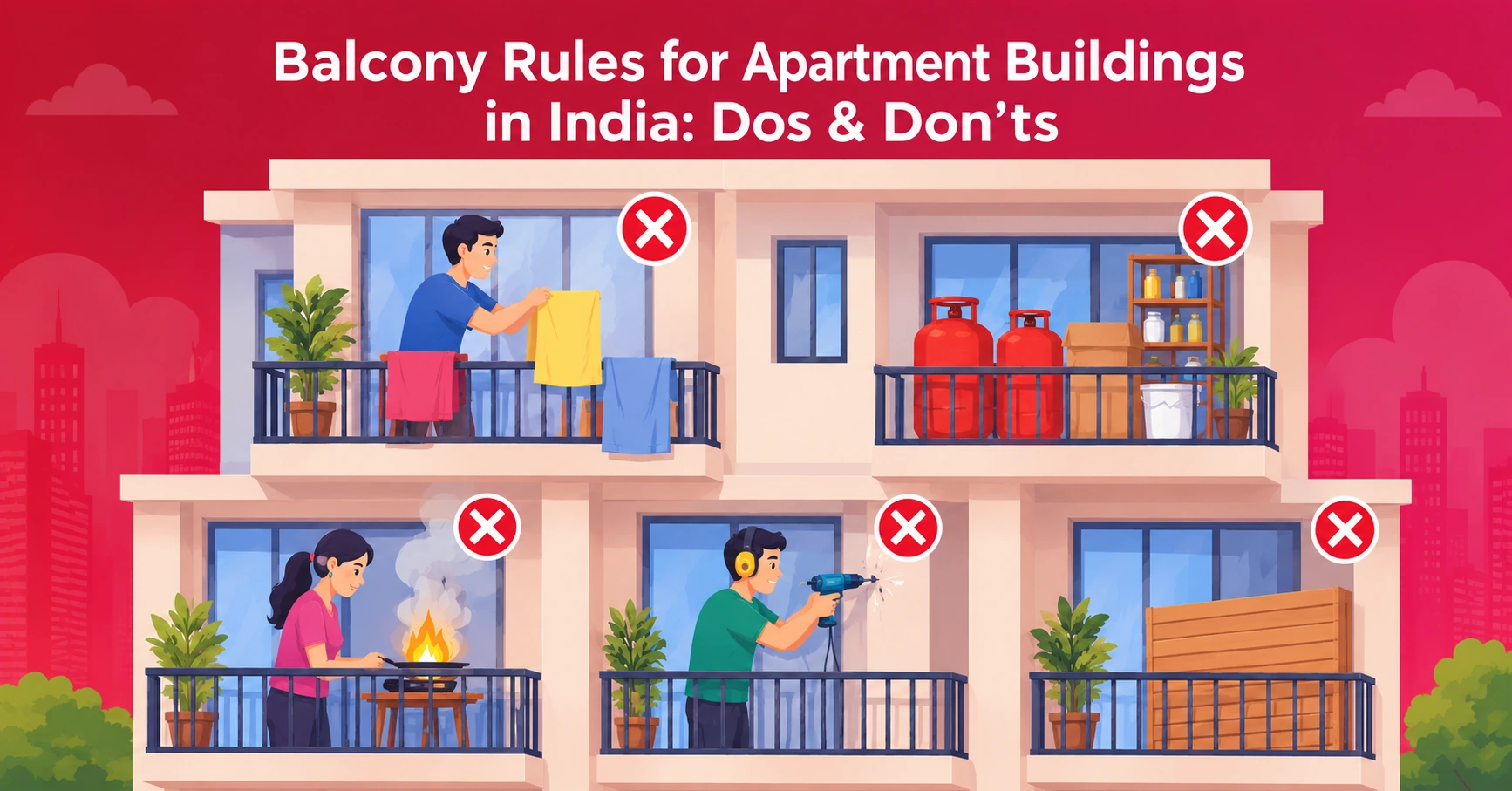
- Laundry: Hanging clothes, linen or mops over the outer railing is barred in most societies. It risks items falling and spoils the facade.
- Flammable storage: Gas cylinders, excess clutter and flammable material violate fire safety norms.
- Open flames: Fireworks and charcoal or gas barbecues are heavily restricted because of fire risk and smoke entering neighbouring flats.
- Facade changes: Unapproved paint colours, signs and awnings break uniform elevation rules.
- Smoking: Indian smoking laws in apartments do not clearly ban smoking on a private balcony, but many societies limit it when smoke or odour reaches other homes.
- Noise and pets: Late-night noise, loud speakers and pets left alone in harsh weather or barking for long hours break neighbourly rules.
- Pigeons: Bird spikes on ledges are commonly accepted, as they keep the area clean without harming birds.
Read also: Pigeon Net for Balcony Installation
How Can Residents Follow Balcony Rules Without Conflict?
Following balcony rules for apartment buildings is easier when you take small, clear steps.
- Read your bylaws: Check the clauses on balconies, facade and fire safety.
- Ask before you build: Get written approval from the committee for grills, drilling or fixed fixtures.
- Follow the balcony enclosure guidelines: Choose removable options over permanent ones.
- Keep records: Save approvals, photos and contractor details in one place.
- Weigh your plants: Spread pots out and use drip trays.
- Talk to neighbours: A quick word about smoke, music or pets prevents most complaints.
Manage Resident Concerns with NoBrokerHood Society Management System
Balcony-related complaints, safety concerns and maintenance requests often require coordination between residents, committee members and society staff. Keeping track of these issues and ensuring they receive attention can be challenging in a large apartment community. NoBrokerHood provides tools that help committees manage these everyday responsibilities.
Some useful features include:
- Complaint Tracking: Residents can report issues such as water dripping from balconies, falling objects or disturbances. Committees can track complaints and monitor their resolution.
- SOS Alerts: Residents can send emergency alerts through the app to notify security personnel when immediate assistance is needed.
- Staff and Vendor Records: Maintain staff details, attendance records and vendor information for easier coordination.
- Digital Notices: Share reminders about balcony safety, approved fixtures, maintenance work and society rules.
These features help committee members address resident concerns, coordinate with staff and keep residents informed.
