






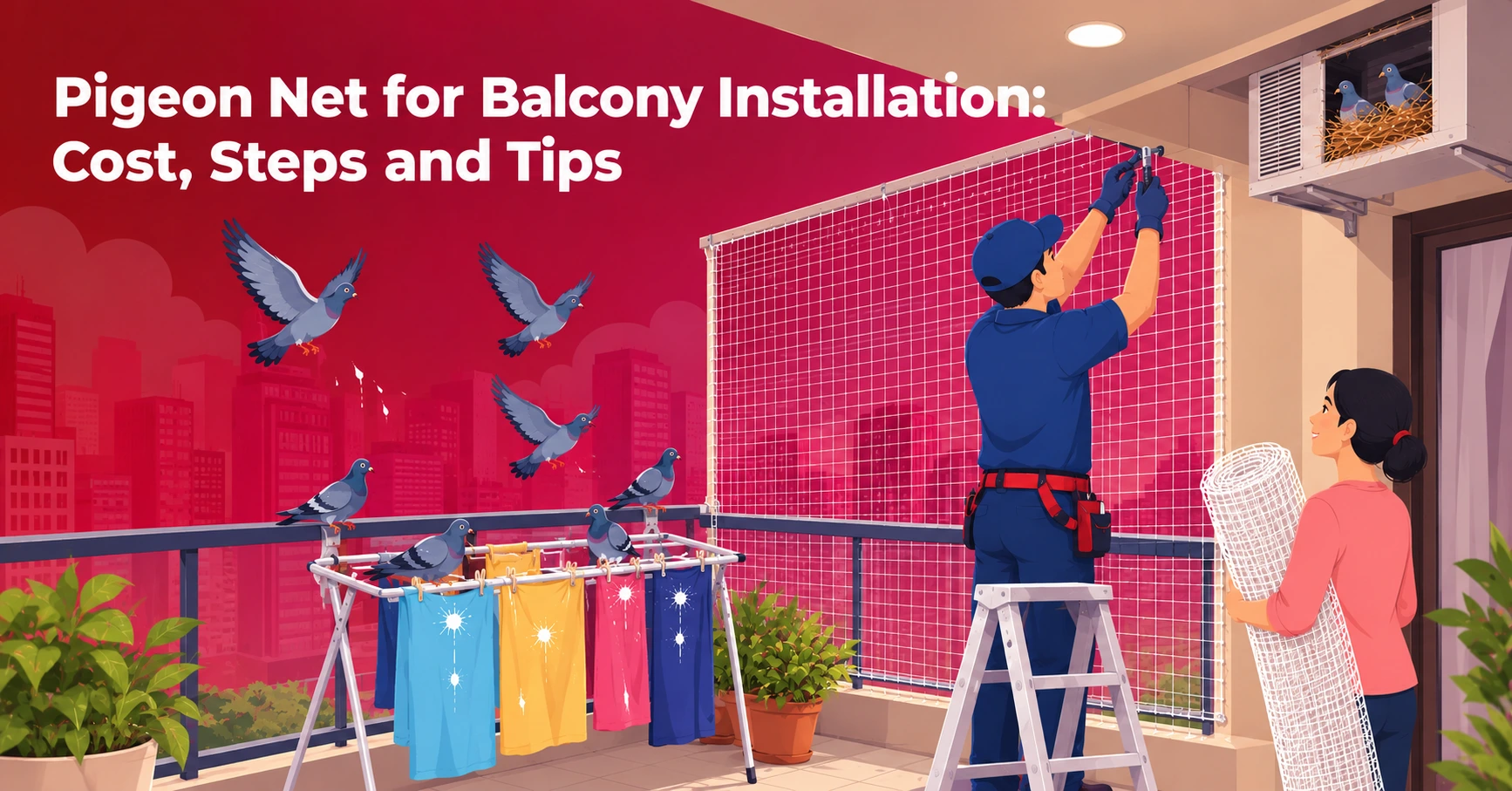


Pigeon net for apartments can make balconies easier to maintain, but choosing the right option is more than just picking a mesh and getting it fitted. Some practical choices, such as comparing materials and installation costs and understanding fitting methods and safety measures, can make a difference in the final result. This guide will take you through the important factors that you should consider while choosing a pigeon net, estimating your budget, selecting between DIY and professional fitting, and coordinating installation in a housing society.

Why Do Apartment Balconies Need Pigeon Nets?
Pigeons tend to choose places where there is peace and easy access to sheltered places. Balcony railings, air conditioners, outdoor shelves and planted pots are all potential places for pigeons to visit if they have somewhere to roost or build their nests. Pigeon droppings will spoil the floor and railings; nests will obstruct the drain pipes, and feathers will get into your freshly washed laundry.
Health and Hygiene Concerns
Pigeon droppings are not just a cleaning issue. According to the CDC, dry pigeon droppings can be the source of histoplasmosis, cryptococcosis, and psittacosis, which are fungal and bacterial diseases. Children, older people and people with asthma should stay away from bird droppings. Besides, the problem of cleaning will become a daily issue when pigeons come back to the same spot.
Key Benefits of Installing Pigeon Nets
A pigeon net for apartments will prevent birds from getting inside the balconies without cutting off light and ventilation. Here’s what you get from that:
- Cleaner surroundings: Reduces the accumulation of droppings, feathers and nesting material.
- Better hygiene: Limits direct contact with bird waste, which needs careful handling during cleaning.
- Protection for belongings: Helps keep laundry, outdoor furniture and potted plants cleaner.
- Less repeated cleaning: Prevents pigeons from repeatedly using the same balcony space.
- Comfortable everyday use: A suitable mesh allows natural light and air to pass through.
Why Should Housing Societies Consider Coordinated Installation?
Residents who dry clothes on their balconies may spend less time re-washing items soiled by bird droppings. However, installing nets in only a few flats may shift the problem to other open balconies. A coordinated, society-wide balcony bird net installation can provide more consistent coverage across the building.
What Should You Check Before Choosing a Pigeon Net?
Not every bird net is suitable for every balcony. The material, mesh opening and fixing method all affect how well it works.
1. Choose the right material
The two common choices are high-density polyethylene (HDPE) and nylon.
- HDPE: UV-stabilised HDPE is widely used for balcony netting. It is lightweight, weather-resistant and suitable for regular outdoor exposure.
- Nylon: Nylon netting can offer a neat appearance and flexibility. Its performance depends on the grade, UV protection and how tightly it is installed.
Ask the vendor about UV resistance, expected service life and replacement terms. A net exposed to strong sunlight, rain and wind needs suitable outdoor-grade material.
2. Check the mesh size
The mesh size will determine what kind of birds the net will exclude. For pigeon exclusion, the usual mesh size is 25 mm, but the size needed will vary depending on the product used and the birds that are intended to be kept out. A smaller size may be required if sparrows are also getting into the balcony. It is best to check with the installer for the actual size of the opening.
3. Inspect the hooks and support wire
The efficiency of the net will depend on how well the net is fixed. Ask for materials that are resistant to corrosion, for example, SS 304 grade stainless steel hooks wherever necessary. The net can be made taut using a tensioned wire frame in case of larger openings. Corrosion resistance will be critical in case of coastal areas such as parts of Chennai and Mumbai.
4. Consider appearance and access
The translucent or white net may not be invisible due to its colour against some backgrounds and lighting. You need to get a sample before deciding. Furthermore, see whether there is an air conditioner, a drain, plants, or a drying area for clothes on the balcony. It must be easy to access for maintenance and cleaning without making holes for the pigeons to enter.
Read also: Pest control for housing society
Pigeon Net for Apartments Cost in India
The price of pigeon net for balcony installation depends on the area covered, quality of material, hardware, accessibility and labour. DIY kits are available online for a few hundred rupees, while professional installation is usually quoted per square foot. The following figures are indicative budget ranges based on estimates provided and published vendor listings. They are not fixed national rates.
| Installation option | Indicative cost | What to consider |
| DIY net kit | ₹209–₹400 for some basic kits | Confirm dimensions, accessories and delivery charges |
| Basic professional installation | ₹15–₹30 per sq. ft. | Check whether hardware and labour are included |
| Wider professional price range | ₹8–₹40 per sq. ft. | Material, access and installation complexity affect the quote |
For a 100 sq. ft. opening, a quoted installation rate of ₹20 per sq. ft. would mean ₹2,000 before any extra charges. The final amount could be higher if the vendor charges a minimum job fee, needs special access equipment or has to install additional support wires. Before accepting a quote, ask the vendor to confirm:
- The measured area and rate per square foot.
- Whether netting, hooks, wire, labour and taxes are included.
- The material grade and warranty period.
- Charges for future repairs or re-tensioning.
- Whether the price covers removal of an old net.
Some installers offer warranties of three to five years, but coverage differs. Get the warranty terms in writing and check whether they cover the mesh, hardware, labour or only manufacturing defects.
Step-by-Step Guide to Pigeon Net Installation for Balcony
Professional pigeon net installation for balcony spaces generally follows a few steps. The exact method depends on the balcony structure and the fixing system selected.
Step 1: Measure the opening
Record the width and height of the area that needs covering. Include open sections beside the railing, above the grill and around the sides if pigeons can enter through them. Do not estimate the size from the balcony floor area alone. The installer needs to measure the actual opening where the net will be fitted.
Step 2: Inspect the fixing points
Check if there is a proper metal grill, concrete borders or existing frames on your balcony. The support system should be suited to both your construction materials and wind exposure.
In case drilling is not allowed, you may need to use some clamp-based systems. You cannot rely on adhesive hooks and magnets in every place for safety reasons.
Step 3: Install the perimeter supports
A professional could install corrosion-resistant hooks/anchors around the opening and then attach a support wire from one to another. It would be helpful to use turnbuckles for adjustment of tension when this kind of construction is chosen. Points for fixation have to be firmly fixed and spaced properly. The exact spacing should be determined by the manufacturer/installer of the fence.
Step 4: Stretch and secure the net
The installer attaches the net to the support frame and tensions it evenly. The edges, bottom boundary and corners need particular attention because loose sections can leave gaps. The net should be firm without being overstretched or damaged. All ties and cut ends should be secured neatly.
Step 5: Check the finished installation
Inspect the entire perimeter from inside the balcony. Confirm that there are no loose corners, open edges or gaps near the ceiling, railing or air conditioner. Also check that the net does not interfere with drainage, emergency access or authorised servicing.
DIY or Professional Installation: Which Is Better?
Both options can work, but the right choice depends on the balcony layout and how safely you can reach the installation area.
| Factor | DIY installation | Professional installation |
| Initial expense | Usually lower for a basic kit | Includes labour and fitting |
| Tools | May require a drill, fasteners and measuring tools | Installer generally brings the required tools |
| Finish | Depends on your measuring and fixing skills | Often offers a more even, tensioned finish |
| High-rise balconies | Not advisable where work requires leaning outside | Better suited to work requiring trained access methods |
| After-sales support | Depends on the kit seller | May include repairs or a written warranty |
For a low, easily accessible opening with an existing suitable frame, a DIY kit may be manageable. However, avoid drilling or reaching over a balcony railing while working at height.
For high-rise apartments, complicated openings or exposed balconies, professional pigeon net installation for balcony spaces is generally the safer choice. Ask how the team manages work at height and whether the quote includes proper safety equipment.
Checklist for Housing Societies Before Pigeon Net Installation for Balcony
In an apartment complex, installing a net on one balcony can affect the building's external appearance and maintenance arrangements. Before proceeding, residents should check the housing society rules and regulations to understand whether approval is required, which designs are permitted, and what precautions must be followed during installation.
- Check the society's rules: Ask the apartment owners association or management office whether approval is needed for balcony-facing fixtures.
- Confirm the permitted design: Some communities may have guidelines for net colour, visible hardware and uniformity across the façade.
- Avoid unauthorised drilling: Do not drill into shared walls or other common structures without the required permission.
- Protect neighbouring flats: Ensure installation work does not drop tools, debris or loose fittings onto balconies below.
- Plan for maintenance: The net must allow safe access to drains, air conditioners and other equipment.
- Choose a responsible vendor: Ask for a written quotation, warranty and a clear plan for completing the work safely.
If several residents face the same pigeon issues, the association can compare quotations and coordinate in the process of balcony bird net installation. Planning, measurement and design will assist in keeping a uniform appearance for the community. Also, residents should not engage in any techniques that would harm the pigeons or cause them to become trapped beneath the net. In case there are any pigeons or nesting sites on the balcony, then one must get proper advice before sealing the hole.
Manage Pigeon-Related Complaints with NoBrokerHood Complaint Management System
Pigeon problems can affect several flats in the same apartment complex, especially when birds keep nesting on ledges, balconies and other shared areas. When residents report these issues through different channels, it can be difficult for the committee to keep track of complaints and follow up on pending maintenance work.
NoBrokerHood’s complaint management system gives residents a structured way to raise issues and helps committees organise their follow-up. This can be useful when multiple residents report pigeon-related concerns or need updates on actions being taken by the management team.
Key features include:
- Centralised Complaint Management: Record resident complaints in one place for easier tracking and follow-up.
- Complaint Assignment: Assign reported issues to the appropriate team or person for action.
- Status Tracking: Monitor complaint progress and identify issues that still need attention.
- Complaint History: Refer to previous complaints when reviewing recurring problems in the community.
A structured complaint process helps committees coordinate responses when pigeon-related issues affect multiple residents. For persistent problems, the association can use this process to organise follow-ups with approved netting vendors or maintenance teams.
