





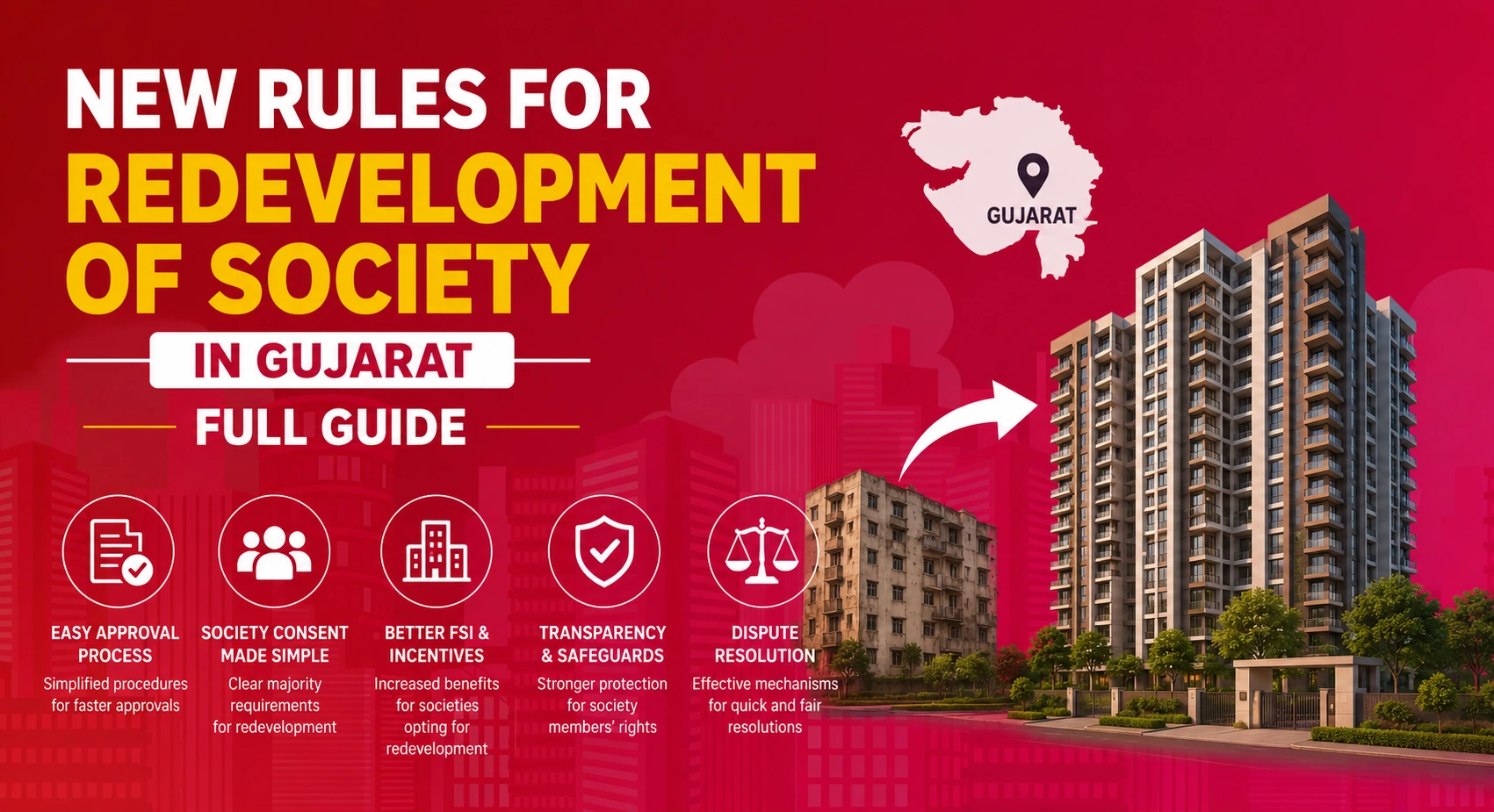


The new rules for redevelopment of society in Gujarat focus on safety, transparency, and clear consent from residents. A minimum of 75 percent member approval, proper agreements, and strong protection of member rights form the core of these rules. Societies must follow the Gujarat Ownership Flats Act and the Gujarat Cooperative Societies Act during the redevelopment process.

What Do the New Rules for Redevelopment of Society in Gujarat Mean for Residents?
The new rules for redevelopment of society in Gujarat provide members a safer and more organised way to handle old or unsafe buildings. These rules help societies make fair decisions, avoid disputes, and ensure that everyone understands how the project will move ahead. The laws apply to cooperative housing societies, apartment associations and public housing clusters across cities like Ahmedabad, Vadodara, Surat, and Rajkot.
The State has updated its redevelopment framework through amendments added in 2019, follow-up clarifications in 2024, and an important government order in March 2025. These updates strengthen member rights and give a clear project structure so residents can trust the process.
Key Society Redevelopment Rules in Gujarat
Below are the most important new rules for redevelopment of society in Gujarat that guide redevelopment according to the Acts, amendments, and government notifications.
Building Age and Condition Criteria
- The building must be at least 25 years old, based on its first development permission.
- A structure can be considered earlier if it is marked as dangerous, dilapidated, or ruinous by the local authority.
- Bodies like the Ahmedabad Municipal Corporation, urban development authorities, or the Gujarat Housing Board can issue such fitness reports.
Mandatory 75 Per Cent Consent
A society can move ahead only if at least 75 per cent of all members give written consent. This includes non-resident owners and members who have rented out their flats.
Developer selection through a transparent process
- The developer must be registered, experienced, and financially capable.
- The society usually forms a panel of offers, evaluates them through a Project Management Consultant, and finalises one through a fair selection method.
Registered Development Agreement
A formally registered agreement must clearly define:
- Carpet area to be given
- Project timelines
- Amenities
- Rent or alternate stay
- Penalties for delay
- Responsibilities of both parties
This agreement cannot remain verbal. It must be legally registered to protect members.
Approvals Under Common GDCR
Developers must obtain approvals from:
- RERA
- Fire department
- Local planning authorities
- Environmental clearance (if applicable)
The permissible FSI can go up to 4.0 in certain public housing redevelopment projects, based on the Common General Development Control Regulations (GDCR).
Protection From Land Mortgage Risks
A 2025 State Government order confirms that the developer cannot mortgage the land in a way that harms the original members. Even if a developer’s loan defaults, members’ flats remain protected.
Member Rights Under the New Rules for Redevelopment of Society in Gujarat
Residents often worry about space, rent, and delays. The laws cover these concerns clearly, so members know what they are entitled to.
Rights Guaranteed To Members
- Every member gets a larger home than before, or a minimum of 30 sq. m., or up to 140% of their existing carpet area, whichever is higher.
- During construction, the developer must provide alternate accommodation or monthly rent.
- Once the project is complete, the society receives flats only after obtaining the Occupancy Certificate (OC) and Building Use (BU) permission.
- If a few residents do not cooperate, the High Court can issue directions to help the project progress, as long as the society has followed proper procedures.
These provisions make redevelopment safer and more practical for families.
Step-by-Step Redevelopment Process Followed in Gujarat
Here is a simple version of the formal redevelopment process as per the updated rules.
1. Initiation by Society Members
- The managing committee may start the process on its own.
- Or at least 25 per cent of members can request a meeting to discuss redevelopment.
2. First Special General Meeting (SGM)
Members discuss safety issues, building age, legal rules, and feasibility. A policy decision is taken to study redevelopment.
Read also: Special General Body Meeting Rules for Housing Societies
3. Appointment of Architect or PMC
A Project Management Consultant (PMC) is appointed to:
- Inspect the site
- Prepare a project report
- suggest options
- Draft a redevelopment policy for the society
4. Developer Proposals and Evaluation
Once the PMC prepares the report, the society invites offers from developers. The PMC compares proposals based on:
- Financial strength
- Past projects
- Technical experience
- Offered carpet area
- Rent or alternate stay
- Completion timeline
5. Final Selection and Agreement
The best offer is placed before the General Body. With 75 per cent consent, the society signs a registered development agreement.
6. Approvals and IOD
The developer takes care of all approvals. After this, the society receives an Intimation of Disapproval (IOD), which allows pre-construction work to begin.
7. Temporary Shifting and Demolition
Members move to alternate accommodation or receive rent. Demolition and construction begin.
8. Completion, OC and Handover
After receiving the Certificate of Occupancy (OC) and Building Use (BU) permission, new flats are allotted to members and possession is handed over.
This stepwise flow helps residents track progress without confusion.
Benefits of Redevelopment for Housing Societies in Gujarat
Redevelopment gives old societies a chance to improve their living conditions and enjoy a safer and more comfortable environment. It helps residents get long-term value and better facilities.
Infrastructure upgrade
Redevelopment allows entire neighbourhoods to receive an upgrade in basic infrastructure. Roads, drainage lines, electrical systems, water supply networks, and safety elements can be modernised. This makes daily life smoother and reduces frequent repair issues.
Increase in housing stock
Old low-rise buildings are often replaced with well-planned towers. This helps create more homes on the same land and supports the growing need for city housing. It is useful for families who want to continue living in the same locality.
Better overall aesthetics
New buildings come with cleaner layouts, better ventilation, and improved designs. Landscaping, compound planning, and modern materials help the entire community look organised and attractive.
Improved community amenities
Most redevelopment projects include practical amenities. These may include green areas, play zones, parking areas, fitness spaces, and small community halls. These spaces help residents enjoy a better lifestyle without leaving the premises.
Support for economic growth
Redevelopment brings activity to the construction and real estate sector. Labour, suppliers, contractors, and nearby shops all benefit. This creates more local employment and supports the city’s economy.
Read also: Society Maintenance Charges Rules in Gujarat
Common Issues Residents Face
1. Fear of losing their current home
The rules guarantee a higher carpet area and legal protection, giving families a clear assurance.
2. Lack of transparency with Developers
Mandatory tendering and a registered agreement reduce confusion and prevent unfair terms.
3. Delays in the project
Penalties, defined timelines, and a clear handover process improve completion accountability.
4. Member disputes
The High Court can intervene if a minority blocks the project without reason, which keeps the redevelopment on track.
Simplify Society Redevelopment with NoBrokerHood
NoBrokerHood offers a digital society management system for residential societies undergoing redevelopment in Gujarat to keep the entire process transparent and well-documented. The system is designed to help managing committees track member consent, developer approvals, and finances through a single app, while keeping every resident informed at each stage. By digitizing the process, it aims to reduce disputes among members and prevent the loss of critical paperwork during a multi-year project.
Here's how the system works:
- Digital Consent & Polls: Collects and records the mandatory 75% member consent for redevelopment resolutions and developer selection digitally, creating a transparent, tamper-proof trail the committee can rely on if disputes arise.
- Document Repository: Stores the registered development agreement, GDCR and RERA approvals, government orders, and PMC reports securely in one place, accessible to every member instead of scattered files and emails.
- Notices & Announcements: Pushes real-time updates on SGMs, developer shortlists, project timelines, and IOD/OC milestones to all residents, including non-resident owners who can't attend meetings in person.
- Society Accounting Software: Tracks corpus fund contributions, monthly rent payouts to displaced members, and developer payment milestones, giving every flat owner full visibility into where the money is going.
- Visitor & Vendor Management: Manages secure entry for the PMC, architects, and contractor staff once construction begins, maintaining accountability even with reduced on-site security during the transition.
All Solutions by NoBrokerHood:
