





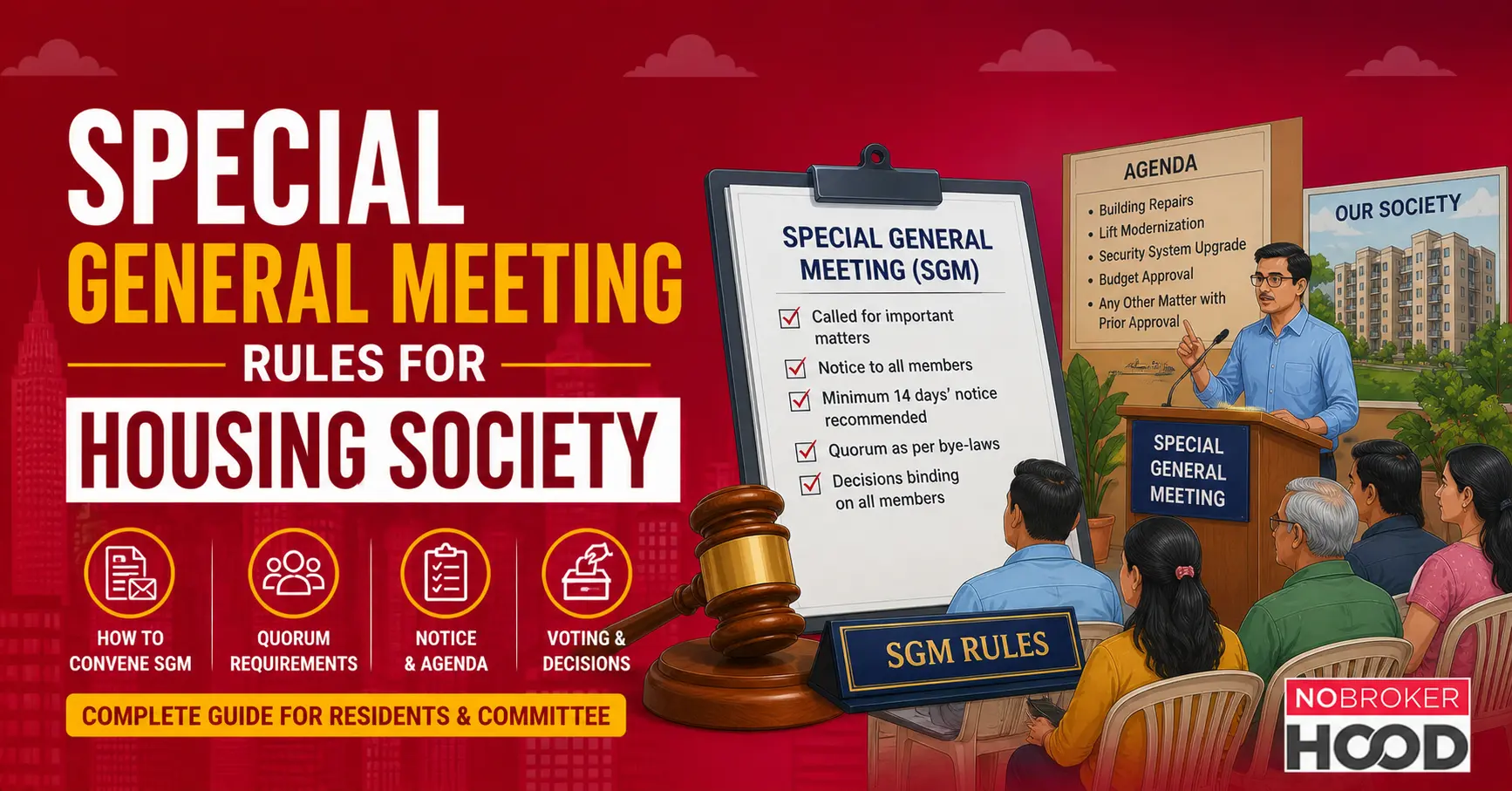


Societies that provide housing are operated in a way that resembles an organised organisation, and this requires frequent and open meetings that are of a governance nature. Though the Annual General Meeting (AGM) deals with general issues like elections, budgetary provisions, and long-term planning, there are issues that need urgent attention or are very exceptional. In times like these, a Special General Body Meeting (SGM) is held.

The guide will present an in-depth description of SGMs, their nature, statutory framework, convening process, and the best practices that will guarantee compliance and transparency.
What is a Special General Body Meeting of Housing Society?
A Special general body meeting is an official meeting organised by a housing society to deliberate on issues that cannot be pushed to the next AGM. The SGMs are also highly issue-focused: the meetings cannot discuss and solve anything not mentioned in the meeting notice.
Examples of situations that necessitate an SGM are:
- Replacement or election of the office-bearers.
- Recovery projects, structural repairs, or extensive infrastructure projects.
- Adherence to government or regulation.
- Handling severe malpractices or governance failures.
- Ratifying emergency financial policies or initiatives on safety.
The limitation of the discussion to certain items that SGMs provide makes the societies take action decisively and without delay.
SGM vs AGM of Housing Society: Key Differences
| Basis | AGM | SGM |
| Full form | Annual General Meeting | Special General Meeting |
| Purpose | Routine yearly business | Urgent or specific issues |
| Frequency | Once every year | Only when needed |
| Mandatory | Yes | No |
| Called by | Managing Committee | Committee or member requisition |
| Agenda | Accounts, audit, budget, auditor appointment, elections | Only matters in the notice |
| Notice period | Usually 14 days | Usually 7 to 14 days |
| Examples | Approving accounts, setting maintenance charges | Redevelopment, bye-law change, major repairs |
Why are SGMs Important?
SGMs are necessary meetings, although they are extra meetings that are critical to the operation of housing societies. They are important in the following way:
- Transparency: The members are updated on the issues that are pressing and this builds more confidence in the managing committee.
- Quick Action: Emergencies are handled immediately as opposed to being pushed to the AGM.
- Member Empowerment: The members are entitled to representation, voting, and contributing to important decisions.
- Enhanced Accountability: The recordings of proceedings and adherence to procedures help to make committees accountable.
- Dispute Prevention: Conflicts and miscommunication are minimized by holding meetings at the right time with the right structure.
Special General Meeting Rules for Housing Society
The regulations that regulate SGMs are established in the laws of the state cooperative societies, like Maharashtra Model Bye-laws and Kerala Cooperative Societies Act. Things might be different depending on the state, but the overall outline is universal.
Who Can Call an SGM
- The managing committee can call an SGM whenever it considers a matter urgent or significant.
- Members can requisition one. Most state laws allow a stated share of members (commonly one-fifth, or 20%) to submit a written request with the proposed agenda. The committee must then convene the meeting within a fixed period, often 30 days.
- The Registrar or competent authority can direct the society to hold one if the committee fails to act on a valid requisition.
SGM Notice Period for Housing Society
- Written notice must go to every member, usually by hand delivery, post, or email, with acknowledgment.
- The notice period is typically 7 to 15 days, depending on state law and bye-laws.
- The notice must state the date, time, venue, and a clear agenda. Business outside the notified agenda generally cannot be transacted.
- The notice should also be displayed on the society notice board.
Quorum for Special General Body Meeting of Housing Society
A meeting needs a minimum number of members present to be valid, often one-fourth of the total membership or a fixed number set by the bye-laws.
- If quorum is missing, the meeting is usually adjourned to a later date, often by 30 minutes on the same day or to the following week.
- The adjourned meeting can often proceed with the members present, but only on the original agenda.
- For a requisitioned SGM, many bye-laws require the requisitionists to be present, and the meeting lapses if they are not.
Conduct of the Meeting
- The Chairperson (usually the society Chairman or President) presides. If absent, members elect a chair from those present.
- Members sign an attendance register on arrival.
- The Housing Society Secretary reads the notice and the agenda.
- Each agenda item is discussed in order, and members may speak briefly and relevantly.
- Resolutions are proposed, seconded, and put to a vote.
- The Chairperson keeps order and may ask disruptive members to leave.
Voting Rules
- Each member generally has one vote, regardless of the number of flats or shares held.
- Ordinary matters pass by a simple majority of members present and voting.
- Special matters, such as bye-law amendments, redevelopment, or removal of committee members, usually need a two-thirds or three-fourths majority, as the Act or bye-laws specify.
- Members with outstanding dues may lose voting rights under many bye-laws.
- Proxy voting is allowed in some states with a written authorisation, but restricted or banned in others.
- Voting may be by show of hands, or by secret ballot if a set number of members demand it.
Minutes and Record-Keeping
- The Secretary must record minutes that cover attendance, discussion points, resolutions, and voting results.
- The Chairman of the housing society should sign the minutes, either at the close of the meeting or at the next committee meeting.
- Copies should be circulated to members within 15 to 30 days.
- Resolutions on matters such as bye-law amendments must often be reported to the Registrar within a set time.
Validity and Challenges
A decision can be challenged or declared invalid if the notice was defective, quorum was not met, the matter was outside the agenda, or voting was irregular. Members who disagree can usually raise a dispute with the Registrar or the cooperative court or tribunal in their state.
Step-by-Step Process of Conducting an SGM
SGMs need to have a systematic procedure to achieve validity and compliance:
- Requisition or Resolution to Call SGM: The managing committee makes its decision, or at least a fifth of the members requisition the meeting in writing.
- Fixing Date, Time, and Agenda: The Secretary should arrange the meeting within 7 days following the requisition. The items on the agenda should be narrow and topical.
- Issuing Notice: A written notice should be issued at least 5 days prior to the meeting (except when urgent), which should give the agenda, date, time, and venue. Advertisements are spread either through hand, post, or even electronically, depending on the bylaws of the society involved.
- Conduct of the Meeting: The Chairman presides. To have a quorum, the attendance is taken. The only items discussed are the agenda and members' votes, where necessary.
- Voting and Resolution: All members present take part in voting, and a resolution is passed through a simple majority unless stated otherwise through law.
- Making and Circulating Minutes: During 15 days, draft minutes are disseminated. Observations may be made by members, and they are included before finalisation.
- Recording in Minutes Book: Minutes are finalised and placed in the minutes book, which is part of the official records of a society.
Virtual Participation and Modern Practices
The COVID 19 pandemic accelerated the adoption of digital platforms in society governance. Several states now permit or are considering the use of virtual SGMs, provided these are properly regulated.
Key considerations for virtual SGMs include:
- Legal Standing: Virtual participation is valid only when explicitly permitted by state law or the society’s bylaws.
- Technical Arrangements: Secure and reliable platforms should be used to enable participation, voting and attendance tracking.
- Transparency: Accurate records must be maintained, and minutes should be circulated promptly after the meeting.
- Inclusivity: Virtual meetings facilitate the participation of non resident Indians (NRIs) and members living away from the locality.
Hybrid meetings combining physical and virtual attendance are gaining popularity as they balance inclusiveness with procedural compliance.
Challenges in SGMs and Best Practices for Societies
Societies may not easily have SGMs despite having clear rules.
Common Issues:
- Lack of quorum because of a low turn-up of members.
- Controversies on the requisition or agenda validity.
- Circulating minutes or objections by members were delayed.
- Opposition to innovative procedures like online notifications or virtual meetings.
Best Practices to overcome them:
- Distribute flyers in person and online.
- Enhance attendance by using reminder systems (WhatsApp groups, email alerts).
- Make it clear what will be discussed on the agenda.
- Note down proceedings properly with signatures of the presiding officer and the Secretary.
- Embrace digital platforms on the distribution of notices, voting, and minutes where they are legal.
- Such practices not only guarantee compliance but also make members trust and cooperate.
How SGMs Enhance Governance
Special General Meetings (SGMs) strengthen housing society governance by enabling quick decisions, encouraging member involvement, ensuring transparency, and resolving conflicts efficiently.
- Swift Decision-Making: Urgent issues such as safety risks or financial approvals are addressed immediately.
- Member Engagement: Active participation reinforces democratic governance.
- Accountability: There are transparent records that keep committees accountable to society members.
- Conflict Resolution: Structured forums prevent the conflict.
Read also: Housing Society AGM rules
Special General Meeting Rules for Housing Society Pdf
Simplify Your Special General Body Meeting with NoBrokerHood Society Management App
Calling a Special General Body Meeting means sending notices on time, getting enough members to attend, and recording decisions properly. Doing this over WhatsApp groups and paper notices is slow and often leads to disputes. NoBrokerHood's Society Management App helps committees and residents handle each step of the SGM digitally.
- Digital notices and announcements: Send the SGM agenda, date, time and venue to every resident's app instantly, with proof that it was sent within the 5-day notice period.
- Reminders for better attendance: Push notifications and alerts before the meeting help you reach quorum.
- Polls and voting: Let members vote on agenda items so decisions are clear and recorded.
- Minutes and documents in one place: Share draft minutes with members within the 15-day window, collect their observations, and keep the final records stored safely.
- Better inclusion for NRIs and members living away: Keep members informed and involved even if they can't attend in person.
- Financial transparency: Share maintenance accounts and expense reports with residents through the Society ERP before meetings on funds, repairs or redevelopment.
All Solutions By NoBrokerHood
