





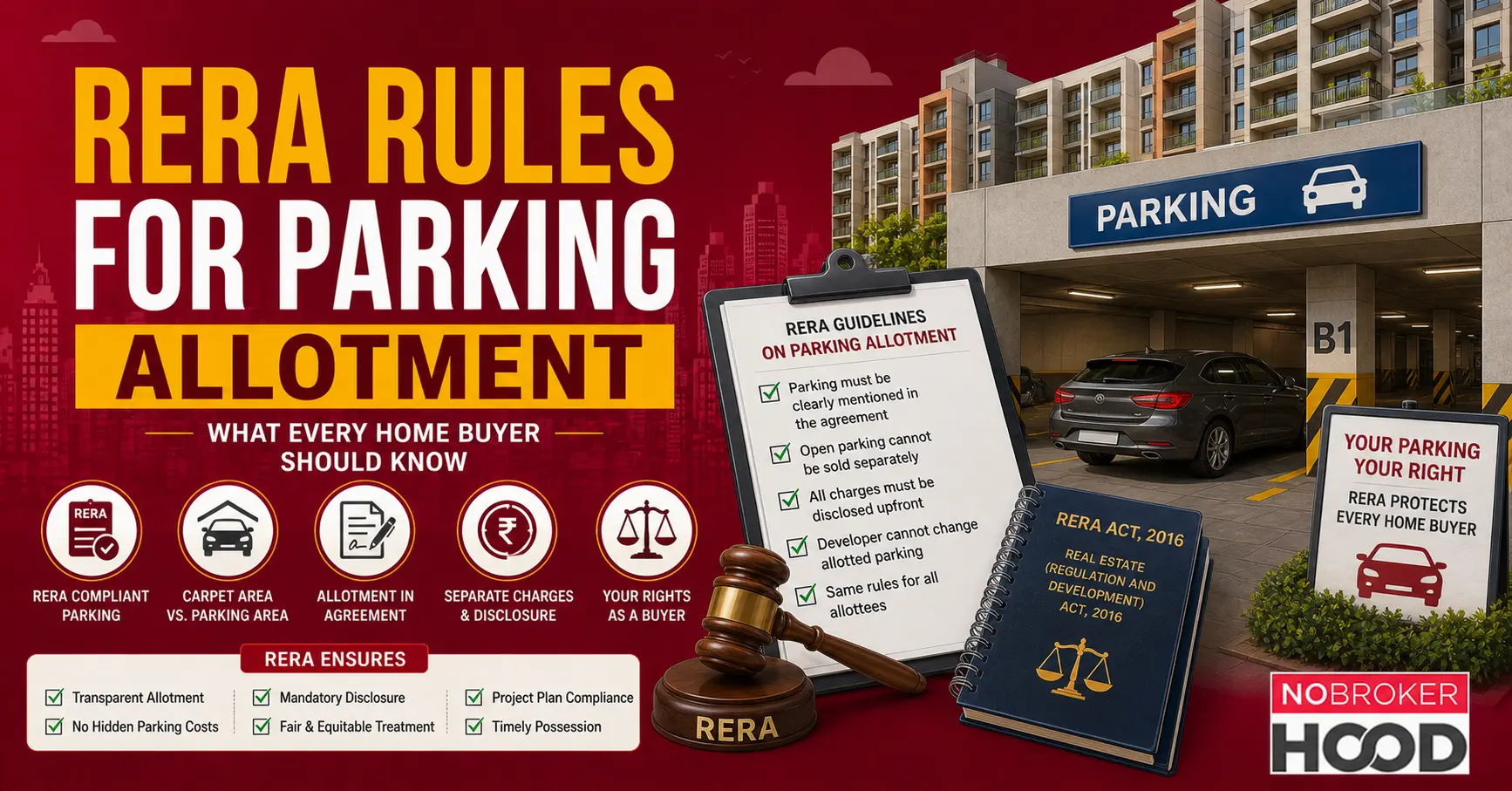


RERA rules for parking allotment make sure flat owners know exactly what they are paying for and how many vehicles they can park. The rules stop societies and builders from charging unfair or hidden fees. When these rules are followed properly, RERA compliance also gets sorted for every resident's parking rights, which in turn reduces conflicts.

What Do the RERA Rules for Parking Allotment Try to Solve?
Parking is one of the most common reasons for disputes in housing societies. There are questions like Who owns the open space? How many slots can a flat get? Whether an extra payment can be charged or not?
RERA rules for parking allotment were created to bring clarity. These rules ensure buyers know the type of parking being offered before purchase, as the builder should clearly show it in official project documents. When these rules are laid, society members can avoid arguments and can run their community smoothly.
Types of Parking Under RERA
RERA divides parking into separate categories so buyers can know what they are paying for. Each type has different rules on whether it can be sold, allotted, or counted as a common area. This makes the process fair for both residents and builders.
Open Parking
- Open parking is a space on the ground level.
- RERA does not permit builders to sell open parking.
- This parking is considered to be a part of the common area.
- The society should allot it fairly to the residents.
Covered Parking
- Covered parking includes stilt parking or indoor space.
- Builders can sell covered parking if it is clearly shown in plans and agreements.
- This allotment should be written and documented.
Garage Parking
- A garage parking is an independent, lockable structure.
- Builders can legally sell garages to buyers.
- The price must be mentioned in the sale deed
These details help buyers compare options and avoid paying for something that cannot be sold.
Open vs. Covered Parking under RERA
Open and covered parking are treated differently under RERA, and this decides whether a builder can charge you for a slot.
| Point | Open Parking | Covered Parking |
| What it is | Uncovered space on the ground level or in the compound | Parking with a roof, such as stilt, basement, podium or an enclosed garage |
| Legal status | Common area | Depends on the type. Stilt is a common area, an enclosed garage can be a separate unit, and basement/podium varies by state |
| Can the builder sell it? | No | Only an enclosed garage, if shown in the agreement and sanctioned plan |
| Can the builder charge extra? | No separate charge for the slot | Only where it qualifies as a garage or as your state's rules allow |
| Who allots it? | The society, after it is formed | The buyer (if a garage was sold) or the society (if common area) |
| What to check | Sanctioned plan showing it as a common area | Agreement, slot number and sanctioned plan |
What Builders Can and Cannot Sell Under RERA
RERA clearly separates what a builder can sell from what belongs to all residents as a common area. Knowing this helps you spot illegal charges early.
What builders can sell
- The flat or apartment, priced on carpet area.
- An enclosed garage (roof and walls on three sides), if it is shown in the agreement and sanctioned plan.
- Basement or podium parking, only where your state's rules allow.
What builders cannot sell
- Open parking, which is a common area.
- Stilt parking, which the Supreme Court has held is a common area.
- Lobbies, staircases, lifts, parks and other common areas.
Standard Parking Size as per RERA
RERA does not fix parking dimensions. Sizes follow the National Building Code (NBC) and your state or local building bye-laws, and RERA-registered projects must follow the plan sanctioned under those rules.
Typical minimum sizes
- Car: about 13.75 sq. m per slot (around 148 sq. ft).
- Common car bay: about 2.5 m × 5 m (roughly 8.2 ft × 16.4 ft).
- Individual car space: about 3 m × 6 m (10 ft × 20 ft), where a separate space is provided.
- Two-wheeler: about 1.25 sq. m per vehicle.
- Headroom: around 2.2 m in stilt and basement parking.
Mandatory Disclosures & Documentation
Before allotting a rear parking space, the following must be disclosed to the applicant and documented.
Mandatory Disclosures
- Nature of allotment: Owned, leased, licensed, or revocable, along with term and transferability.
- Space details: Slot number, dimensions, type (covered, open, tandem), and permitted vehicle size.
- Charges: Allotment fee, recurring maintenance, deposits, taxes, and penalties.
- Usage rules: Restrictions on storage, commercial use, subletting, and EV charging.
- Liability and safety: CCTV coverage and a statement that management is not liable for theft or damage unless stated.
- Legal status: Confirmation that the space is approved in the sanctioned plan, with any disputes or encumbrances disclosed.
- Termination terms: Grounds for withdrawal and the notice period.
Required Documentation
- Signed allotment application and agreement
- Proof of ownership or tenancy
- Vehicle registration certificate (RC)
- Government-issued photo ID
- Payment receipt
- Layout extract showing the slot
- Signed acknowledgment of rules and disclosures
- No-dues certificate, where applicable
What Do Buyers Need to Know Before Paying for a Parking Slot?
Before making payment, residents should check:
Is the parking slot listed in the agreement?
Parking should never be taken on a verbal promise. RERA-approved documents will mention slot numbers, location, and type.
Is the space clearly marked on the layout plan?
If the builder plans to sell covered parking, it must appear on the sanctioned plan. If it is missing, residents should ask for clarification.
Is it open parking?
If it is open parking, the builder is not allowed to sell it. The space is part of the common area and belongs to the housing society.
Is an extra amount being charged without receipts?
Residents should only pay through legal invoices. RERA helps protect buyers from hidden charges.
When residents ask these questions early, they avoid confusion during handover and society formation.
How Gated Societies Follow RERA Rules for Parking Allotment?
When the building is handed over, the society manages the parking area. The committee must follow the same rules that apply to the builder. A common approach is:
- Review which slots are already officially allotted
- Create a list of total available slots
- Collect only approved charges for maintenance, not for open slots
- Keep the records clear and accessible to residents
Some gated societies also create bylaws like one car slot per flat. A clear policy avoids bias and helps everyone feel heard.
Read also: How Parking System Works in a Gated Society?
Allocation and approval rules for parking
Parking has to be managed clearly and fairly. Whether the society is newly formed or already active, the allocation method should be written, shared with residents, and easy to understand.
Fair allocation
- Parking cannot be sold as a separate real estate unit.
- Builders can charge for the right to use a covered slot, but only if it is mentioned in approved plans and in the agreement.
- Societies should divide the parking slots based on the number of flats.
Space and design standards
- Developers must follow the National Building Code for size guidelines.
- Size guidelines are around 13.75 sq. meters for a car and 1.25 sq. meters for a two-wheeler.
- Parking markings and layout must match the government-approved building plan.
Changes and modifications
- If there’s a need for slot reallocation or layout changes, then the Resident Welfare Association (RWA) or the society committee must approve.
- Decisions are usually recorded in meeting minutes and shared with residents to avoid confusion.
This structure keeps parking decisions transparent and reduces arguments among members.
Read also: Car Parking Rules in Apartment
Common Problems Residents Face With Parking
Even with rules, societies deal with challenges such as:
- Extra cars with no available space
- Misuse of visitor parking
- Residents blocking fire lanes or pathways
- Tenants taking over slots without approval
- Guests parking overnight without permission
These problems turn into daily arguments. A good record system, clear notices, and cooperative communication make life easy for everyone.
Simple Tips for Fair and Smooth Parking Management
- Mark all slots with numbers that are easy to see
- Keep a register of vehicles and owners
- Create visitor parking rules and display them at the gate
- Use stickers so security can identify genuine residents
- Make a small group to handle parking queries
- Take decisions in meetings so members feel included
- Provide visitor parking separately.
- Set rules for EV charging points so everyone gets equal access.
When every resident knows the rules, fewer vehicles are left in the wrong place and neighbours stay friendly.
RERA Rules for Parking Allotment Pdf
Simplify Your Society Parking by NoBrokerHood Parking Management System
Many societies use simple tools for communication but struggle to keep proper records. Community management platforms like NoBrokerHood Parking Management System help societies to maintain parking lists, vehicle details, owner names, and visitor approvals in one place. Security staff can check entries on the app, so the chances of confusion are reduced.
NoBrokerHood also supports digital approvals. Committee members can update parking rules, broadcast notices, and track which slots are free or occupied. It keeps things transparent and easy for everyone.
All Solutions by NoBrokerHood:
