





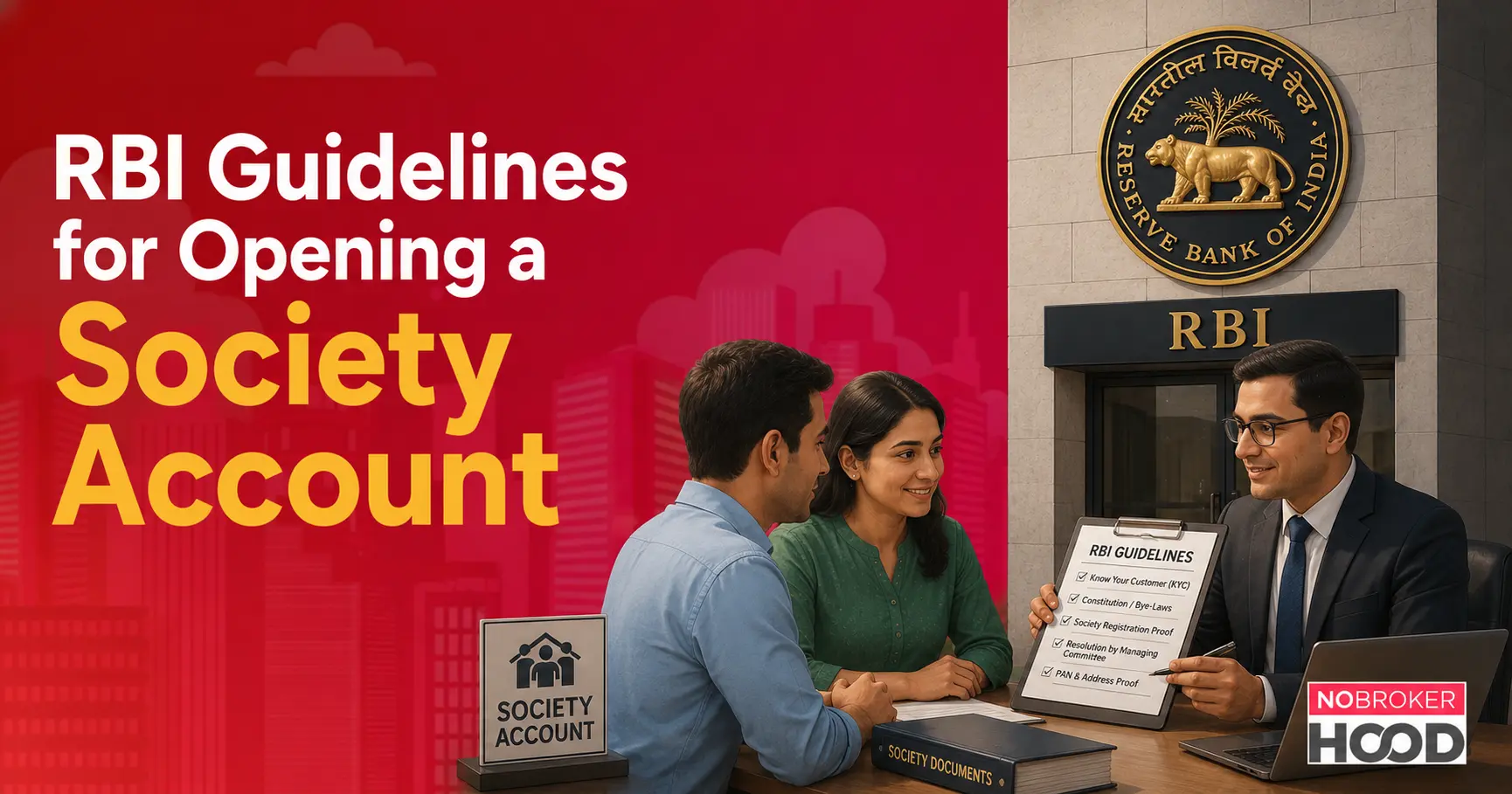


Societies such as housing associations, charitable groups, and cultural organisations need a bank account to manage funds, collect donations, and maintain accountability. To ensure transparency and prevent misuse, the Reserve Bank of India (RBI) has laid down specific guidelines that banks must follow before allowing societies to open and operate accounts.

This article explains the key RBI requirements, eligibility criteria, documents needed, and compliance rules to help societies manage their finances smoothly.
What Is a Society Account?
The society account is a non-profit-making organisation that was founded under the Societies Registration Act 1860 to undertake social, cultural, charitable, or housing development work. Unlike an individual, trust, or NGO account, a society account is supposed to reflect collective governance and other financial transparency. It plays an important role in financial discipline, in which societies can record the membership fees, contributions, and expenditures.
Society Account Opening Documents
To open a society account in compliance with regulations, society account opening documents are:
- Society Registration Certificate: A copy of the society’s registered certificate under the Societies Registration Act, 1860 (or relevant state act).
- Memorandum of Association (MoA) & By-Laws / Rules: The MoA gives the objectives and the state of the society. A certified copy of the society’s rules or by-laws.
- Governing Body Resolution: A managing committee or board resolution on society letterhead authorising the account's opening and operation, as well as identifying authorised signatories.
- PAN Card of the Society: The Permanent Account Number to comply with tax and electronic transactions in the society.
- KYC Documents of Office Bearers / Signatories: Identity and address proof - Aadhaar, PAN, passport, voter ID, or driving licence - for all authorised persons and beneficial owners holding 15% or above.
- Address Proof of Society: Utility bill, society registration proof, latest audited I-T return, or comparable documents in the society’s name.
- Beneficial Ownership Declaration: A declaration identifying ultimate beneficial owners, especially where control or substantial interest (e.g. ≥15%) exists.
Read More on: Bye laws of Co-operative Housing Society
RBI’s Know Your Customer (KYC) Norms for Societies
To avert fraud and money laundering, the KYC standards are obligatory:
- The identity and address of every office bearer have to be verified by banks.
- To remain compliant, KYC documents must also be re-verified on a periodic basis.
- In the scenario of societies that are receiving foreign contributions, FATCA and AML norms apply, and this ensures transparency in the resulting international inflows.
Operational Guidelines for Society Accounts
Society accounts are run on disciplined and open practices:
- Two signatories (e.g., President and Secretary/Treasurer) will be required to authorise transactions.
- In some banks, the withdrawal and deposit limits are imposed by the society's bylaws.
- Online transactions and currency should be controlled due to transparency and responsibility.
Read Also: Roles and Responsibilities of Society Treasurer
RBI Rules on Foreign Contributions and Donations
In the Foreign Contribution (Regulation) Act (FCRA):
- Those societies that receive foreign donations should create special FCRA bank accounts.
- RBI tracks inward remittances to ensure that the money is duly channelled.
- The foreign contributions are transparent and traceable with mandatory reporting.
Importance of Maintaining Proper Records
Once a society account is up and running, opening it is only half the job — banks and the RBI expect the society to keep its financial records clean, current, and audit-ready throughout its operation. Accurate bookkeeping is crucial for the following reasons:
- RBI expects transparent accountability and audit trails - Every transaction routed through the society's bank account should be backed by a supporting document receipt, voucher, or bank advice so that funds can be traced end-to-end whenever the bank, auditor, or Registrar of Societies asks for verification.
- Donations, membership fees, and grants must be listed - Each income stream should be recorded separately in the society's books, with donor/member details, amounts, dates, and purpose clearly captured. This is especially important for societies that also handle foreign contributions, since it complements the FCRA reporting discussed earlier.
- Annual balance sheets and financial statements improve transparency among members and authorities - Preparing and circulating audited financial statements at least once a year gives members visibility into how funds were used, and gives the bank/RBI the documentation needed to confirm the account is being operated strictly for the society's stated objectives not for personal or unrelated use.
Well-maintained records also make it far easier for the managing committee to satisfy periodic KYC re-verification, respond to bank queries about large or unusual transactions, and support renewal of registration all of which reduces the risk of the account being flagged, frozen, or restricted.
RBI Guidelines on Interest Earnings and Taxation
Below explores tax matters as outlined under the RBI guidelines for opening a society account:
- Interest earned on society accounts or fixed deposits must be properly recorded.
- Societies are generally exempted from income tax due to their charitable status.
- TDS (Tax Deducted at Source) regulations can be used on payments.
- RBI facilitates transparency through regulatory reporting mechanisms.
Eligibility Criteria for Opening a Society Account
Prior to opening a housing society bank account, people should possess some eligibility requirements:
- The society should be registered within the Societies Registration Act, 1860 (or any one of the state acts).
- The bylaws specify that a minimum number of members is needed.
- The goals of the society ought to be non-commercial, charitable, cultural, education, or housing-based.
- Some types of societies, such as mutual benefit or unregistered groups, may not be eligible to open bank accounts.
- The Registrar of Societies can be consulted to enable the Bank to activate the account.
This ensures that only legitimate societies open and operate these accounts, preventing misuse of the financial system.
How to Open a Society Bank Account ?
Opening a bank account for a society involves a structured process to ensure compliance with RBI regulations and smooth financial operations. Here's a step-by-step breakdown:
Step 1: Confirm Eligibility
Ensure your society is registered under the Societies Registration Act, 1860, or the applicable state act. The society's objectives must be non-commercial in nature charitable, cultural, educational, or housing-related and it must meet the minimum membership requirement specified in its bylaws.
Step 2: Gather Required Documents
Before approaching a bank, collect the following:
- Society Registration Certificate
- Memorandum of Association (MoA) and by-laws
- Governing body resolution authorising the account and naming signatories
- Society's PAN card
- KYC documents of all office bearers and signatories
- Address proof of the society
- Beneficial ownership declaration (if applicable)
Step 3: Select a Suitable Bank
Compare banks based on transaction fees, deposit limits, and nonprofit-friendly features like multi-user access and sub-accounts. Decide whether a traditional bank, an online/fintech bank, or a credit union best fits your society's needs.
Step 4: Designate Authorised Signatories
Most banks require at least two authorised signatories, typically the President and Secretary or Treasurer to jointly approve transactions. This dual-control mechanism strengthens financial accountability.
Step 5: Submit the Application and Complete KYC
Submit all documents to the chosen bank branch. The bank will verify the identity and address of each office bearer as part of its KYC process. Note that KYC details may need periodic re-verification even after account opening.
Step 6: Set Up an FCRA Account (If Applicable)
If your society expects to receive foreign donations or contributions, you'll need to open a separate FCRA-designated account, as RBI mandates distinct tracking and reporting for such funds.
Step 7: Establish Internal Financial Controls
Once the account is active, define withdrawal and deposit limits as per your society's bylaws, and set up a system for recording all transactions to maintain transparency for audits and member reporting.
Common Challenges Faced While Opening a Society Account
While cooperative society accounting is essential for transparent financial management, various regulatory and procedural barriers often complicate the account-opening process. Regulatory, procedural, and coordination issues are also common in societies and would cause delays or complicate the initiation of an account.
- Document verification delays are inconvenient to society, which discourages setting up the account.
- Large committees may have a hectic KYC, and there should be coordination among multiple office bearers.
- The restriction of foreign transactions will discourage the opportunities of accepting foreign donations without FCRA authorization.
- Ignorance of revised rules and norms by RBI officials may lead to compliance issues and errors in the process.
RBI’s Emphasis on Transparency and Accountability
RBI considers societies as socially oriented institutions:
- Rules eliminate money laundering and anomalies.
- Compliance supports the trust of the donors and maintains financial integrity through proper maintenance of final accounts of cooperative society records.
- Societies that obey rules facilitate the establishment of financial discipline and trust among the people.
Read Also: Society Balance Sheet Format
How to Choose the Right Bank for a Society Account?
Below, explore how selecting a suitable bank is very important:
Clarify Your Society’s Banking Needs
- Evaluate usual transaction activity, deposit methods, debit usage, and account type needs.
- Identify essential tools: online banking, multi-user access, receipt tracking, and accounting software integration.
Minimise Fees and Maximise Deposit Capacity
- Opt for accounts with no or low monthly/transaction fees and clear fee waivers.
- Make deposit limits generous, particularly on cash /check inflows.
Bank Types: Evaluate Suitability
- Traditional banks provide physical branches and full services, albeit at higher prices.
- Online banks/fintech institutions typically feature lower fees, higher yields, and advanced tools, but lack in-person support.
- Credit unions are more inclined to be member-based, personalised service with competitive rates and minimal branches.
Look for Societal or Ethical Alignment (If Relevant)
- Some banks prioritise environmental or social impact (e.g., Certified B Corps or ethical banks).
- Opt for institutions whose values align with your society’s mission for example, Amalgamated Bank is known for its nonprofit focus and B Corp status.
Evaluate Features & Additional Support
- Think about all of the banks with specialised nonprofit functions -multiple account users, sub-accounts, receipt tracking, and officer turnover amenities.
- Access to value-added support, such as relationship managers, treasury solutions, fundraising tools, and cybersecurity, adds a significant advantage.
Conduct Final Due Diligence
- Evaluate fee schedules, terms, and requirements across shortlisted banks.
- Check insurance to make accounts FDIC-insured (banks) or NCUA-insured (credit unions).
- Some qualitative factors to take into account would be accessibility of the branch, the quality of customer service, local availability, and the ease with which your society can conduct business with the institution.
RBI Guidelines for Opening Society Account Pdf
Simplifies RBI-Compliant Society Account Management with NoBrokerHood
Opening a society bank account as per RBI guidelines is just the first step staying compliant on an ongoing basis (tracking transactions, maintaining audit trails, managing signatory approvals, and generating reports) is where most Managing Committees struggle. NoBrokerHood's Society Accounting Software takes this burden off MC members and helps societies stay financially transparent and RBI-compliant, year-round.
- Automated billing & maintenance collection - Reduces manual errors and keeps member contributions properly recorded, as expected under RBI's transparency norms
- Real-time transaction tracking - Gives MC members and residents visibility into every deposit, withdrawal, and expense
- Audit-ready financial reports - Generates balance sheets and statements instantly, simplifying annual audits and RBI-related documentation
- Multi-signatory approval workflows - Makes it easy to manage authorised signatory permissions as specified in your account-opening resolution
- Tally integration - Syncs seamlessly with existing accounting systems for societies with more complex financial needs
- Digital record-keeping - Stores KYC documents, resolutions, and society records securely, ready to share with banks or auditors when needed
All Solutions by NoBrokerHood
