





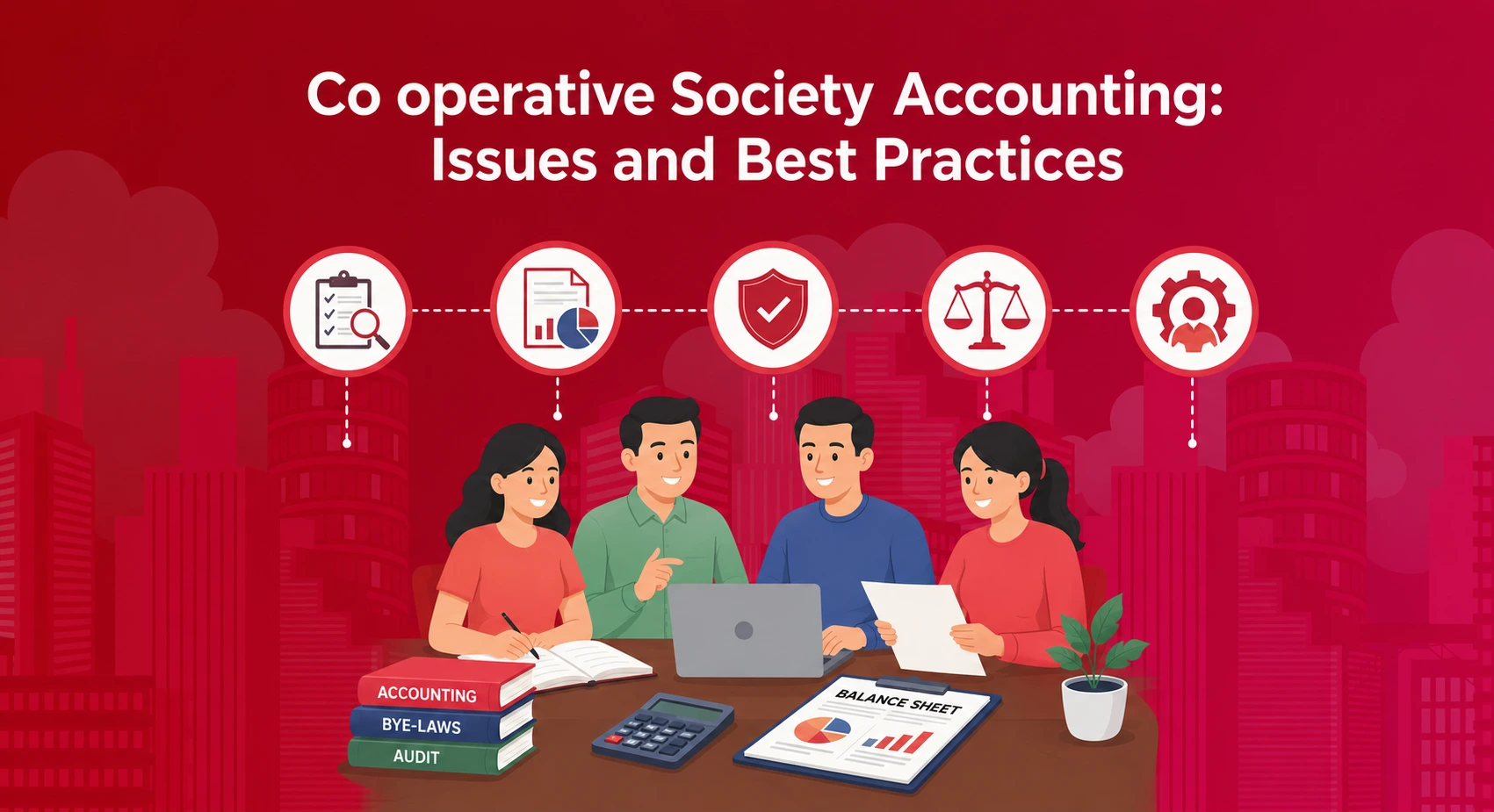


In India, cooperative societies need to keep clear financial records according to the Societies Registration Act 1860. Many societies find this challenging, and it can sometimes lead to misunderstandings between the residents and the management board. Switching from manual bookkeeping to digital accounting for cooperative society will make managing finances easier and transparent.

By regular monitoring and the usage of cashless payments, societies can stay organised and meet obligations like TDS and GST without stress. Digital tools help committees manage accounts efficiently while keeping everything accountable and clear.
What is Cooperative Accounting?
Cooperative accounting refers to the process of maintaining clear and transparent financial records of a cooperative housing society. It covers income, expenses, member contributions, staff salaries, utility bills, and vendor payments. Unlike traditional business accounting, co-operative society accounting must also comply with the Cooperative Societies Act, including TDS and GST filings, annual audits, and retention of financial records for 7 to 10 years. The goal is to ensure financial transparency, build member trust, and keep the society legally compliant at all times.
Cooperative Society Accounting Rules
Cooperative societies follow accounting rules shaped by their Cooperative Societies Act, by-laws, and the principle of mutual benefit rather than profit maximization. Key rules include:
- Statutory Compliance - Accounts must be maintained as per the applicable Cooperative Societies Act and by-laws.
- Accrual Basis - Income and expenses are recorded when earned/incurred, not just when cash is received or paid.
- Share Capital as Liability - Members' share capital is recorded as a liability, separate from reserves.
- Statutory Reserve Fund - A fixed percentage of profit (often 25%) must go to a Reserve Fund before any surplus distribution.
- Dividend Restriction - Dividends to members are capped at a maximum rate set by the Act.
- Education/Development Fund - A portion of profit is often set aside for member education and training.
- Mandatory Audit - Annual accounts must be audited by an auditor approved by the Registrar of Cooperative Societies.
- Patronage-Based Surplus - Surplus may be shared based on members' business volume with the society, not just shareholding.
- Lending/Investment Limits - Restrictions apply on loans to a single member and on investment of surplus funds.
- Annual Filing - Financial statements and returns must be submitted to the Registrar within a set time.
- Prescribed Formats - Standard formats for Balance Sheet and Profit & Loss Account are often mandated.
- Fund Segregation - Reserve Fund, Building Fund, and other special funds must be kept and used separately.
These rules keep cooperative societies transparent, financially sound, and aligned with cooperative values.
Read Also: What is the Role of an Accountant in Society
Common Accounting Issues Faced by Cooperative Societies
The nature of accounting records required by cooperative societies is notably different from traditional businesses.
The main issues facing societies from an accounting standpoint include:
- Classifying a member’s shares as equity or liability
- Revenue recognition, there can be multiple performance obligations involved
- Difficult financial record-keeping while complying with principles of cooperation and compliance obligations
It is not uncommon for societies to also experience weaknesses in internal controls. These can include internal control weaknesses using the framework established by the Committee of Sponsoring Organisations of the Treadway Commission, which focuses on financial reporting risk.
Some common internal control weaknesses are:
- No adequate segregation of duties,
- The transaction records provided by a member are not complete,
- Delays in financial reporting,
- Complex requirements for statutory compliance.
There is a lack of cohesiveness at the state and national levels associated with the accounting systems that apply to cooperative accounting.
- Current accounting standards are not consistent with cooperative values and principles.
- It is difficult to demonstrate the socio-economic contributions made with cooperative financial statements.
Financial constraints:
Many cooperatives are unable to raise capital to employ trained accountants and to maintain and safeguard records. This impacts the financial management of the society.
Read Also: Financial Statement of Cooperative Society
How to Maintain Co operative Society Accounts
Keeping society’s accounts is not that complicated when the accounts are well-managed. The audits become easier, disputes are minimised, and members feel confident in the committee’s handling of funds. Here’s a practical guide on how to maintain society accounts effectively:
Maintain a Standard Chart of Accounts
Set up a clear and consistent chart of accounts for income, repair fund, staff salaries, utility bills and bank charges. This setup will simplify bookkeeping and will simplify audits. This will help you to quickly locate any transaction.
Record Transactions Every Day
Record maintenance charges, utility bills, salaries, repairs, and vendor payments every day. Do not let it pile up. Daily updates will reduce errors, keep the society's finances clear, and build a continuous audit trail for every entry.
Follow the Double-Entry System
Every transaction should have a matching debit and credit entry. This will reduce mistakes and provide a clear picture of the society’s financial health.
Dedicated Society Accounting Software
A Society accounting software can maintain bills, receipts, ledgers, TDS deductions, and GST compliance. It keeps your accounts ready for audits by reducing manual work and errors.
Reconcile Bank Statements Monthly
Cross-check your bank statements with your books every month. This will spot missing entries, unrecorded cheques, pending deposits, or bank charges before they become serious issues.
Keep a Separate Bank Account for the Society
Never mix personal and society funds. A dedicated account ensures cleaner financial records and makes audits faster and simpler. It will also build trust and reflect transparency.
Prepare Monthly Financial Statements
Generate an Income & Expenditure Statement, Balance Sheet, and Cash Flow Statement every month. These reports will help the committee track budgets, make informed decisions, and spot any financial trends early.
Keep Records for 7 to 10 Years
The cooperative laws state that the Society’s financial documents should be recorded for at least 7 to 10 years. Proper documentation is essential for audits, legal compliance, and resolving any disputes.
Conduct Annual Audits Promptly
Audits should be completed within 60 days of the financial year-end. During this process, auditors check cash balances, legal compliance, pending dues, and maintenance collections to ensure all accounts are accurate and up to date.
Read also: How to Prepare Final Accounts of Cooperative Society
Essential Books and Records for Cooperative Society Accounting
A cooperative society is required to maintain a set of books and records to ensure transparency, accountability, and compliance with the relevant Cooperative Societies Act. These records not only help in tracking day-to-day financial transactions but also serve as legal evidence during audits, inspections, and disputes. The essential books and records include:
1. Cash Book
Records all cash and bank receipts and payments on a daily basis, showing the running balance of cash in hand and at bank.
2. General Ledger
Contains all accounts of the society (assets, liabilities, income, expenses, capital) in a classified form, prepared from journal or subsidiary book entries.
3. Journal / Journal Proper
Used to record non-cash transactions such as adjustments, rectification of errors, and opening/closing entries that do not fit into other subsidiary books.
4. Members' Ledger (Share Register)
Maintains individual records of each member's share capital contribution, admission, transfer, and withdrawal of shares.
5. Loan Ledger
Applicable to credit and thrift societies; records loans issued to members, repayment schedules, interest charged, and outstanding balances.
6. Stock Register / Inventory Register
Maintained by consumer or marketing cooperatives to record purchase, issue, and balance of goods or stock-in-trade.
7. Receipt and Payment Vouchers
Supporting documents for every cash or bank transaction, providing evidence and authorization for entries made in the cash book.
8. Minutes Book
Records proceedings, resolutions, and decisions taken during meetings of the general body, board of directors, and committees.
9. Register of Members
Contains particulars of all members such as name, address, date of admission, and membership number.
10. Fixed Assets Register
Details all assets owned by the society, including cost, date of purchase, depreciation, and current book value.
11. Audit Register / Objection Book
Records observations, objections, and comments raised by auditors along with the society's replies and corrective actions taken.
12. Statutory Registers
Includes registers required under the Cooperative Societies Act, such as the register of debentures, mortgages, and by-laws amendments.
Together, these books form the backbone of a cooperative society's financial system, ensuring accurate record-keeping, facilitating statutory audits, and enabling members and regulators to assess the society's financial health.
Essential Documents for Co operative Society Accounting
To keep society’s finances transparent and well-organised, it’s important to maintain proper records of all transactions. Essential documents include:
- Member Contribution Records, including membership fees, share capital, and maintenance payments from members.
- Receipts and Invoices of all expenses, like repairs, utility bills, and vendor payments.
- Salaries, deductions, and benefits of the staff.
- Monthly statements for all society accounts that have to be reconciled with transactions in future.
- Document any investments, loans, or borrowings.
- Tax Documents including TDS, GST challans, returns, and other statutory filings.
- The past audit Reports will help for reference and compliance checks.
- Other Supporting Documents - Store agreements, legal papers, or receipts related to society finances.
- Properly maintaining these documents ensures smooth audits, boosts transparency, helps settle disputes, and keeps society compliant with legal requirements.
Tips for Co operative Society Accounting
- Keep records: Maintain clear financial records for 7 years.
- Separate duties: Divide authorisation, custody, and recording tasks.
- Reconcile regularly: Check accounts and balances monthly.
- Internal controls: Secure assets, cash, and documents.
- Review finances: Track income, expenses, and cash flow.
- Tax compliance: File TDS, GST, and maintain documents.
- Use software: Adopt easy-to-use accounting tools.
- Go digital: Minimise cash; use banking apps and UPI.
Also Read: Choosing the Right Accountant for Your Apartment Society: What to look for
Annual Financial Management Processes
Annual financial management processes are essential for proper financial management of societies. The key activities include:
- Preparation of monthly trial balances and monthly adjustments
- Preparation and submission of audit reports within six months of the year’s end
- Retention of accounting records for a minimum of ten years
The annual audit, which must be performed within 60 days after a financial year-end, reconciles at a minimum the cash balances, securities, and debts overdue. The board members must also ensure adequate internal controls and appropriate management of financial and accounting records during the full fiscal year! Audited financial statements should be circulated and reviewed at the Annual General Meeting (AGM) within the six-month time limit allowed after the financial year-end.
Read Also: Housing Society Balance Sheet
Society Accounting Software by NoBrokerHood
NoBrokerHood's society accounting software is an end-to-end solution designed specifically to solve the financial problems facing cooperative housing societies. It simplifies record-keeping, compliance, and transparency through automated billing, real-time expense tracking, and digital ledger management - eliminating manual work and human errors. Treasurers and management committees can generate reports, manage member contributions, and file TDS and GST more easily. With UPI and bank integrations supporting cashless transactions, NoBrokerHood facilitates a digital-first, audit-ready approach to co-operative society accounting.
| Feature | What NoBrokerHood Offers |
|---|---|
| Automated Billing | Auto-generate maintenance and utility bills |
| Real-Time Expense Tracking | Monitor society expenses instantly |
| Digital Ledger Management | Maintain accurate digital financial records |
| TDS & GST Filing | Simplified tax compliance and filings |
| Report Generation | Generate income, expense, and balance reports |
| Member Contribution Management | Track and manage member payments easily |
| Cashless Transactions | UPI and bank integration for digital payments |
| Audit-Ready Accounts | Organised records for smooth annual audits |
All Solutions by NoBrokerHood:
