





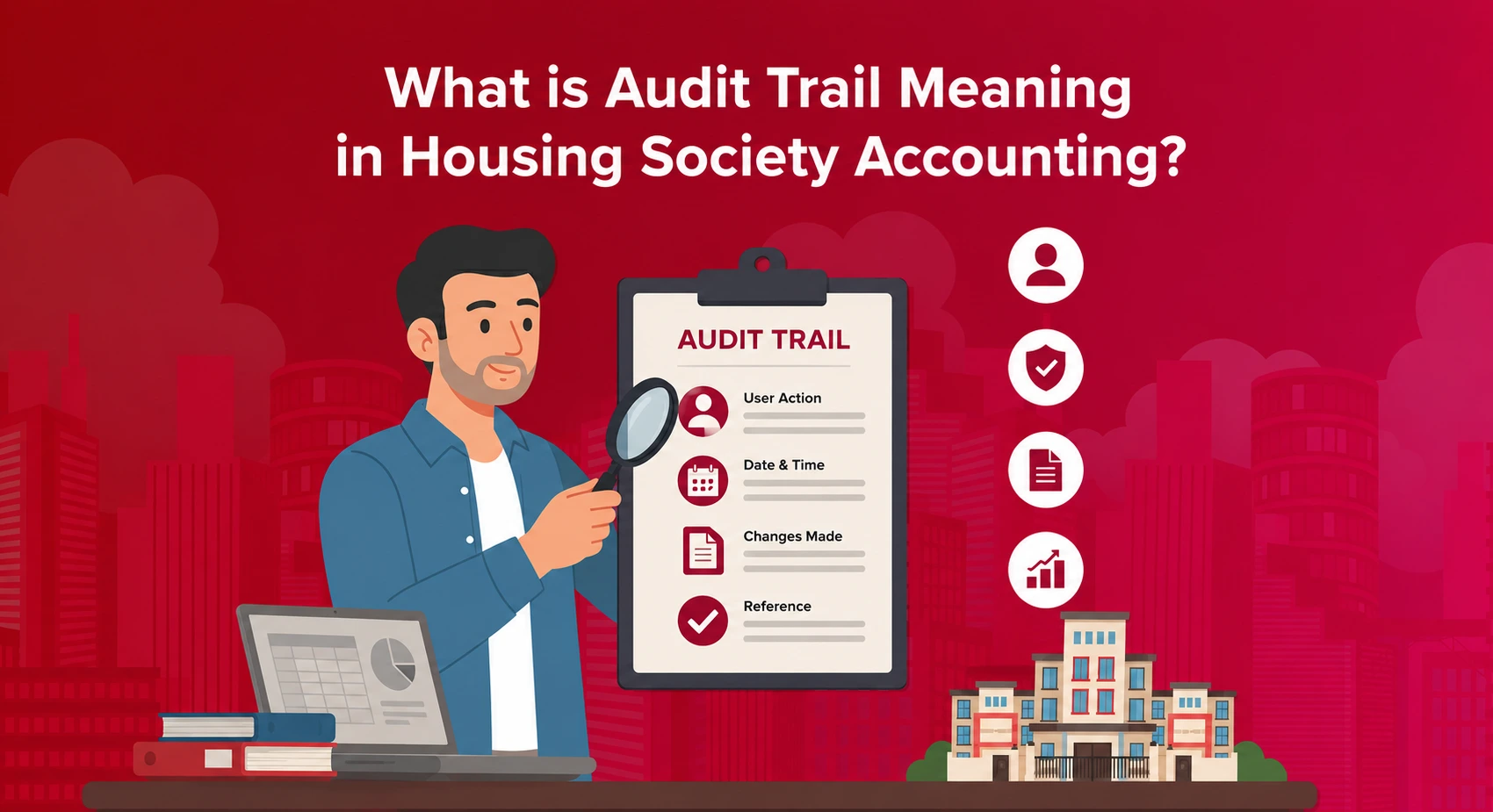


An audit trail in housing society accounting is a complete chronological record of every financial transaction - from maintenance collections and vendor payments to fund transfers and expense entries. For housing societies managing large pools of member funds, an audit trail system ensures every rupee is tracked, every change is logged, and every action is attributed to a responsible person. It builds transparency among residents, simplifies statutory audits, and protects the society from financial mismanagement and fraud. With increasing regulatory oversight in India, understanding audit trail meaning is no longer optional - it is essential for every housing society committee.

What is an Audit Trail and Why is it Important?
An audit trail in a housing society is a dated record of every financial and administrative action: who collected a payment, who approved an expense, who changed a member's records, and when it happened. It lets members, the managing committee, and auditors trace any entry back to its source.
For example, if a maintenance payment is recorded, the audit trail shows the receipt number, the amount, the member who paid, who entered it, and the date. If that entry is later edited or deleted, the change is recorded too.
Why it matters for a housing society
- Everyone can see where the money goes. Residents can check how maintenance and sinking funds are being used, and that builds trust in the committee.
- It keeps spending honest. When every expense needs a voucher, an approval, and a payment record, misuse is hard to hide.
- Office-bearers stay answerable. The Chairman, Secretary, and Treasurer can stand behind every decision they made, because the records show it.
- Audits become easier. Receipts, bank entries, and approvals all line up, so auditors don't have to chase paperwork.
- It keeps the society compliant. Cooperative societies are expected to keep proper books under their state Act and bye-laws.
- Disputes get settled faster. If there's a disagreement over dues or a penalty, the records decide it, not anyone's memory.
- Handovers go smoothly. A new committee inherits a clear, verifiable history instead of starting from guesswork.
What is the Purpose of Audit Trail and Logging?
In a housing society management system, an audit trail records who did what, when, and from where, covering actions like maintenance payments, member record updates, and visitor entries. This promotes accountability among committee members and staff, helps detect unauthorized changes or suspicious logins, and lets the committee resolve disputes by tracing exactly what happened. It also gives auditors clear evidence of financial transparency and supports compliance with cooperative society rules and data protection requirements.
AP automation with well-designed structured audit trails will have the ability to potentially shave workflow time by 80% or more time. The advantages indicate what an audit trail checks for - user activity, timestamps, unauthorized access, construction of each financial transaction.
Understanding Audit Trails in Financial Management
In social finance, what is the audit trail in software refers to the ability of accounting systems to record, track and secure every financial transaction. What does audit trail mean in practical terms? It means every add, delete and change in the financial ledger is traceable and will be securely logged.
Aspects of audit trails in financial management include:
● Time stamps indicating when transactions occurred or any changes made
● User identification indicating who acted
● Event descriptions indicating transaction details
● System information indicating the technical detail in regards activity location and type
There are two types of audit trails:
- Transaction Audit Trails - Track payments, receipts and invoices.
- System Audit Trails - Track user access and logins, changes to settings, and changes to permissions.
Whether you are looking to learn what an audit trail is and why it is important, or what an audit trail means for internal audits, these trails help you identify discrepancies and quickly investigate anomalies.
Benefits of Audit Trails for Societies
Still asking yourself what is the purpose of audit trail and logging? Here are five benefits to consider:
| Benefits | Description |
|---|---|
| Fraud detection | Identify inconsistencies early on |
| Data integrity | Improve consistency of recordkeeping |
| Audit preparedness | Make internal/external audit a simple process |
| Member confidence | Develop trust amongst the residents |
| Regulatory compliance | Stay one step ahead of potential future legal change |
If you think about audit trails of information and build it correctly into societies then you can avoid financial error and mismanagement which can turn into costly decisions. What is an audit trail and what is its purpose is not just paperwork but rather a methodology to help organizations with long term stability.
Common Society Financial Frauds Prevented by Audit Trails
Without a proper audit trail system, housing societies remain vulnerable to financial mismanagement. An audit trail actively prevents the most common frauds found in Indian housing societies by ensuring every transaction is logged, verified, and attributed to a responsible person.
| Common Fraud Type | How Audit Trail Prevents It |
|---|---|
| Duplicate Payment to Vendors | Flags duplicate entries instantly |
| Unauthorised Fund Withdrawals | Logs every withdrawal with user identification |
| Fake Maintenance Receipts | Matches receipts against actual member payments |
| Inflated Repair Bills | Tracks approved amounts vs actual payments |
| Cash Collection Misuse | Converts cash records into traceable digital logs |
Legal and Regulatory Importance for Housing Societies in India
While the Companies Act, 2013 and MCA audit trail rules primarily govern registered companies, housing societies in India are regulated under their respective State Co-operative Societies Acts and State Apartment Acts. These laws mandate annual statutory audits, transparent financial recordkeeping, and accountability of committee members managing society funds. Though societies and trusts are explicitly excluded from MCA compliance, maintaining a proper audit trail is strongly recommended - and in many states, legally expected - to ensure clean audits, avoid disputes, and protect committee members from fraud allegations.
Key Legal Obligations for Housing Society Audit Trails at a Glance
| Legal Requirement | Applicable Law | What It Means for Societies |
|---|---|---|
| Annual Statutory Audit | State Co-operative Societies Act | Societies must submit audited accounts every financial year |
| Financial Recordkeeping | State Apartment Acts | All income, expenses, and fund movements must be documented |
| Reserve Fund Maintenance | RBI & State Co-op Rules | Sinking and repair funds must be tracked and verified |
| Committee Accountability | State Co-op Societies Act | Office bearers are personally liable for financial mismanagement |
| Record Retention | Best Practice (Min. 8 Years) | Financial records should be retained for future audits and disputes |
| Registrar Inspection | State Co-op Societies Act | Registrar can demand full financial records at any time |
Role of Audit Trail in Housing Society Statutory Audit
Housing societies in India are legally required to conduct annual statutory audits under their respective State Co-operative Societies Acts. An audit trail directly supports this process by providing auditors with a complete, chronological record of all financial transactions - from maintenance collections and vendor payments to reserve fund transfers. Societies with a proper audit trail system receive faster audit clearances, face fewer objections, and demonstrate stronger financial governance to members and registrars.
| Audit Requirement | How Audit Trail Helps |
|---|---|
| Annual Statutory Audit | Provides complete transaction history for auditors |
| Reserve Fund Verification | Tracks all deposits, withdrawals, and transfers |
| Vendor Payment Verification | Logs every payment with timestamps and approvals |
| Maintenance Collection Records | Confirms receipts against dues for each member |
| Registrar Inspection | Offers tamper-proof records for regulatory review |
Implementing Audit Trails in Society Accounting Systems
Choosing the right accounting software is critical for housing societies to implement a reliable audit trail system. The ideal software should enforce member compliance, ensure accountability, and actively detect fraud - making financial management transparent and audit-ready at all times.
Audit trail functions to look for in society accounting software:
- Real-Time Transaction Monitoring - Instantly reviews financial activity and flags suspicious patterns as they occur
- Immutable Records - Prevents anyone from tampering with, deleting, or disabling audit logs
- User Identification - Records exactly which committee member or admin performed each financial action
- Timestamps - Logs the precise date and time of every transaction or change made
- Detailed Event Logging - Captures a complete history of all financial actions for easy review
- Data Retention - Stores all financial records securely for a minimum of eight years for future audits and dispute resolution
Society Accounting System by NoBrokerHood
NoBrokerHood's Society Accounting Software enables complete audit trails for housing societies - digitally recording every transaction with timestamps and user details. All entries, edits, and deletions are traceable, tamper-proof, and exportable for easy auditing. Real-time dashboards give residents and admins full financial visibility.
| Feature | Description |
|---|---|
| Timestamped Records | Every transaction logged with date, time, and user |
| Tamper-Proof Logs | Immutable records prevent manipulation or deletion |
| Full Traceability | Every entry, edit, and deletion traced to a specific user |
| Exportable Reports | Audit logs exportable for internal and external audits |
| Real-Time Dashboard | Live financial monitoring for admins and residents |
| Automated Alerts | Flags high-value or unusual transactions instantly |
All Solutions by NoBrokerHood:
