







Maintaining accurate records is crucial for managing a society’s finances. In accounting, one special type of transaction that frequently comes up is the contra entry. In this blog, we’ll explore what a contra entry is, its significance in accounting, contra entry examples and step-by-step instructions on recording contra entries in your society’s accounting books, making your accounting and billing solutions easier.

What is Contra Entry with Example?
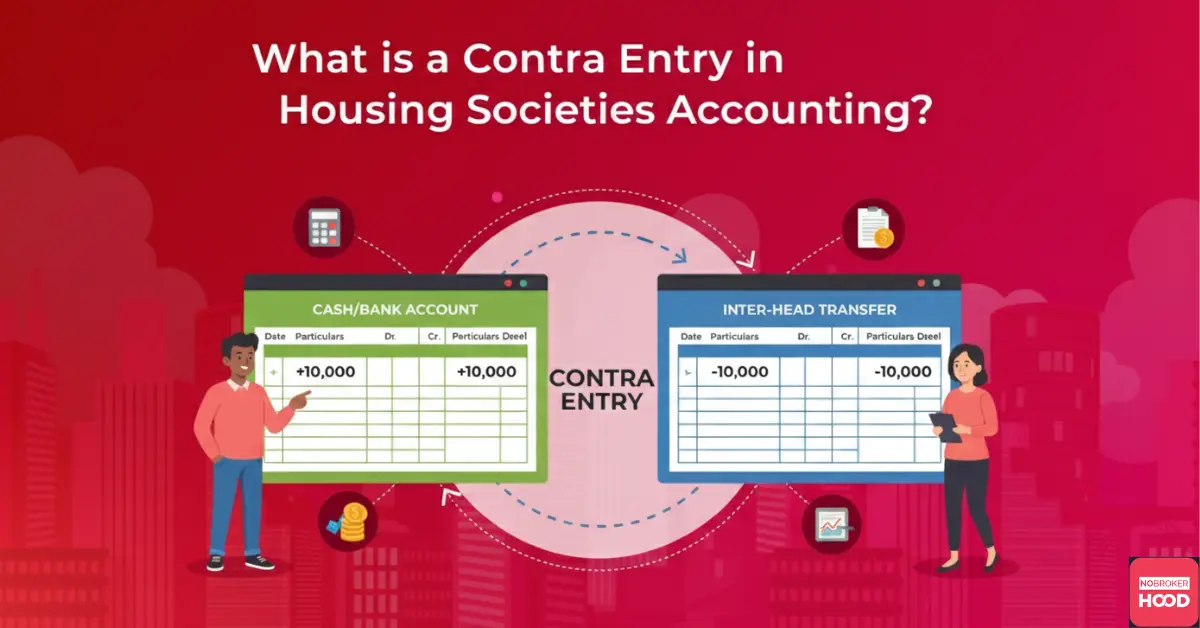
A contra entry is an accounting transaction where funds are transferred between two similar accounts. This usually involves cash and bank accounts or transactions between two bank accounts. The key to understanding what a contra entry in accounting lies in its dual nature: it simultaneously debits and credits two related accounts without impacting the financial position of the society.
Contra Entry Example: Let’s say you transfer funds from the society’s main bank account to a petty cash account for minor expenses. Here, the cash account is debited, and the bank account is credited, but the total cash balance of the society remains the same.
Contra Entry Examples
To make contra entries easier to understand, let’s look at a few common contra entry examples:
1. Contra Entry for Cash Withdrawal for Petty Cash
If your society needs petty cash for daily expenses, you might withdraw cash from the bank. This results in a contra entry where the bank account is debited, and the cash account is credited.
2. Contra Entry for Cash Deposit into Bank
When you deposit cash into the bank, the cash account is debited, and the bank account is credited. This is a common contra entry for cash deposit.
3. Transfer Between Bank Accounts
If the society has multiple bank accounts, funds can be transferred between them. One bank account will be debited, while the other will be credited. This is known as a contra entry bank-to-bank transaction.
These contra entry examples illustrate what a contra entry example looks like, making it clear that contra entry in accounting involves transactions within similar accounts and often occurs when moving cash or funds between accounts.
Also Read: Effective Income and Expense Management for Gated Communities
Types of Contra Entry in Accounting
Contra entries in accounting are broadly classified based on the nature of the accounts involved:
Bank Account to Cash Account
When cash is withdrawn from the bank.
Cash Account to Bank Account
When cash is deposited into a bank account.
Bank Account to Bank Account
When transferring funds from one bank account to another.
Cash Account to Cash Account
In rare cases where two cash accounts exist, funds may be transferred between them.
In co-operative society accounting, these transactions typically arise when managing petty cash, making bank deposits, or balancing funds between accounts to meet daily expenses.
Contra Entry Rules
Contra entries follow a specific set of rules to ensure they're recorded correctly and don't get mixed up with regular receipts or payments:
- Applies only to cash and bank accounts: A contra entry is passed only when both sides of the transaction involve the society's own cash and bank accounts, never when a third party is involved.
- Recorded on both sides of the cash book: In a double-column cash book, the entry appears on both the debit side (bank/cash column) and the credit side (cash/bank column) simultaneously.
- Marked with letter "C": Instead of posting to the ledger, contra entries are denoted with a "C" in the ledger folio column, indicating no further ledger posting is needed since both aspects are already covered in the cash book.
- No effect on the trial balance: Since both the debit and credit are recorded within the same cash book, contra entries don't create any additional ledger balances or impact the trial balance.
- Common transaction types: Includes cash deposited into the society's bank account, cash withdrawn from the bank for office or petty expenses, and transfers between multiple bank accounts held by the society (if applicable).
- Excludes third-party transactions: Payments received from members or made to vendors, even if routed through cash or bank, are not contra entries since they involve external parties, not just internal fund movement.
- Must be supported by documentation: Every contra entry should be backed by supporting documents like bank deposit slips, withdrawal slips, or transfer receipts, to maintain a proper audit trail.
What is the Purpose of Contra Entry in Housing Societies Accounting?
A contra entry records transactions where funds move between the society's own cash and bank accounts, such as cash deposited into the bank or cash withdrawn for petty expenses. Since the money stays within the society's control, contra entries keep the books accurate without affecting income or expenditure.
Key purposes for housing societies:
- No impact on income/expenditure: Contra entries don't count as income or expense, so they don't distort the Income and Expenditure Account.
- Accurate cash and bank records: Societies often handle small cash collections (parking fines, minor repairs) alongside bank transactions (maintenance dues, NEFT payments). Contra entries keep both the cash book and bank book correct.
- Clear audit trail: Marked with a "C" in the cash book, contra entries create a traceable record of fund movements, useful during statutory audits and committee reviews.
- Easier reconciliation: Recording cash deposits or withdrawals as contra entries simplifies preparing bank reconciliation statements.
- Avoids duplication: Without contra entries, the same transaction could get recorded twice, once in cash and once in bank, inflating totals.
Contra Journal Entry in Accounting
A contra entry journal entry is recorded in the cash book. You’ll use two columns: one for cash and one for bank transactions. Contra entries are indicated with the letter “C” in the Ledger Folio (L.F.) column to denote that the transaction is internal.
Contra Account Journal Entry Examples
When a business withdraws cash from the bank for office use, the cash balance increases, and the bank balance decreases. This transaction is recorded as a contra entry because both accounts belong to the business.
Contra Entry Examples Table
| Transaction Type | Debit Account | Credit Account |
| Cash withdrawn from the bank | Cash Account | Bank Account |
| Cash deposited into the bank | Bank Account | Cash Account |
| Transfer from Bank A to Bank B | Receiving Bank | Paying Bank |
| Funds moved between cash accounts | Cash Account | Cash Account |
Journal Entry for Contra Entry
| Particulars | Debit (₹) | Credit (₹) |
| Cash A/c Dr | 10,000 | |
| To Bank A/c | 10,000 |
(Cash withdrawn from the bank for office use)
Contra Entry in Cash Book
| Date | Particulars | L.F. | Cash (Dr) | Bank (Cr) |
| Date | To Bank A/c | C | 10,000 | |
| Date | By Cash A/c | C | 10,000 |
Read also: Choosing the Right Accountant for Your Apartment Society
Step-by-Step Guide for Recording Contra Entry in Cash Book
To correctly record a contra entry in cash book, follow these steps:
Identify the Accounts Involved
Contra entries only apply to cash and bank accounts. Before recording, ensure that the transaction is between these accounts.
Determine Debit and Credit Entries
Decide which account will be debited and which will be credited. For example, if you are depositing cash into the bank, debit the cash account and credit the bank account.
Record in the Cash Book
Enter the details on the debit side for the receiving account and on the credit side for the giving account.
Mark as Contra
Label each entry as a contra by writing “C” in the L.F. column to indicate that the transaction does not impact the society’s financial position.
Double-Check Entries
Verify that each debit entry has a corresponding credit entry and that all details match the actual transaction.
Read also: Choosing the Right Accountant for Your Apartment Society
Advantages of Contra Entries
Using contra entries offers several benefits:
Efficient Record-Keeping
Contra entries make it easier to record internal transactions involving cash and bank accounts, providing a consolidated view.
Accurate Financial Reporting
These entries ensure that all cash and bank transactions are accurately tracked and reported in the financial statement of cooperative society.
Simplified Reconciliation
Since contra entries offset each other, they simplify the process of balancing cash and bank accounts at the end of the month.
Disadvantages of Contra Entries
While contra entries offer many advantages, there are some downsides to consider:
Increased Complexity
Each transaction requires both a debit and a credit entry, which can be confusing if not done correctly.
Potential for Errors
Mistakes can happen if a bookkeeper misinterprets what a contra entry is in accounting, leading to inaccuracies in the financial books.
Limited Scope
Contra entries are specific to cash and bank accounts and don’t apply to other types of transactions.
Read Also: Co operative Society Balance Sheet Format
Common Mistake to Avoid
- Recording third-party transactions as contra: Treating member payments or vendor payments routed through cash/bank as contra entries, when they should be recorded as regular receipts or payments since they involve external parties.
- Missing the "C" notation: Forgetting to mark the entry with "C" in the ledger folio column, which can lead to confusion about whether the entry needs separate ledger posting.
- Recording only one side: Entering the transaction on just the debit or credit side of the cash book instead of both, which breaks the self-balancing nature of contra entries.
- Treating inter-bank transfers as regular entries: When a society has multiple bank accounts and moves funds between them, failing to record it as a contra entry can lead to incorrect bank balances.
- Skipping supporting documents: Not attaching deposit slips, withdrawal slips, or transfer confirmations, which weakens the audit trail and can raise red flags during statutory audits.
- Confusing contra entries with journal entries: Mistakenly passing a journal entry for a cash-to-bank or bank-to-cash transfer instead of using the cash book's contra column, leading to duplicate or inconsistent records.
- Incorrect timing: Recording the contra entry on a different date than when the actual cash deposit or withdrawal happened, causing mismatches during bank reconciliation.
- Ignoring petty cash reimbursements: Not treating the withdrawal of cash from the bank to replenish the petty cash fund as a contra entry, which can understate cash-in-hand records.
- Mixing up debit and credit sides: Placing the entry in the wrong column (for example, recording a bank deposit on the bank credit side instead of the debit side), which throws off the cash book balance.
How NoBrokerHood Helps in Accounting Management for Housing Societies
NoBrokerHood simplifies accounting management by acting as an all-in-one society accounting app. It automates billing, tracks expenses, manages payments, and generates accurate financial reports, helping housing societies maintain transparent, error-free, and efficient accounting systems.
| Feature | How NoBrokerHood Helps |
| Society Accounting App | NoBrokerHood works as a complete society accounting app to manage day-to-day financial activities. |
| Automated Billing | Automatically generates maintenance bills and tracks dues from members. |
| Expense Tracking | Records all society expenses such as utilities, repairs, and vendor payments in one place. |
| Online Payment Integration | Allows residents to pay maintenance online, reducing manual entry errors. |
| Ledger Management | Maintains member-wise and vendor-wise ledgers for transparent accounting. |
| Reports & Statements | Generates income–expense reports, balance sheets, and audit-ready statements. |
| Bank Reconciliation | Simplifies matching bank transactions with society records. |
| Compliance Support | Helps societies stay organised for audits and statutory requirements. |
All Solutions by NoBrokerHood:
