





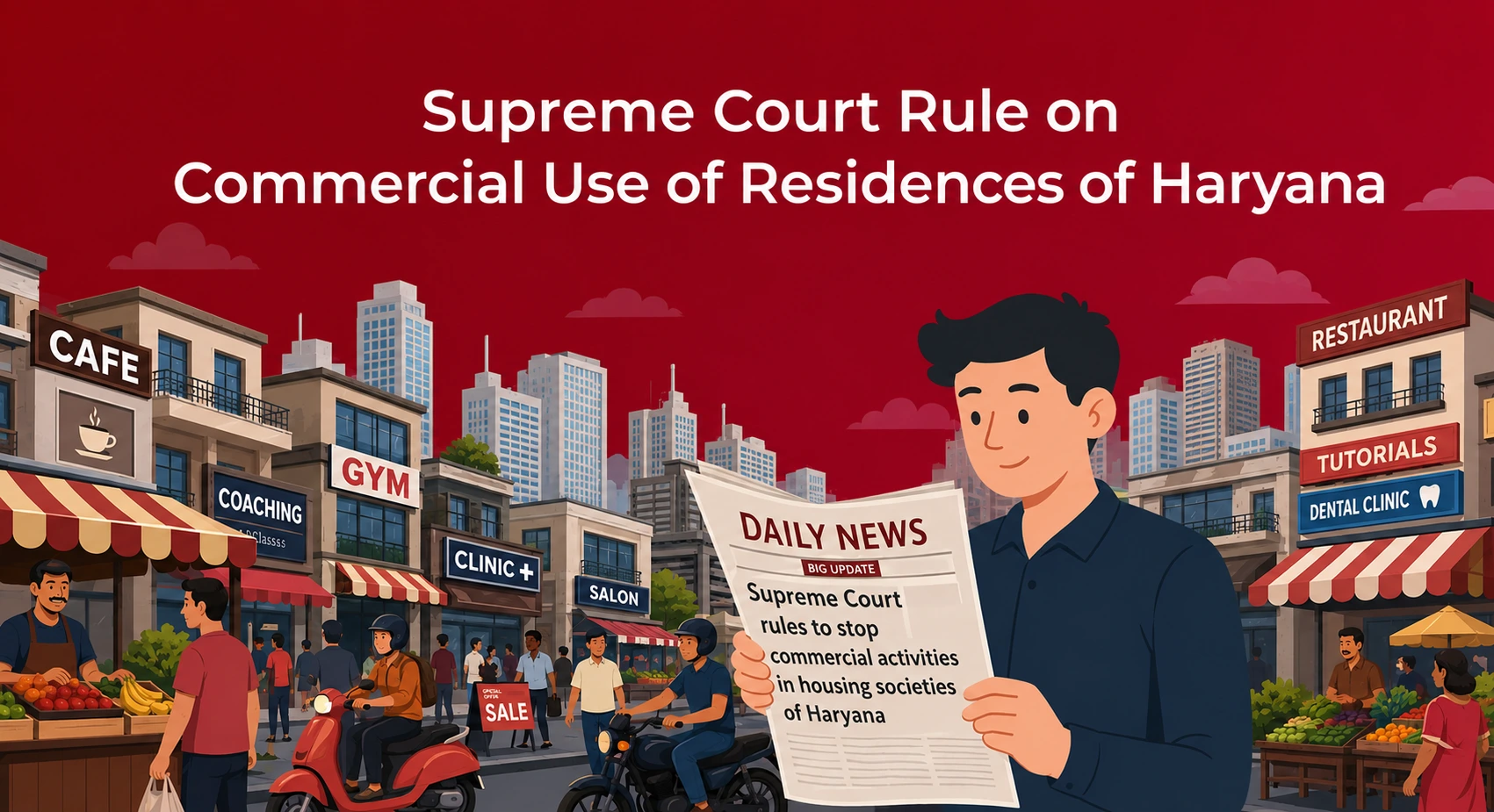


Across many urban and semi-urban areas of Haryana, there has been a considerable increase in commercial use of residential properties. Homes and apartments are being used for offices, retail shops, and service-based businesses. This leads to issues such as inadequate parking, noise pollution, and security risks within communities.

It is important to understand the Supreme Court judgment on the commercial use of residential property in Haryana, as this is a crucial violation of the law. This article explores the applicable legal framework, the types of commercial activities permitted in residential zones, and key considerations for housing societies engaging in commercial operations.
What Is Commercial Use of Residential Property?
The legality of commercial use in residential projects varies by jurisdiction; it depends on local development control regulations, zoning permissions, municipal bylaws, and licensing conditions.
Understanding Residential and Commercial Land Use
Urban development authorities in Haryana and across India classify land into specific categories based on its intended purpose. The major categories include:
- Residential use: Housing, apartments, and living spaces for families
- Commercial use: Shops, offices, business establishments, and trading activities
- Industrial use: Manufacturing units, factories, and workshops
- Institutional use: Schools, hospitals, government buildings, and public services
- Mixed-use zones: Areas where both residential and limited commercial activities may be permitted under regulations
Common Examples of Commercial Use in Residential Properties
Several forms of commercial activity are commonly carried out from residential properties in modern housing societies. Common examples include:
- Retail shops operating from ground floors or converted rooms
- Small offices for professionals such as accountants, lawyers, or consultants
- Medical clinics or diagnostic centres run by doctors
- Tuition centres or coaching institutes for students
- Beauty salons or wellness service setups
- Independent consulting or freelance service offices
- Paying guest accommodations or rental hostels (where specifically regulated or permitted)
Read also: List of Commercial Activities Allowed in Residential Area
Why Commercial Use of Residential Property Becomes a Legal Issue
With property owners seeking to operate businesses from their homes, unrestricted commercial activity can affect the character and functionality of residential neighbourhoods. This is one of the key issues addressed in discussions surrounding the supreme court judgement on commercial use of residential property in Haryana.
Impact on Neighbourhood Infrastructure
Commercial activities will attract visitors, customers, employees, and service providers, who may disrupt the building's residents.
- Increased traffic: More vehicles entering and leaving the area throughout the day.
- Parking congestion: Occupation of resident parking spaces by customers and visitors.
- Higher utility consumption: Greater demand for water, electricity, and waste management services.
- Increased footfall: Higher movement of people within residential premises and common areas.
Impact on Residents
These commercial uses can often alter the peaceful surroundings and quality of life in housing societies, giving rise to objections from their residents. Common concerns of residents can include:
- Privacy issues: Increased public access to residential buildings and common areas.
- Security risks: Entry of unfamiliar visitors, customers, and delivery personnel.
- Noise disturbances: Business operations, customer activity, and vehicle movement.
- Safety concerns: Overcrowding, traffic hazards, and strain on emergency access routes.
Importance of Zoning Regulations
Zoning of individual properties is an important step that helps in specifying how land and buildings are used. These zoning laws help determine whether residential properties can be used for commercial purposes.
These regulations are intended to:
- Maintain the residential character of neighbourhoods.
- Ensure infrastructure is used within its planned capacity.
- Prevent conflicts between incompatible land uses.
- Promote orderly and sustainable urban development.
- Protect the safety, convenience, and welfare of residents.
Legal Framework Governing Commercial Use of Residential Property in Haryana
To understand the implications of the Supreme Court judgement on the commercial use of residential property in Haryana, it is important to first examine the legal and regulatory framework governing how properties may be used within the state.
Role of Development Authorities
Haryana employs several government authorities that are responsible for regulating land use and development across the state. Key authorities include:
- Urban development authorities: They plan and manage urban infrastructure and residential sectors.
- Municipal bodies: They regulate local building activities, trade licences, and civic services.
- The Department of Town and Country Planning (DTCP), Haryana: It prepares development plans, controls land use, and oversees urban development in many parts of the state.
Zoning and Land Use Regulations
Land use in Haryana is primarily governed by zoning regulations prepared by the relevant planning authorities. Lands are classified into residential, commercial, industrial, institutional, and mixed-use zones. Property owners are generally expected to use their premises in accordance with the zoning regulations applicable to their locality.
The applicable zoning designation determines:
- The permitted use of a property.
- Activities that may be allowed on the property.
- Restrictions on commercial operations within residential areas.
- Requirements for change of land use, where applicable.
Building and Occupancy Conditions
Apart from zoning requirements, the property has certain approved building plans depending on whether it is a residential society, an independent floor, or a plotted development. The building plans approval conditions may include:
- Residential occupancy.
- Parking provisions.
- Common area usage.
- Building safety requirements.
- Permitted and prohibited activities within the premises.
Property owners and residents should avoid assuming that the same rules apply to every residential property in Haryana. The legality of commercial activities may vary depending on factors such as location, master plan, zoning classification and type of development.
Supreme Court Judgement on Commercial Use of Residential Property
The case M.C. Mehta v. Union of India (2006) is a landmark Supreme Court judgment addressing the misuse of residential properties for commercial purposes in Delhi and the failure of the authorities to enforce town planning laws. It became one of the most important cases on urban planning, zoning violations, and illegal commercialisation of residential areas in India.
Background of the Case
- The case arose from a series of PILs filed by environmental lawyer M.C. Mehta.
- Residential houses were being converted into shops, offices, and commercial establishments
- Authorities like the Municipal Corporation of Delhi were found to be failing to stop illegal commercialisation.
What the Supreme Court Held
- Residential areas cannot be used for large-scale commercial activities if the Master Plan does not permit it
- Authorities have a duty to strictly enforce zoning laws and stop misuse
- Illegal commercial use (like shops, showrooms, offices in residential zones) must be acted upon
- Enforcement must be phased and systematic, starting with major violations
Important Observations by the Court
- Master Plans clearly separate residential and commercial zones
- Residential areas are meant for living, not trade or large-scale business
- Misuse of residential premises contributes to congestion, traffic issues, and environmental stress.
Why This Case Matters
This judgment is widely used in India because it:
- Strengthens zoning and land-use enforcement
- Confirms that residential properties cannot be commercially misused in violation of the law
- Supports strict action against illegal commercialisation
- Is frequently cited in disputes across Delhi, Haryana, and the NCR regions
Read also: Supreme Court Judgement on Commercial Use of Residential Properties
What Commercial Activities May Be Permitted in Residential Areas?
Limited or controlled commercial activities are permitted if they do not violate zoning laws, building approvals, or local regulations.
Mixed-Use Policies and Permitted Activities
In several urban planning frameworks, authorities recognise the need for mixed-use development, especially in densely populated areas. As a result, certain low-impact commercial activities may be allowed in residential zones and will include restrictions such as:
- Limited scale of operation
- No disturbance to neighbours
- Compliance with parking and traffic norms
- No structural alteration of residential use without approval
Read also: Mixed Use Apartment Building
Professional Activities From Home
Many planning regulations and housing society bylaws permit individuals to carry out non-disruptive professional work from home, especially where client footfall is minimal. Common examples include:
- Independent consultants
- Freelancers and remote professionals
- Architects working on design assignments
- Chartered accountants handling client work
- Lawyers offering advisory services
Activities Requiring Special Permissions
Certain types of commercial use may be permitted only after obtaining specific approvals or fulfilling regulatory requirements. Businesses such as clinics with patient visits, coaching centres, salons, and small offices with regular public access. The approvals will include:
- Business registration and trade licenses from municipal authorities
- No-objection certificates (NOCs) from housing societies or RWAs
- Change-of-land-use permissions from planning authorities such as the DTCP
- Compliance with fire safety, parking, and occupancy norms
This is central to the interpretation of the supreme court judgement on commercial use of residential property in Haryana, which reinforces that land use must remain consistent with approved regulations and cannot be altered arbitrarily.
Rights and Responsibilities of Property Owners
Property ownership doesn’t diminish the responsibility of following the planning laws, zoning rules, and community regulations. The supreme court judgement on commercial use of residential property in Haryana highlights that while property ownership carries rights, it also comes with clear legal responsibilities that must be followed to avoid violations.
Rights of Property Owners
Property owners generally have the right to:
- Use and enjoy their property lawfully
- Live in or rent out residential premises
- Carry out permitted activities within legal limits
- Benefit from ownership subject to applicable rules
Responsibilities Under Planning Regulations
Along with rights, property owners must follow certain responsibilities, including:
- Using the property as per the zoning classification
- Following approved building plans and occupancy conditions
- Obtaining the required licences for any business activity
- Complying with municipal and planning authority rules
- Respecting housing society or RWA guidelines, where applicable
Consequences of Non-Compliance
If residential properties are used for unauthorised commercial activities, it can lead to regulatory issues and action being taken. These include:
- Issuing warning notices
- Imposing penalties or fines
- Ordering closure of illegal commercial operations
- Initiating legal or enforcement proceedings
Role of RWAs and Housing Societies in Commercial Use Disputes
Housing societies and Resident Welfare Associations (RWAs) are often the first point of contact when disputes arise over the commercial use of residential properties.
Monitoring Compliance: RWAs and housing societies help ensure that residents follow society bylaws and community rules.
Handling Resident Complaints: RWAs and Housing Societies help resolve concerns regarding noise, parking, security, or increased visitor movement.
Coordination with Authorities: In cases involving possible violations of zoning regulations or other legal requirements, RWAs and housing societies can bring the case towards the rightful authorities.
Maintaining Community Harmony: RWAs and housing societies are key to balancing individual property owners' rights with the interests of the wider community.
Common Disputes Related to Commercial Use of Residential Property
The supreme court judgement on commercial use of residential property in Haryana highlights the importance of balancing property rights with the interests of residential communities to avoid the rise of disputes.
Commercial Activity: Commercial operations may create noise, disturbances, or inconvenience for nearby residents.
Parking and Traffic Issues: With additional customers, employees, or visitors to the commercial spaces, traffic can increase, creating parking shortages in residential areas.
Unauthorised Advertising: The display of commercial signboards, banners, or advertisements may violate society's bylaws or local regulations.
Increased Visitor Footfall: Businesses operating from residential properties may attract large numbers of visitors, raising concerns about privacy, security, and congestion in common areas.
Violation of Society Rules: Disputes may arise when residents believe a property is being used for a commercial purpose that violates the societal rules.
What Should Residents Do Before Starting a Business From Home?
Review Development Regulations: Residents should check whether commercial use of the building is permitted under zoning and land-use regulations.
Society Bye-Laws and Community Rules: All the bylaws of housing societies and RWAs should be reviewed to avoid disputes with other residents.
Licenses and Approvals: Make sure to obtain required licenses, registrations, or approvals from local authorities.
Impact on the Community: Residents should assess how the business will affect the common areas, parking and visitor movement to avoid disruptions.
Professional Advice: If there is any uncertainty regarding the legality of a proposed activity, it may be helpful to consult a qualified legal, planning, or regulatory professional for guidance.
Best Practices for Housing Societies Managing Commercial Use Issues
The Supreme Court judgement on the commercial use of residential property in Haryana highlights the importance of effectively managing commercial activities in housing societies.
Clear Usage Policies: Clear policies should be established to understand and differentiate between the commercial use of residential units.
Communication: Clear communication regarding the applicable bylaws, guidelines, and policy updates will help to prevent misunderstandings and potential disputes.
Maintain Documentation: Always maintain records related to complaints, approvals, and notices to maintain transparency in decision-making.
Complaint Resolution Procedures: A complaint resolution system should be established to receive, review, and resolve the complaints of its residents.
Coordination with Authorities: Where a matter involves potential violations of zoning regulations or other legal requirements, societies may need to coordinate with municipal bodies, planning authorities, or other competent authorities to take appropriate action.
How NoBrokerHood Helps Housing Societies Manage Property Usage and Compliance
NoBrokerHood helps housing societies manage disputes that may arise with commercial use of residential units more efficiently by providing a centralised platform for communication and record-keeping.
For the Management Committee
Document Management: Store society bye-laws, resolutions, and policy documents digitally for easy access and reference.
Notice Board: Share property usage policies, society rules, and important regulatory updates with residents.
Helpdesk: Record, track, and manage complaints related to unauthorised commercial activities and other community concerns.
Visitor Management: Monitor visitor entries and access patterns to help maintain security and transparency.
Resident Database: Maintain updated records of residents, tenants, and occupants within the society.
For Residents
Access to Society Rules: View society bylaws, policies, and guidelines anytime through the platform.
Complaint Tracking: Submit complaints and track their status transparently until resolution.
Community Communication: Receive updates regarding society regulations, notices, and governance matters.
Benefits of Using NoBrokerHood
- Better documentation and record management
- Improved transparency in society operations
- Faster complaint handling and dispute resolution
- Consistent enforcement of society policies
- Enhanced community governance and communication
By digitising communication and compliance processes, NoBrokerHood helps housing societies reduce confusion, improve accountability, and create a more organised living environment.
All Solutions by NoBrokerHood:
