






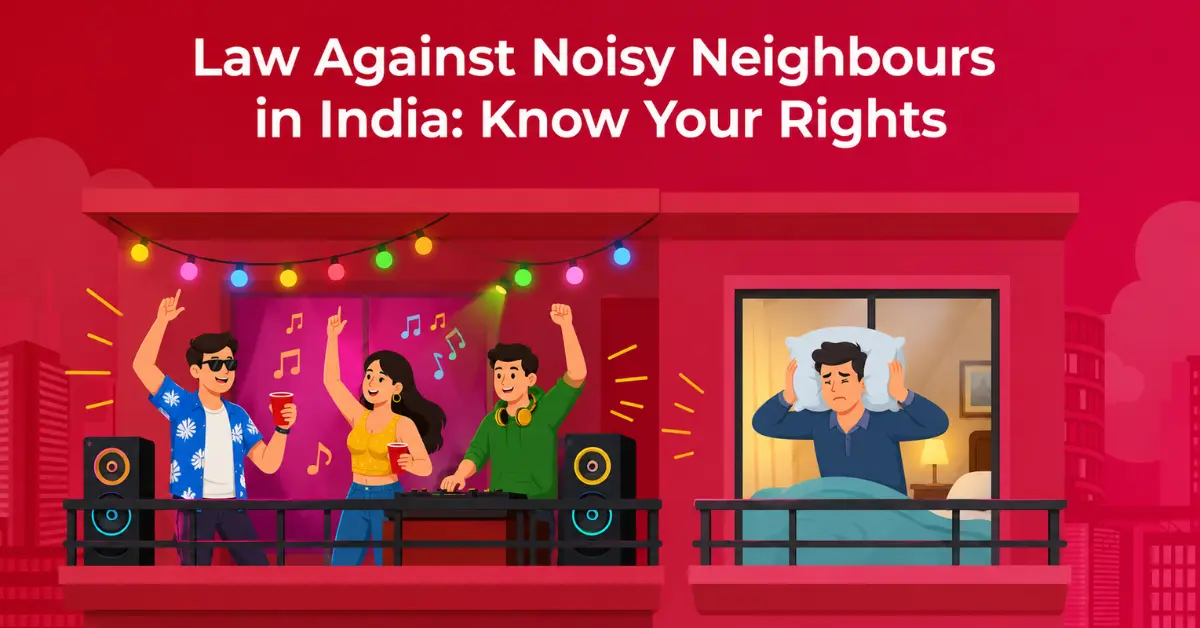


The people residing in the society always have expectations regarding peace, comfort, and mutual respect. But sometimes, loud music, late-night partying, noise due to construction works, and other types of disturbance can quickly interfere with their routine. This article explains the law against noisy neighbours in India, the noise level limit for residential societies, the rights of the people residing in such societies, and how one can go about solving the noise dispute. It also covers relevant laws, court rulings, complaint procedures, and practical solutions to help you protect your right to a peaceful living environment.

Why Noise Pollution in Housing Societies Is a Serious Issue?
Think of this: It’s Tuesday night, past 11 PM. Tomorrow is another workday. But your neighbour starts playing loud music or drilling into his kitchen wall, you wonder if you should say something or keep quiet. Most people keep quiet because they don’t know what steps they can take. Moreover, it is difficult to confront people about such issues. But a noise that disrupts sleep, affects elderly residents, and stops students from studying is a public nuisance. Indian law considers it a health and welfare issue.
The neighbourly problems that you face are mostly legal issues. Prolonged exposure to noise higher than 70 decibels leads to exhaustion, insomnia, and stress. An ordinary conversation occurs at a level of 60 dB. That is specifically why the law against noisy neighbours in India is directly related to public health, quality of life and constitutional rights.
The Supreme Court of India in the case of In Re: Noise Pollution (2005) 5 SCC 733 stated that the right to live in an environment free from any form of pollution, including noise, is included within the right to Life mentioned in Article 21 of the Indian Constitution.
Is There a Law Against Noisy Neighbours in India?
Yes, the law against noisy neighbours in India is derived from environmental laws, criminal laws, and the Constitution of the country. This act applies to the residents living in gated communities, apartments, and standalone houses. Here are the main frameworks you should know about.
The Noise Pollution (Regulation and Control) Rules, 2000
These rules came out of the Environment (Protection) Act, 1986, and they do something quite specific: they treat noise as a form of air pollution. Which means it is regulated the same way toxic emissions are.
For residential areas, the permitted limits are:
- Daytime (6:00 AM to 10:00 PM): Up to 55 dB(A)
- Nighttime (10:00 PM to 6:00 AM): Up to 45 dB(A)
- Silence Zones (near hospitals, schools, courts): 50 dB in the day, 40 dB at night
Anything beyond these limits after 10 PM is a violation. Loud music, parties, loudspeakers, plain and simple. Rule 5 of the Act bans loudspeakers and public address systems entirely during night hours without special permission.
The Air (Prevention and Control of Pollution) Act, 1981
Under Sections 16 and 17 of this Act, residents can take their complaints all the way to the Central or State Pollution Control Board if noise from a neighbour keeps crossing permissible levels and local action has not worked.
Read also: What Is Considered Excessive Noise in an Apartment?
Other Laws That Support the Law Against Noisy Neighbours in India
The law against noisy neighbours in India goes well beyond just decibel measurements. Depending on how persistent or severe the problem is, several other legal tools are available.
Bharatiya Nyaya Sanhita (BNS): The Nuisance Law, Updated
In 2023, the Bharatiya Nyaya Sanhita replaced the old Indian Penal Code. Under BNS Sections 270 and 292 (which took over from IPC Sections 268 and 290), any act causing "common injury, danger, or severe annoyance" to people living nearby is classified as public nuisance. Fines and court orders to stop the nuisance are both on the table. So if a neighbour keeps this up repeatedly, they are not just being rude. They may actually be breaking the law.
Bharatiya Nagarik Suraksha Sanhita (BNSS)
This replaced the old Code of Criminal Procedure. One useful provision here: it gives Executive Magistrates the power to issue restraining orders against someone creating a continuous public nuisance. If you have been dealing with this for weeks and neither the society committee nor the police have done much about it, going to a Magistrate is a legitimate next step.
What does the Constitution say?
Article 21 protects the right to life, and courts have interpreted that to include the right to sleep, to health, and to a peaceful environment. Persistent noise that is affecting your wellbeing is a constitutional concern, not just an apartment dispute.
On the religious events front, the Supreme Court addressed this directly in Church of God (Full Gospel) in India v. K.K.R. Majestic Colony Welfare Association (AIR 2000 SC 2773). The verdict was clear: no religion requires that its prayers or celebrations disturb the people around them. Loudspeakers during festivals are not automatically protected under Article 25.
The Police Act, 1861
Local police have longstanding authority to regulate or shut down loud events that happen without permission. Fines apply for those who ignore noise rules.
Read also: Noise Pollution Rules in Residential Areas
What to Actually Do When Your Neighbour Is Too Loud?
Knowing the law against noisy neighbours in India is useful. Knowing the right order of steps to follow is what makes the difference. Here is a practical path, from the simplest to the most formal.
Step 1: Have a conversation
First and foremost, try talking to your neighbour. This seems quite simple, but it is actually quite effective. Just keep it friendly and specific: "The music after midnight has been audible. Any chance you could keep it lower after 10?" People respond better to a personal request than to a formal complaint they did not see coming.
Step 2: Go to your RWA or society committee
If talking doesn't help, talk to the Resident Welfare Association or the society management committee. Most societies have bylaws which include quiet hour rules, and the committee has real authority in this area. They have the power to issue formal warnings and penalties for repeat offences. Make sure that your complaint is in writing and not just spoken verbally.
Step 3: Start documenting everything
From this point forward, keep a clear record:
- Write down each incident with the date, time, and how long it lasted
- Use a free decibel meter app on your phone to get rough noise readings
- Record short audio or video clips with timestamps, where this is legally okay
- Save copies of any complaints you have submitted to the society
If things escalate to the police or a court, this record becomes your most important asset.
Step 4: File a police complaint
In case of noise at night after 10 pm, or something extreme happening in daytime, you can contact 100. The police will come, issue warnings to your neighbour, and seize their equipment too. If you are not getting any response from the phone call, go to the nearest police station and make a written complaint. Always ask for a stamped acknowledgement copy.
Step 5: Approach an Executive Magistrate
If the police response has been slow or ineffective, you can go directly to an Executive Magistrate. Under the BNSS, Magistrates can order a neighbour to stop causing public nuisance. This step carries more legal weight than a police complaint and tends to get taken more seriously.
Step 6: Legal notice or civil action
For situations that have gone on too long, a lawyer can help in two ways. One option is sending a formal legal notice via Registered Post with Acknowledgement Due (RPAD). This alone often pushes people to act, without ever going to court. The other is filing a civil suit under the Specific Relief Act, 1963, asking the court to issue an injunction that legally stops the neighbour from continuing the disturbance.
Read also: Housing Society Rules and Regulations
Common Noise Complaints in Residential Societies and Their Legal Solutions
Loud music or parties running late
If the noise is crossing 45 dB past 10 PM, it is legally over the limit. Calling the police at 100 is a valid and direct response. They can step in the same night.
Drilling and renovation at odd hours
Most RWAs limit renovation work to weekdays, somewhere between 9 AM and 6 PM. Work happening outside that window can be flagged with the society committee and with the local municipal authority. City-level laws, including the BMC Act in Mumbai, the MCD Act in Delhi, and the BBMP Act in Bengaluru, all have provisions covering construction noise in residential areas.
Loudspeakers during religious events or festivals
The short version: permission is required. Police have the authority to stop events that are running without the right approvals or that are clearly breaching sound limits. The Supreme Court has said this plainly.
A neighbour running a business from a residential flat
If the business is generating regular noise in a residential zone, it may be violating zoning regulations on top of noise rules. In this case, the complaint can go to the State Pollution Control Board as well.
Handle Noise Complaints Better with NoBrokerHood
Noise-related disputes often become bigger problems when complaints are communicated informally. A concern shared in a WhatsApp group may be missed, misunderstood, or lead to unnecessary arguments between residents.
NoBrokerHood is a society management system that helps create a more structured approach through its complaint management system. Residents can report noise-related issues directly on the platform, allowing committees to review concerns, maintain records, and respond through a formal process.
How this supports better community living:
- Residents can raise complaints without public confrontations
- Committees receive a clear record of recurring issues
- Complaint history helps identify patterns and repeated violations
- Issues can be addressed through an organised process rather than scattered conversations
This approach encourages transparency and helps housing societies manage noise concerns more fairly, reducing the chances of small disturbances turning into larger community disputes.
All Solutions by NoBrokerHood:
