





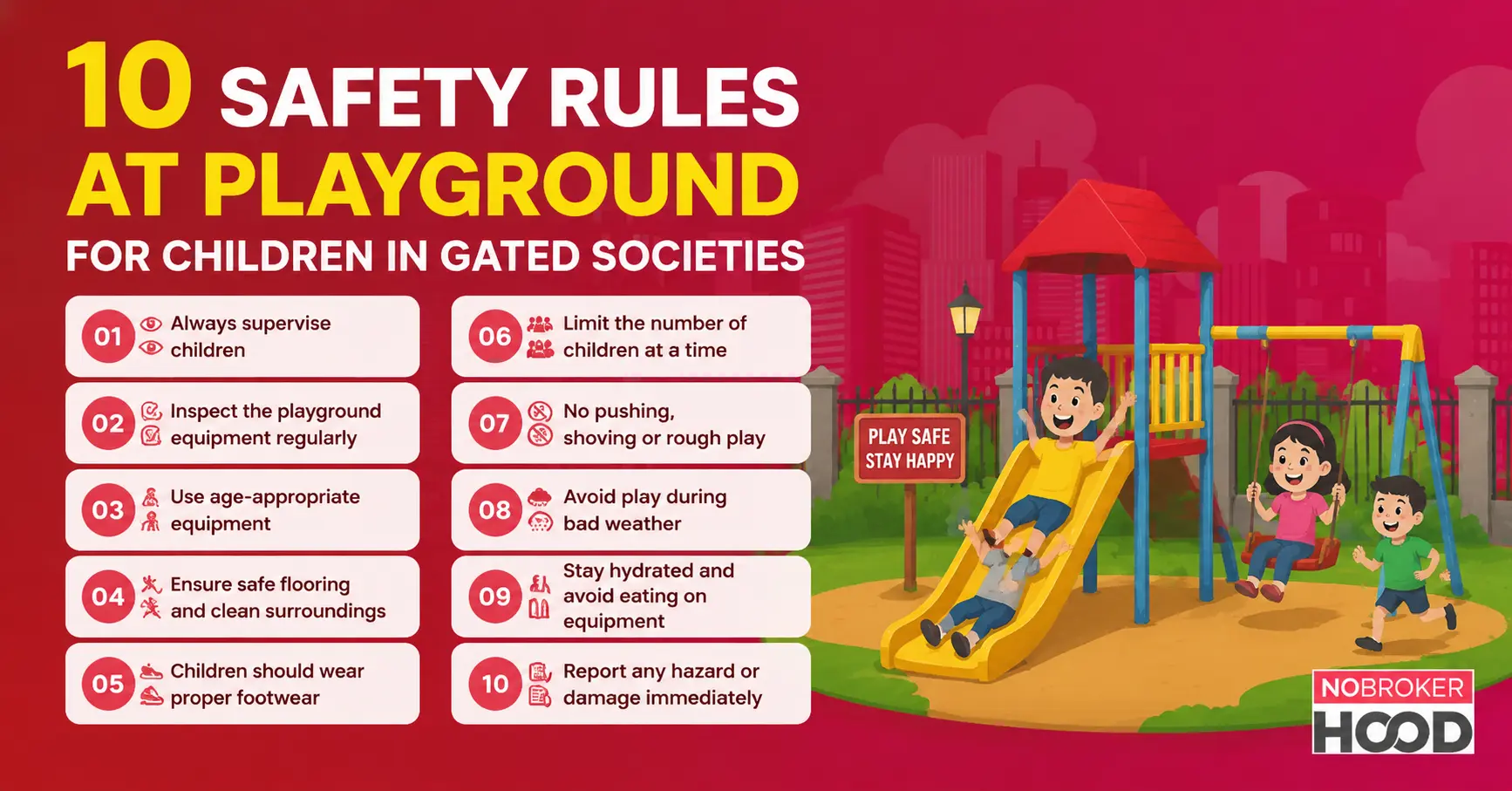


Keeping kids safe at the playground in a housing society doesn’t have to be tough. Did you know that around 40% of playground injuries in India happen because of unsafe play areas? Simple actions like checking equipment regularly, keeping surfaces clean, and ensuring an adult is always nearby can make a big difference in keeping children secure. With the right care and awareness, playgrounds can become joyful spaces where children explore, learn, and play without worry.

Why Are Safety Rules at Playgrounds of Housing Societies Essential?
In a housing society, the playground is a space of laughter, learning, and fun for children. But without proper safety measures, it can quickly turn risky. Many playground injuries occur due to poor maintenance or unsafe surfaces. And that’s why setting clear child safety rules at playgrounds is essential. These rules help communities to:
- Protect children from accidents
- Give peace of mind to parents and caregivers
- Ensure the facility remains usable and safe for all ages
- Build a responsible community culture around play
- Encourage more families to use the facility safely
When residents and management adopt these standards, the playground will become a trusted space.
General Safety Rules in Playground for Kids
Playgrounds are where kids can run around and have fun. They get to test how strong they are and make friends. Sometimes kids can get hurt if they fall down or get their jacket caught on something. The CDC says that more than 200,000 kids go to the emergency room every year because of accidents on the playground. Most of these accidents happen because of falls.
We do not have to take the fun from kids to keep them safe. We just need to teach them simple things to do before and during play.
1.Before You Play
Before kids start playing we should take a look around the playground. This only takes a seconds:
- We need to check the equipment: Look for water on the slides, hot metal in the sun or broken chains and sharp edges.
- We should get rid of things that can catch on the equipment: Kids should not wear hoodies with strings, loose scarves or necklaces because they can get caught and hurt.
- We need to wear the shoes: Closed-toe shoes with good grip are the best. Flip-flops and sandals can cause kids to trip and hurt their toes or ankle.
2. Smart Rules for the Equipment
Accidents happen when kids do not use the equipment correctly. We just need to set a simple rules:
- Kids should go down the slide feet-first: They should not go down the slide head-first or climb back up.
- One kid should be on the swing at a time: Kids should not stand on the swing or jump off when it is high in the air.
- Kids should hold on tight when climbing: We should teach kids to hold on with two hands when they are climbing on the monkey bars or ladders.
- Kids should stay away from moving parts: They should stay back from swings, merry-go-rounds and seesaws so they do not get hurt.
3. Playground Etiquette & Social Rules
The playground is like a classroom where kids can learn to share and be kind to others.
- Kids should take turns and not push: If there is a line for the slide or zip line kids should wait their turn. Give the other kid space.
- Kids should not push or fight near the equipment: They should not play rough games near the high platforms or ladders.
- Kids should include others: We should teach kids to share their toys and invite kids to play with them.
- Kids should tell an adult if they see something that's not safe: If kids see something broken or sharp on the playground they should tell an adult right away.
The important rule is that adults should always watch the younger kids. Kids who are two to five years old are still learning how to balance. Can get hurt easily if they fall. General Safety Rules in Playgrounds for Kids are very important.
10 Safety Rules at Playgrounds for Children of Housing Society
Here are 10 safety rules at playground areas that every housing society can adopt to ensure safer play for children:
Supervise young children
Make sure toddlers under the age of 7 are accompanied by a parent or caretaker when on the playground. This helps them to follow the rules and prevents accidents.
Use age-appropriate equipment
Label the equipment based on the age groups (for example, 2-5 yrs, 6-10 yrs, 11+ yrs). That way, a toddler of 5 years of age won’t attempt the big climbing frame meant for 11-year-old kids.
Check surfacing and layout
Use soft surfacing such as rubber mats, wood chips or sand under and around play equipment instead of bare concrete. Also, ensure that there is sufficient space between equipment so that children don’t collide.
Inspect equipment regularly
The society management should inspect playground equipment monthly and after any monsoon or heavy rain. Check for loose bolts, rust, broken parts, unstable frames or sharp edges. Keep a log so issues are fixed quickly.
Enforce proper dress code for play.
Encourage children to wear closed-toe shoes with a good grip. Avoid loose scarves, strings, jewellery or clothing with hanging bits that can get caught in equipment.
Avoid wet or slippery surfaces.
After rain or cleaning, the equipment may be wet or slippery. Postpone play or wipe down surfaces. Encourage children to avoid running on wet slides.
Teach children safe usage of swings, slides, and seesaws.
For example, one child per swing, wait until the swing stops before getting on or off. Slide feet-first. Avoid climbing backwards or standing on seesaws. Ensure landing zones are clear.
Ensure no rough or overcrowded play.
Pushing, shoving, and overcrowding on equipment is not allowed. Allocate time slots if space is tight because too many children on one slide or climber increases the risk.
Provide shade and rest breaks.
In India, the sun exposure is really high. Ensure there is a shaded area where the children can take occasional rest. Provide a drinking water supply near the playground. Equipment like metal slides can get very hot in the Indian sun. Make sure that play happens during safe times, or use shade and caution.
Communicate and reinforce the rules.
Post a visible sign in the society listing the safety rules at playgrounds along with important fire safety rules for housing society guidelines. During society meetings, encourage parents and older children to talk about these rules. Make it part of the society culture.
By setting these 10 safety rules at the playground, housing societies create a structure where children can be free, playful and safe.
Read also: Facility Management Services in Societies
Safety Measures at Playground
Playground safety is really important. We need to make sure that kids are safe when they are playing. This means we have to think about how the playground is designed how it is taken care of and who is watching the kids. We also need to teach kids about safety.
1. Safe Equipment Design
The equipment should be right for the age of the kids who are playing on it. We should have areas for little kids, bigger kids and older kids.
All the equipment should be made so that it is safe. This means it should have edges and no sharp parts. It should also be stable so it does not fall over.
We need to make sure there is space between each piece of equipment so kids do not run into each other.
2. Impact-Absorbing Surfaces
The ground under the swings, slides and climbing things should be soft. We can use things like rubber mats, wood chips or sand. We should not use things like concrete or asphalt.
The soft surface should go around the equipment so kids are safe if they fall.
3. Regular Inspection and Maintenance
We should check the playground all the time to make sure everything is okay. We need to look for parts, sharp edges or things that are loose.
If something is broken we should fix it. Get rid of it. We should also put up signs to tell kids about safety.
4. Adult Supervision
Parents/guardians should always watch the kids when they are playing. This is especially important for kids. Grown-ups should be able to see everything that is going on.
They should be able to stop kids from doing things that might hurt them. They should also be able to help if someone gets hurt.
5. Clear Safety Signage and Guidelines
We should put up signs that tell kids how old they should be to play on equipment. We should also have signs that tell kids how to play. We should have rules like "do not push" or " one kid at a time". This helps kids know what to do.
6. Boundary and Traffic Safety
We should put up fences around the playground so kids do not run into the street. We should also make sure that the gates are safe and that grown-ups can see them.
7. Emergency Preparedness
We should have a first-aid kit in case someone gets hurt. Grown-ups should know what to do in case of an emergency. We should also have a plan for what to do if someone gets hurt. We should have phone numbers for people to call in case of an emergency.
8. Weather and Equipment Checks
We should check the equipment when it is very hot or very cold. Sometimes the equipment can get too hot or too slippery. We should not let kids play when the weather is bad. We should close the playground if it is stormy or ice.
9. Community and Parental Involvement
Everyone in the community should help keep the playground safe. If someone sees something that is broken they should tell the people in charge. We should all work together to keep the playground safe. This way kids can have fun. Be safe, at the same time.
All of these things help make the playground a safe and fun place for kids to play. Playground safety is very important. We need to think about playground safety all the time so kids can grow and have fun.
Management and Parent’s Responsibility
Playground safety is not one person's job. It takes cooperation between the people in charge of the playground and the parents or guardians who bring kids to play.
Responsibilities of Playground Management
- They have to make sure the equipment is good for the age of the kids who will be using it and that it is installed correctly by people who know what they are doing.
- They have to check the equipment all the time to make sure it is not broken or worn out and keep a record of when they do this.
- If something is broken they have to fix it away so kids do not get hurt.
- They have to keep the surfaces around the equipment safe and clean like the sand or the wood chips.
- They have to put up signs that say what age kids can use the equipment and how to use it and they have to put up signs with phone numbers in case of an emergency.
- They have to make sure parents or guardians can see everything that is going on and have a place to sit.
- They have to have people come in and check the playground to make sure it is safe.
- They have to have a plan in case of an emergency and have an aid kit.
- They have to have a way for parents or guardians to tell them if something is not safe.
Responsibilities of Parents and Guardians
- They have to watch their kids all the time especially when they're little and not get distracted by their phones or talking to other people.
- They have to make sure their kids are playing on equipment that's right, for their age.
- They have to teach their kids how to play, like taking turns and not pushing.
- They have to dress their kids in clothes that're safe like not wearing jewelry that could get caught in something.
- They have to know if their kids have any health problems that could be a concern when they are playing.
- If they see something that's not safe they have to tell the people in charge of the playground.
- They have to teach their kids to be kind and share with kids and they have to stop any behavior that is not safe.
- They have to know what to do in case of an emergency like if their kid gets hurt and they have to tell the people in charge of the playground.
How a Society Management App Helps Residents Keep Playgrounds Safe?
Appoint a Playground Safety Coordinator
A resident volunteer who ensures rules are communicated, inspections logged, and feedback from residents collected.
Schedule regular community inspections
Inspect surfacing, shade, drainage, equipment wear and tear every month, especially after monsoons.
Organise a “Playground Safety Day”
Invite parents and children for a fun session where they can go through the Apartment Playground Safety Rules together. Make it fun — e.g., a quiz or poster creation by children, and ask them to take a pledge.
Display the rules prominently
At the playground entrance, display these safety rules at the playground in simple language and include illustrations that can help younger children.
Feedback loop
Encourage residents to flag hazards, share suggestions (for example, adding shade, fixing drainage or replacing worn surfacing). The playground becomes a living, evolving space.
When management and residents act together, the playground’s safety doesn’t rest solely on one team—it becomes the society’s collective responsibility.
Maintain open feedback channels
Let residents suggest suggestions (maybe adding an extra shade cover, replacing worn equipment or scheduling timings to avoid overcrowding). When management and residents work together, the playground’s safety doesn’t rest solely on one team; it becomes the society’s collective responsibility.
Read also: Understanding Common Area Maintenance Charges
Keep Your Society Playground Safe with NoBrokerHood
Spotting a broken swing or a loose bolt is only half the job; the real challenge is making sure it gets reported, tracked, and fixed before a child gets hurt. This is where NoBrokerHood's society management app features make playground safety rules easy to enforce, not just easy to write down.
- Report hazards instantly - Any resident can raise a complaint about damaged equipment, unsafe surfacing, or broken fencing directly from the app, with photos attached for the maintenance team.
- Track repairs to closure - MC members and facility staff can assign, monitor, and update the status of every playground-related ticket, so nothing gets forgotten between meetings.
- Digital notice board for rules - Instead of relying on a physical signboard that fades or gets ignored, post the 10 playground safety rules, age-group guidelines, or maintenance schedules where every resident sees them.
- Send safety alerts in seconds - Notify parents immediately if equipment is out of service, surfacing is being replaced, or the playground is closed after heavy rain.
- Plan events like Playground Safety Day - Use the app's event and RSVP feature to organise safety awareness drives and get better turnout.
- Maintain an inspection log - Keep a running, time-stamped record of monthly checks so accountability doesn't depend on memory or paperwork.
All Solutions by NoBrokerHood
