





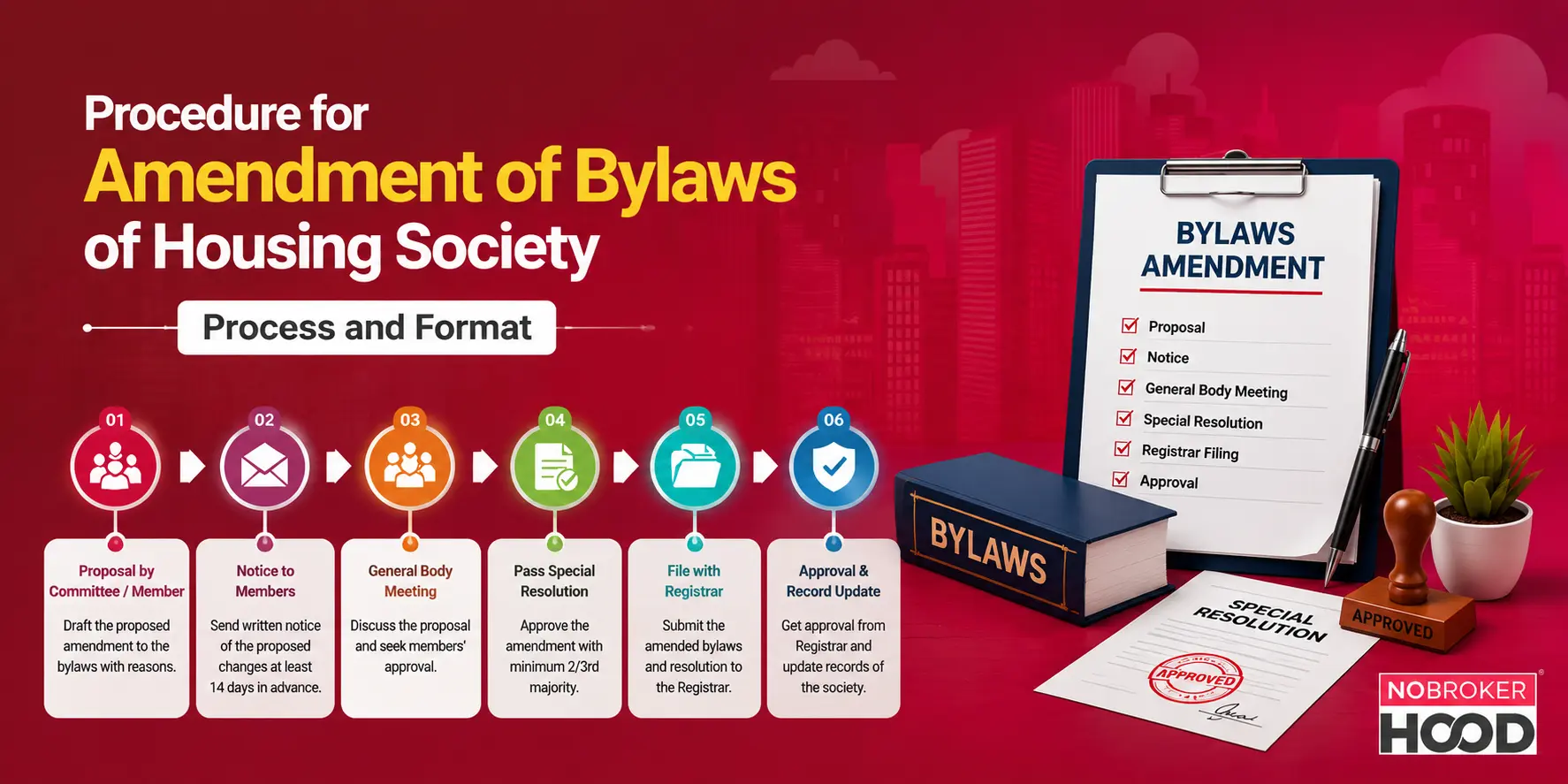


A bylaw amendment format helps a society clearly record what is being changed, why it is required, and how members approved it. To amend bylaws, the society must give 15 days of notice, hold a General Body Meeting, pass the resolution with a two-thirds majority, and then submit the amendment to the Registrar within the given time.

Why Do Housing Societies Need to Amend Bylaws?
Most societies update their bylaws at least once to match new needs or legal requirements. Over time, rules written many years ago may not fit current challenges, such as parking, visitor entry, digital record keeping, maintenance calculations, or safety guidelines.
Common reasons include:
- New government regulations
- Safety requirements for buildings
- Better clarity in day-to-day working
- Requests raised by members
- Improving the accountability of the managing committee
- Digitisation of processes
- Community growth and new facilities
When housing societies follow the proper amendment bylaws co operative society process, decisions become stronger, more transparent, and easier to follow.
Procedure for Amendment of Bylaws of Society in India
The procedure for amendment of bylaws of society is clearly defined under the cooperative society laws in India. It ensures that all members get a chance to review changes before they are approved.
Below is the complete bylaw amendment process explained simply.
Step 1: Give notice for a general body meeting
The society must give at least 15 clear days of notice to all members before the General Body Meeting. The notice should include the text of the proposed amendment and, ideally, the existing wording for comparison. This allows members to understand the change and prepare questions in advance.
It is helpful to attach supporting notes or reasons so that every member sees the purpose behind the suggestion. This brings clarity and reduces confusion during the meeting.
Step 2: Hold the meeting and vote
On the day of the meeting, the society must ensure that a proper quorum is present as stated in its current bylaws. Once the proposal is presented, members can ask questions, discuss the intention behind the amendment, and then vote.
A bylaw amendment requires at least a two-thirds majority of the members present in the meeting. This ensures that major changes are taken with the collective agreement and not by a small group.
Step 3: Submit the amendment for registration
After the resolution is passed, the managing committee must submit the amendment to the Registrar of Housing Societies within the allowed time. Many states require submission within one or two months.
The documents usually include:
- Request letter to the Registrar
- Minutes of the meeting
- Four copies of both the existing and amended bylaws
- Attendance sheet
- List of members who voted in favour
Once the Registrar approves the changes, the updated bylaws become official and must be followed by all members.
Key Elements Included in a Bylaw Amendment Format
A complete bylaw amendment format helps avoid misunderstandings and makes the process smooth for review authorities. A standard format includes:
I. Formal Identification
- Title of the document
- Name of the society
- Registration number
- Date of proposal and adoption
- Reference to the Article and Section being changed
II. Statement of Change
A clear presentation of what is changing. Many housing societies prefer a table format, such as:
- Current wording
- Proposed amendment
- Final text if approved
This helps members compare versions easily.
III. Reasoning
A short explanation of why the amendment is required. It could be for clarity, legal compliance or better management practices.
IV. Documentation of Approval
- Details of the meeting
- Voting results
- Confirmation of two-thirds approval
- Signatures of the Secretary and Chairperson
V. Finalisation
After approval, the society must update the master copy of the bylaws and send the revised version to all members. This keeps everyone informed and avoids confusion in day-to-day functioning.
Practical Tips for Housing Societies When Planning Amendments
Here are simple and useful suggestions for a smooth bylaw amendment process:
- Share the draft with members early so that they have time to understand it
- Conduct a short pre-meeting discussion to address concerns
- Use clear and simple wording
- Maintain proper attendance records
- Keep copies of all notices, reminders, and meeting minutes
- Store the updated bylaws digitally for easy access
These small steps help society maintain transparency and trust.
Bylaw Amendment Format For Housing Society
Title: Amendment to the Bylaws of [Name of the Society]
Society Registration Number: [Reg. No.]
Date of Proposal: [DD/MM/YYYY]
Date of Adoption (if approved): [DD/MM/YYYY]
1. Reference to Existing Bylaw
(Identify the exact Article and Section)
Existing Article: [Article Number]
Existing Section: [Section Number]
Subject: [Short title or topic]
2. Statement of Change
(Show the current text, proposed amendment, and final text clearly)
| Part | Details |
| Current Wording | Paste the exact current text here |
| Proposed Amendment | Explain what is being suggested |
| Final Legal Wording (if adopted) | Write the final revised version of the bylaw |
To understand this clearly,
Current Wording: “Pets are not allowed inside the society premises.”
Proposed Amendment: Allow pets inside the society with basic guidelines.
Final Legal Wording (if adopted): “Pets are permitted inside the society premises. Pet owners must follow safety and cleanliness rules issued by the managing committee.”
3. Reason for Amendment
State why the change is needed. The Example reasons could be:
- To match new government rules
- To remove confusion in the existing text
- To update processes for society's functioning
- To improve transparency or safety
Reason: Write a short justification here.
4. Details of Approval
To be filled after the General Body Meeting
Name of Meeting: General Body Meeting
Date of Meeting: [DD/MM/YYYY]
Quorum Present: [Number of members present]
Resolution Number: [Resolution number]
Voting Outcome:
- Total members present: [Number]
- Votes in favour: [Number]
- Votes against: [Number]
- Two-thirds majority achieved: Yes / No
5. Certification by Office Bearers
We certify that the amendment was discussed and approved in accordance with the existing bylaws and legal requirements.
Secretary Name and Signature: __________________________
Chairperson Name and Signature: __________________________
Treasurer Name and Signature (optional): ___________________
Date: [DD/MM/YYYY]
6. Documents to be Attached for Registrar Submission
Attach in the order listed
- Request letter to Registrar
- Copy of the meeting notice with proof of 15-day notice
- Minutes of the General Body Meeting
- Four copies of the existing bylaws
- Four copies of the amended bylaws
- Attendance sheet of members present
- Voting list of members in favour
- Resolution copy
7. For Registrar Office Use Only
Leave this section blank for the Registrar to fill it.
Received On: __________________
Checked By: __________________
Registered On: _______________
Latest Amendment in Bye Laws of Cooperative Society
Cooperative societies periodically amend their bye-laws to stay aligned with changes in the governing Cooperative Societies Act, evolving member needs, and modern administrative practices. Recent amendments across cooperative housing societies commonly include the following changes:
- Virtual and hybrid meetings: Bye-laws now increasingly permit General Body Meetings (GBMs) to be conducted via video conferencing or in hybrid mode, with provisions for recording attendance and proceedings, making participation easier for members who can't attend in person.
- Provisional membership for legal heirs: On the death of a member, nominees or legal heirs can be admitted as provisional members allowing them to attend meetings and stay involved in society matters while the formal transfer of ownership and voting rights is processed.
- Revised charge-sharing methods: Many societies are moving toward more equitable formulas for splitting charges for example, water charges based on the number of taps/fixtures per unit, and common service charges split equally across all units rather than by area.
- Capped and simplified penal interest: A common reform caps interest on delayed maintenance payments (often around 12% per annum, simple interest), replacing older provisions that allowed higher or compounded rates.
- Mandatory reserve and repair funds: Updated bye-laws typically require societies to maintain minimum contributions to a Sinking Fund and a Repair & Maintenance Fund, ensuring long-term building upkeep isn't left underfunded.
- Higher committee spending limits: Managing committees are being given greater authority to approve routine repair and maintenance expenses without requiring a full General Body vote, reducing administrative delays.
- Recognition of commercial units and associate members: Shops, offices, and other non-residential units within a society are increasingly given clearer membership status, along with defined rights and obligations.
- Faster resolution of vacancies and disputes: Provisions for filling casual vacancies on the managing committee internally (without waiting on the Registrar) and streamlined recovery procedures for unpaid dues are becoming standard.
- Mandatory adoption timelines: Once a Registrar issues updated model bye-laws, societies are typically required to adopt them within a fixed window (often three months) and re-register accordingly.
Manage Your Society's Bylaw Amendment Process with NoBrokerHood
Following the correct procedure for amendment of bylaws of society involves a lot of moving parts notices, drafts, voting records, and Registrar documents all of which need to reach every member on time. NoBrokerHood’s society management app gives managing committees a single digital space to run this entire process without chasing paperwork or relying on scattered WhatsApp groups.
- Digital notices - Send the 15-day GBM notice and proposed amendment draft instantly to every resident's app
- Document repository - Upload and store the current bylaws, proposed changes, and final amended version in one organised place
- E-voting & attendance tracking - Record voting outcomes and quorum digitally, making it easy to confirm the two-thirds majority
- Meeting minutes & resolutions - Log minutes and resolutions directly in the app for easy retrieval during Registrar submission
- Member communication - Keep residents informed at every stage, from draft sharing to final approval, reducing confusion or disputes
- Easy access to approved bylaws - Members can refer to the latest bylaws anytime instead of hunting for physical copies
All Solutions by NoBrokerHood:
