





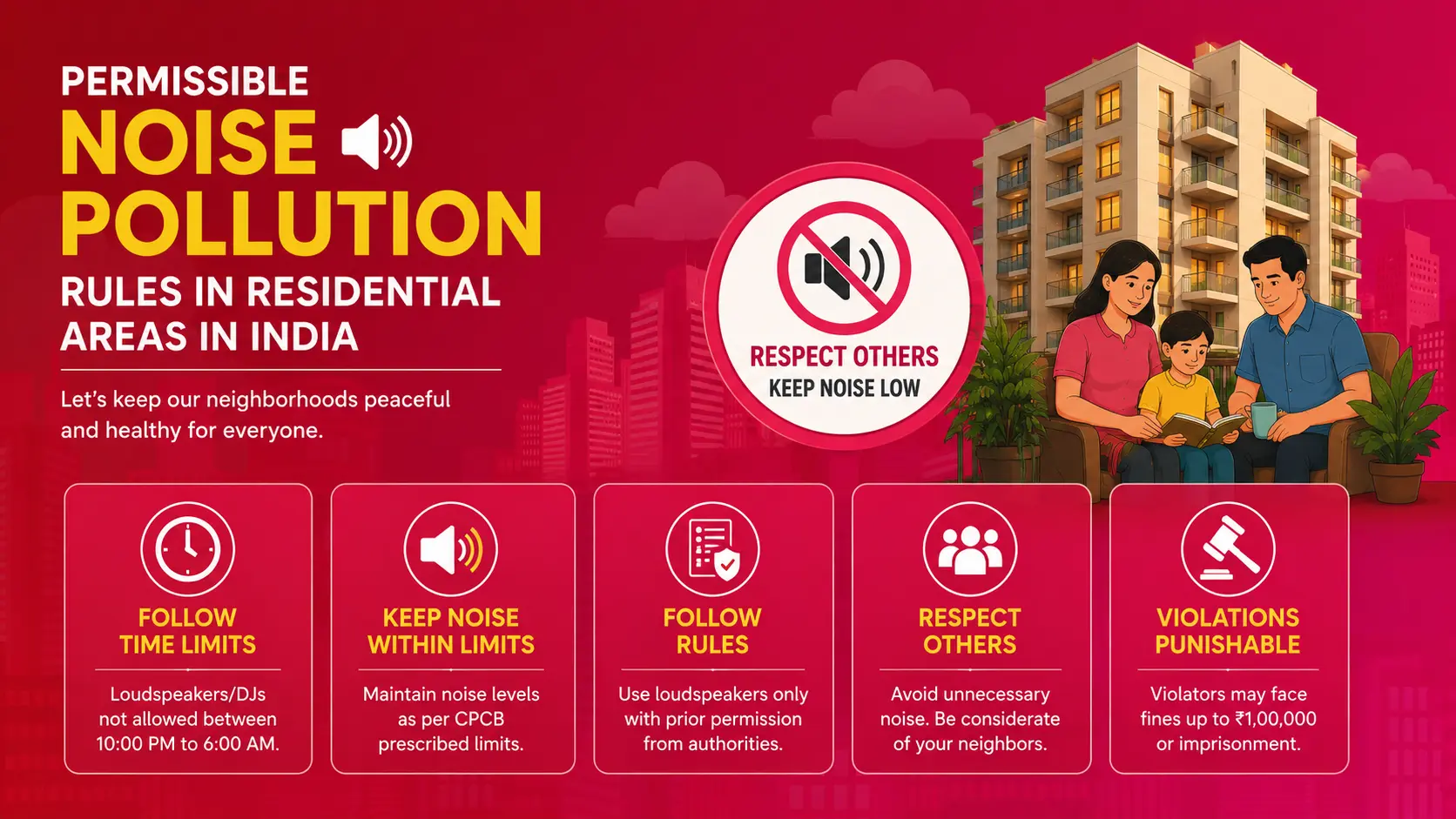


Noise pollution has emerged as a pressing issue in India, especially in densely populated urban residential areas. Noise from traffic, construction, and public events, especially with loudspeakers, often disrupts the peace, affecting the quality of life and health of residents. To address this, the Indian government has introduced noise pollution rules that define permissible noise level in residential area in India to maintain a balanced, healthy environment in residential zones.

This article focuses on the noise pollution rules in residential areas, including their allowed levels, prohibition of loudspeaker usage, and penalties for violation. These will be imparted to the residents to alert them to their rights and their duties, which will surely make for a quieter and healthier community.
What are Noise Pollution Rules in Residential Areas?
In India, permissible noise levels are as stated by the Noise Pollution (Regulation and Control) Rules, 2000. These rules are issued by the Ministry of Environment and Forests. The permissible levels have been set for industrial, commercial, residential, and silent zones. The permissible level varies across these zones, helping maintain peace and protect public health. These levels are rather lower in residential areas.
It stipulates and forms the basis of controlling rules on noise pollution, besides amplifying penalties for those responsible for breaking the rules. For residential areas, especially at night when fewer sounds are reasonably required, these rules have emphasised the provision of a place to sleep.
Top Noise Pollution Rules in Residential Areas
- Maximum noise level: 55 dB during the day, 45 dB at night.
- Loudspeakers are banned from 10 PM to 6 AM without permission.
- Stricter noise limits apply in silence zones like hospitals and schools.
- Violations lead to fines or prosecution under the Sound Pollution Act.
- Enforcement by pollution control boards and magistrates.
- Aimed at protecting health and ensuring a peaceful environment.
Read also: Housing Society Rules and Regulations
Permissible Noise Level in Residential Area in India
Noise pollution measurements are expressed in decibels, and the Noise Pollution Rules in residential areas have specific limits: daytime and nighttime from 10:00 p.m. to 6:00 a.m. Here are the specific limit levels for residential areas against noise pollution:
- The permissible noise level in residential area at day time is 55 dB.
- The permissible noise level in residential area at night time is reduced to 45 dB to facilitate rest and sleep.
These limits are meant to ensure that residential areas maintain a quiet environment free of noise pollution, thus enhancing the health and well-being of residents.
Values are also set to consider the levels of background noise. A quiet neighbourhood may go to 40-50 dB, while a busy street may reach as high as 70 dB or higher. This creates quieter places in residential premises, very vital for health, mental well-being, and comfortable living.
Noise Pollution Act India
The Noise Pollution (Regulation and Control) Rules, 2000, form the main legal framework for controlling noise pollution in India. These rules were notified under the Environment (Protection) Act, 1986, aiming to regulate and control noise from various sources such as industrial activity, construction, generator sets, loudspeakers, and vehicular horns. Together, these sound pollution rules in India specify permissible ambient noise levels that vary by zone:
Sound Pollution Rules in India: Zone-Wise Limits
- Industrial areas: 75 dB (day), 70 dB (night)
- Commercial areas: 65 dB (day), 55 dB (night)
- Residential areas: 55 dB (day), 45 dB (night)
- Silence zones (around hospitals, schools, courts): 50 dB (day), 40 dB (night)
The rules under the Noise Pollution Act prohibit loud noises during night hours (10 PM to 6 AM) without permission and mandate stricter scrutiny and penalties for violations in silence zones.
Authorities like pollution control boards and executive magistrates are empowered to enforce these regulations, including imposing fines or other penalties for non-compliance. These rules under the Sound Pollution Act aim to protect public health and psychological well-being by maintaining ambient noise within permitted limits, especially in sensitive zones such as hospitals, schools, and courts
Limitations of Noise Pollution and the Use of Loudspeakers in Residential Areas
Noise restrictions in residential areas are strictest for loudspeakers, since they're the single largest source of resident complaints during festivals and events. Loudspeakers are one of the most common noise polluters in residential areas. They often cause noise during festivals, religious gatherings, and other celebrations. But the use of loudspeakers in residential areas is highly regulated to prevent any disturbances.
1. Allowed Time Duration
Loudspeakers are allowed to be installed only between 6:00 AM and 10:00 PM in the areas of residential places. Loudspeakers can be used after getting special permission from the district authorities, which is obtained for special purposes only.
2. Noise Levels
Even during permitted hours, the loudspeaker volume has to be kept within the noise pollution limits in residential areas. This rule ensures that people can enjoy the events without disturbing others in the neighbourhood.
Read also: Law Against Noisy Neighbours in India
3. Permissions and Penalties
Permission in advance to use any sound-generating device would also require clearance from local officials. Over and above violations would make them incur losses with heavy fines and repossessed sound emitting devices.
These regulations on loudspeakers again try to achieve a fair balance between the delight of such community events and the silent peace required in residential locations.
How Long Can Construction Noise Last in Residential Areas?
Construction is one of the most common noise complaints in growing residential neighbourhoods, and the rules here are different from the loudspeaker/ambient limits covered above.
- Permitted hours: Most municipal corporations and the Noise Pollution (Regulation and Control) Rules restrict construction activity, including drilling, hammering, and heavy machinery, to daytime hours, generally 6:00 AM to 10:00 PM. Many local bylaws further narrow this to 8 AM to 6 PM in purely residential zones.
- Night-time construction: Construction noise after 10 PM is not permitted without a special exemption from the local municipal body, which is rarely granted in residential zones.
- Duration limits: There's no single national cap on how many days construction noise can continue, since that's tied to the project's approved timeline and permits. But the daily time window is fixed. Construction noise cannot legally continue into night hours, and the equipment used must stay within the 55 dB (day) and 45 dB (night) residential limits covered above.
- How to act on it: Residents can lodge a complaint with the State Pollution Control Board or local police if construction noise continues past permitted hours or exceeds decibel limits. This is the same enforcement mechanism used for loudspeaker violations.
Noise Laws in Apartment Buildings in India
Apartment complexes and gated societies sit at the intersection of two rule sets: the national and state noise pollution rules covered above, and the society's own bylaws.
- Society bylaws layer on top of law, not instead of it: An RWA or management committee can set its own quiet hours, for example, no loud music after 9 PM or no drilling on Sundays, for common areas and individual flats. These bylaws cannot permit anything louder than the legal residential limit of 55 dB during the day and 45 dB at night.
- Common sources inside apartment buildings: DJ and speaker systems at clubhouse events, generator sets, water motors, home renovation work, and vehicle horns in parking areas are the most frequent noise complaints raised within societies.
- Renovation and drilling: Most societies restrict flat renovation noise, such as drilling and hammering, to daytime hours on weekdays, similar to the construction noise rules above, since apartment walls carry sound between units far more than standalone houses.
- Firecrackers during festivals: Bursting firecrackers is a major seasonal noise complaint in apartment complexes, particularly around Diwali. The Supreme Court and various state pollution control boards have restricted firecracker use to specific windows, commonly 8 PM to 10 PM on Diwali and shorter windows on other festivals, and several states permit only green crackers with lower noise and emission output. Firecrackers exceeding 125 dB (AI) at a distance of 4 metres are banned outright under the Environment Protection Act. Societies often reinforce this with their own notices reminding residents to burst crackers only within the permitted hours and only in designated open areas, away from elderly residents, pets, and children.
- Escalation path: Within a society, the usual order is an informal request to the resident, a written complaint to the management committee, and if unresolved, a formal complaint to the local police or pollution control board citing the Noise Pollution (Regulation and Control) Rules, 2000.
Consequences of Violating Noise Pollution Rules in Residential Areas
Failure to comply in residential areas with the rules on noise pollution can cause such consequences legally and socially:
1. Penalties and Enforcement Actions
Noise pollution authorities may impose a fine on an individual or organisation for not exceeding the permissible noise level. For repeated offenders, the law might take it further, even to cause more penalties, and further, even bring criminal charges.
2. Equipment Confiscation
The loudspeakers or other sound equipment that are used without permission or are beyond the limits of noise pollution limits can be confiscated by the authorities in order not to disturb further.
Excessive noise causes community complaints, which triggers interference from the local authorities. Further event restrictions may be imposed on them, or frequent inspections or even warnings for habitual violators.
Health Impacts of Excessive Noise Pollution in Residential Areas
Noise pollution not only interferes with our life but also our health. Chronic exposure to high decibels affects not only physical but also mental health, and residential noise pollution leads to the following health issues:
1. Hearing Loss
Prolonged exposure to more than 85 dB can cause hearing loss. Exposure at lower levels is also a contributing factor, even in residential areas.
2. Sleep Disturbances
Noise pollution leads to sleep quality disruptions and therefore fatigue, distraction in concentrating, and irritability. Poor sleep impairs overall health as well as general activities.
3. Increased Stress and Anxiety
High levels of noise increase the levels of stress, which eventually causes anxiety. Continuous noise affects the body's stress response, leading to hormonal imbalances and mental fatigue.
4. Cardiovascular Diseases
Long-term exposure to noise also causes cardiovascular diseases and hypertension, increasing the rate of heart conditions.
Read also: What Is Considered Excessive Noise in an Apartment?
Streamline Noise Complaint Management & Enforcement in Your Society with NoBrokerHood
Managing noise complaints and enforcing noise pollution rules in residential societies requires efficient coordination between management, residents, and authorities. NoBrokerHood's Society Management System empowers MC members and residents to document, track, and resolve noise-related issues in real-time, ensuring a peaceful living environment for everyone.
How NoBrokerHood Helps Control Noise Pollution in Your Community:
- Digital Complaint Tracking: Residents can instantly report noise violations with timestamps and descriptions; MC members monitor all complaints from a centralised dashboard
- Real-Time Notifications: Send immediate alerts to residents about noise pollution rules, loudspeaker usage windows (6 AM -10 PM), and upcoming enforcement drives
- Complaint History & Documentation: Maintain detailed records of repeated noise violations for legal action and authority reporting
- Automated Escalation: Flag repeat offenders automatically, enabling fair enforcement without bias or delays
- Communication Hub: Share noise pollution awareness campaigns, local rules, and decibel limits (55 dB day/45 dB night) with the entire community
- Visitor & Event Management: Track registered events to ensure loudspeaker usage is within permitted hours and volumes
- Evidence Repository: Store photos, videos, and complaint logs that serve as proof when filing complaints with pollution control boards or local authorities
Reduce noise-related conflicts, improve resident satisfaction, and create a healthier community with digital society management.
All Solutions by NoBrokerHood:
