





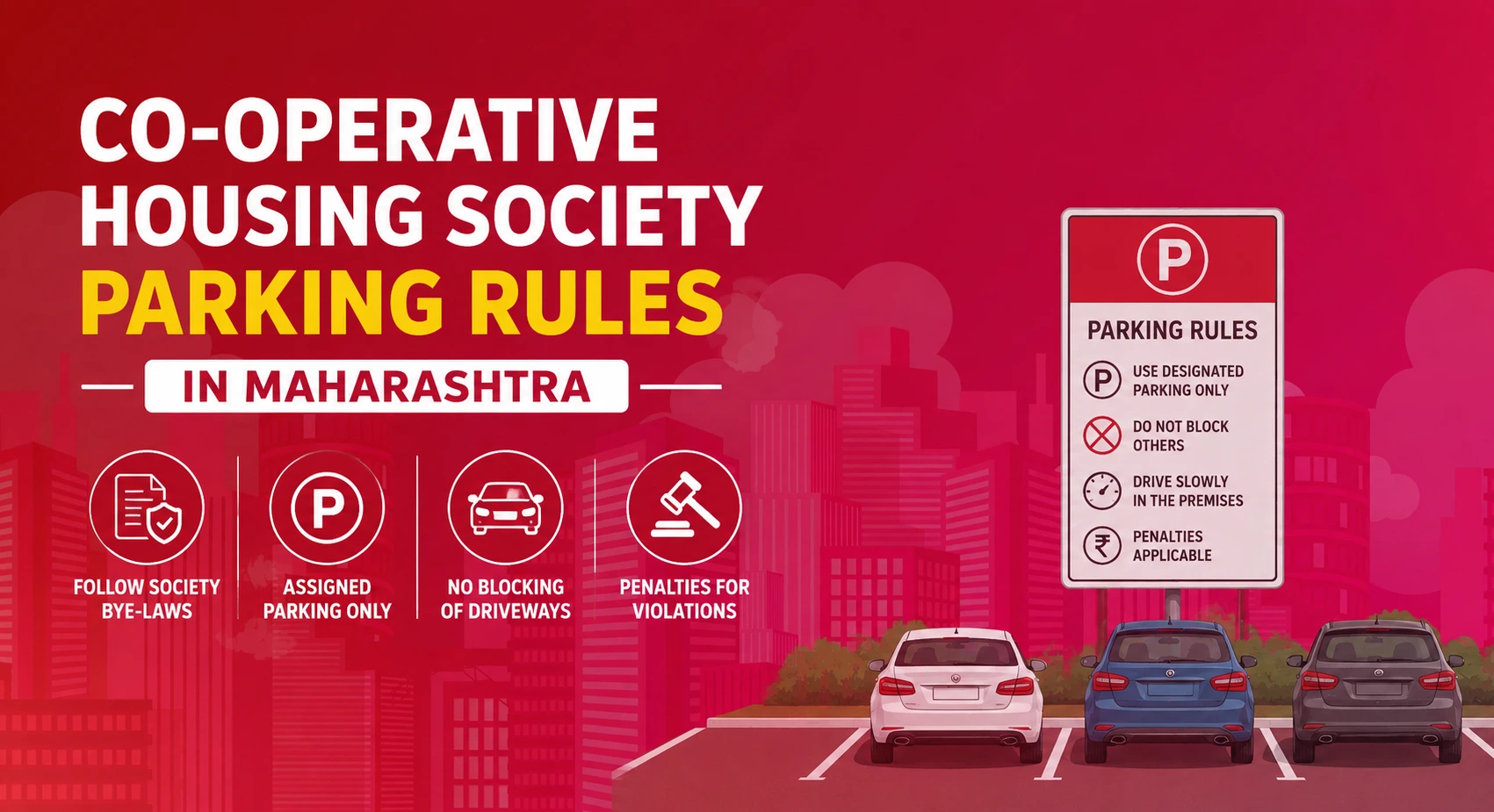


With so many vehicles and limited space, parking in housing societies can easily cause confusion. The co-operative housing society's parking rules in Maharashtra help bring order to that chaos. It made it clear that the society owns all parking areas and ensures that allotment and charges are handled fairly and transparently.

Co-operative Housing Society Act for Parking Rules in Maharashtra
The parking rules under the Co-operative Housing Society Act treat all parking spaces like open, stilt, or covered as common areas owned by the society and not by individual members. The Managing Committee has to allot slots fairly, often through a lottery or rotation system if space is limited. Members can’t sell or transfer their slots, and they must use them only for parking vehicles. Parking charges are decided in the General Body Meeting, keeping things transparent and fair for everyone in the community.
Types of Parking in Society in Maharashtra
Under the Co-operative Housing Society Act, all parking types are common areas owned by the society not by individual members. Here are the main types of parking found in housing societies in Maharashtra:
1. Open Parking
Surface-level, uncovered parking spaces. Most common in older societies. Charges apply even if unused, and slots cannot be claimed as permanent property by any member.
2. Stilt Parking
Ground-floor parking beneath the building, supported by pillars. Cannot be sold as an independent unit by the builder. Allotment is done solely by the Managing Committee.
3. Covered / Basement Parking
Fully enclosed parking, usually in a basement. Limited in number, so allotted via lottery or rotation under Bylaw 80. Higher charges may apply as decided by the General Body.
4. Tandem Parking
Two vehicles parked one behind the other in a single slot. Both vehicles are the responsibility of the allotted member. Society bylaws must define usage to avoid disputes.
5. Visitor Parking
Reserved for guests only cannot be used by residents permanently. Time limits and monitoring are managed by the society or security staff.
6. Two-Wheeler Parking
Separate designated zones for motorcycles and scooters. Charges are lower and fixed independently by the General Body under Bylaw 83.
| Type | Covered | Allotment | Charges |
| Open | No | Managing Committee | Lower |
| Stilt | Partial | Managing Committee | Medium |
| Covered / Basement | Yes | Lottery / Rotation | Higher |
| Tandem | Partial | Managing Committee | Shared rate |
| Visitor | Varies | Not permanent | Nil / Time-based |
| Two-Wheeler | No | Managing Committee | Lowest |
What do the Model Bylaws Say About Parking in Maharashtra Societies?
Parking in Maharashtra’s housing societies is regulated by the Maharashtra Co-operative Societies Act, 1960 and the Model Bylaws (2014). Together, they outline how parking should be owned, allotted, and charged. The bylaws (Nos. 78–84) clearly define members’ rights and responsibilities.
Here’s what the key Bylaws state:
- ByLaw No. 78: All open, stilt, and covered parking spaces belong to the society as common areas. Members cannot claim ownership over them.
- ByLaw No. 79: The Managing Committee must allocate parking spaces based on the availability and number of vehicles owned by members. Priority should be given to those who do not yet have a slot.
- ByLaw No. 80: If demand exceeds availability, slots should be allotted through lottery or rotation system so every member gets fair access.
- ByLaw No. 81: Members are not allowed to transfer or sell their parking slots independently.
- ByLaw No. 82: Parking slots cannot be used for storage or commercial activity. They should be used only for parking vehicles.
- ByLaw No. 83: The General Body decides the parking charges for each vehicle type (two-wheeler, four-wheeler, etc.).
- ByLaw No. 84: The MC must maintain a record of all parking allotments and revise them annually or when members change vehicles.
These bylaws ensure parking remains a shared facility, prevent misuse, and protect residents from unfair practices. Any society following the Co-operative Housing Society Act for parking rules in Maharashtra must refer to these clauses for transparent operations.
Read Also: Tandem Parking
Allotment and Usage of Parking Slots
Here are practical points on allotment and usage of parking slots under these rules:
Allotment:
- A resident or member can apply for a parking slot if they own or use a vehicle.
- The Managing Committee follows the society’s bylaws to allocate. If slots are fewer, they may use a lottery, rotation, or a first-come basis.
- After every eligible member has received one parking slot, the society may allot the remaining spaces as second slots to others who apply.
- Parking slot allocation does not mean you “own” that slot permanently as property. It will still remain as a society’s common area.
Usage & Restrictions:
- Each slot must be marked, numbered and used only for parking, not storage or commercial use.
- The member cannot sell or transfer the slot.
- Tenants are entitled to park if the flat owner’s rights allow it (for example, under a lease); the society cannot unfairly deny them if the flat owner is eligible.
These guide what you can expect and what you should ask for in your society’s parking policy.
How Parking Charges Work in Maharashtra?
Charges form a big part of parking rules and often cause disagreements. Under the Co-operative Housing Society Act, for parking rules in Maharashtra:
- The General Body of the society decides the rate for parking.
- Charges apply even if you don’t use the allotted slot.
- The society may differentiate between two-wheelers, four-wheelers, and additional vehicles.
- The society cannot sell parking slots as independent assets or charge members any extra amount that isn’t approved under the bylaws.
Tips for residents:
- Check your society’s bylaws to see how parking charges are framed.
- Ask for the resolution of the General Body Meeting where parking charges were fixed to ensure transparency.
- If charges appear unreasonable or outside the policy, raise the point in the General Body Meeting.
Maharashtra Car Parking Rules for Housing Societies: Step-by-Step Implementation
Here are practical steps for both residents and managing committees:
- Draft or update the parking policy in a General Body Meeting, referencing bylaws 78–84.
- Label and number all parking slots like open, stilt or covered so each slot is identifiable.
- Publish the procedure for allotment (application, eligibility, waiting list) so all members are aware.
- Fix parking charges in the General Body Meeting, disclose rates for different types of vehicles and whether the owner or the tenant pays.
- Monitor usage and violations. For instance, if someone uses a slot for storage or commercial use. Let the Managing Committee act per policy.
- Circulate the parking rules to all members, display them on the notice board or a digital platform.
These steps help ensure your society abides by the Co-operative Housing Society Act for parking rules in Maharashtra while maintaining harmony among residents.
Read More on: Housing Society Annual Body General Meeting Rules
Common Parking Rules and Management Challenges in Maharashtra Housing Societies
Even when societies follow the Co-operative Housing Society Act for parking rules in Maharashtra, parking management can still become a source of confusion and conflict. From a shortage of space to unclear rules, these challenges are best addressed with clear processes and communication.
Here are some common parking challenges and ways to solve them:
1. Limited parking space
Problem: Older housing societies were designed when fewer residents owned vehicles. Now, multiple vehicles per flat create pressure on limited slots.
Solution: Use a rotation or lottery system for fair access, as suggested under Bylaw 80. Encourage residents to use nearby rented parking if possible, and review parking allocation yearly.
2. Unfair or unclear allotment
Problem: Members feel allocation favours certain flats or friends of the committee.
Solution: Adopt a transparent policy approved by the General Body. Display allotment lists on the notice board or digital apps like NoBrokerHood to maintain fairness.
3. Unauthorised usage or encroachment
Problem: Residents, tenants, or guests park in other members’ slots or occupy common driveways.
Solution: Mark all slots clearly, maintain a parking log, and enforce penalties for repeated misuse as per society’s bylaws. Use digital tracking for entry and exit if feasible.
4. Disputes over parking charges
Problem: Members disagree on why they are charged even without using a slot, or on higher rates for four-wheelers.
Solution: Ensure all charges are approved in a General Body Meeting and mentioned in the maintenance bill under a separate head. Transparency prevents confusion.
5. Storage or misuse of a parking space
Problem: Some members store furniture, cycles, or unused items in parking areas.
Solution: Refer to Bylaw 82, which allows only vehicle parking. MC can issue a written warning or reclaim space for community use.
6. Visitor parking disputes
Problem: Guests occupy members’ slots, leading to arguments and inconvenience.
Solution: Reserve a few visitor slots and regulate them through watchmen or community apps. For larger societies, use entry logs to manage time limits.
7. Poor communication between members and the committee
Problem: Members are unaware of policies or feel unheard.
Solution: Share all parking-related updates digitally, keep a grievance register, and review complaints monthly.
By addressing these common parking challenges proactively, societies can maintain harmony and ensure all residents benefit fairly under the Co-operative Housing Society Act for parking rules in Maharashtra.
Read More on: Apartment Parking Issues and Solutions
Manage Society Parking Digitally with NoBrokerHood
Knowing the parking rules is one thing, implementing them fairly across your entire society is another. NoBrokerHood's Parking Management System makes parking allotment, charges and compliance simple, organised and fully digital for both Managing Committees and residents.
What you can do:
- Digitally assign and track open, covered and stilt parking slot allotments for all members
- Collect parking charges transparently as part of monthly maintenance billing without manual follow-ups
- Maintain and revise parking allotment records annually as required under Bylaw 84
- Monitor visitor parking entries and exits in real time through the app
- Raise and resolve parking complaints or disputes directly between residents and the Managing Committee
- Send parking-related notices and rule updates to all residents instantly without physical circulars
- Eliminate paperwork during General Body Meetings when parking charges or allotment rules are revised
All Solutions by NoBrokerHood
