





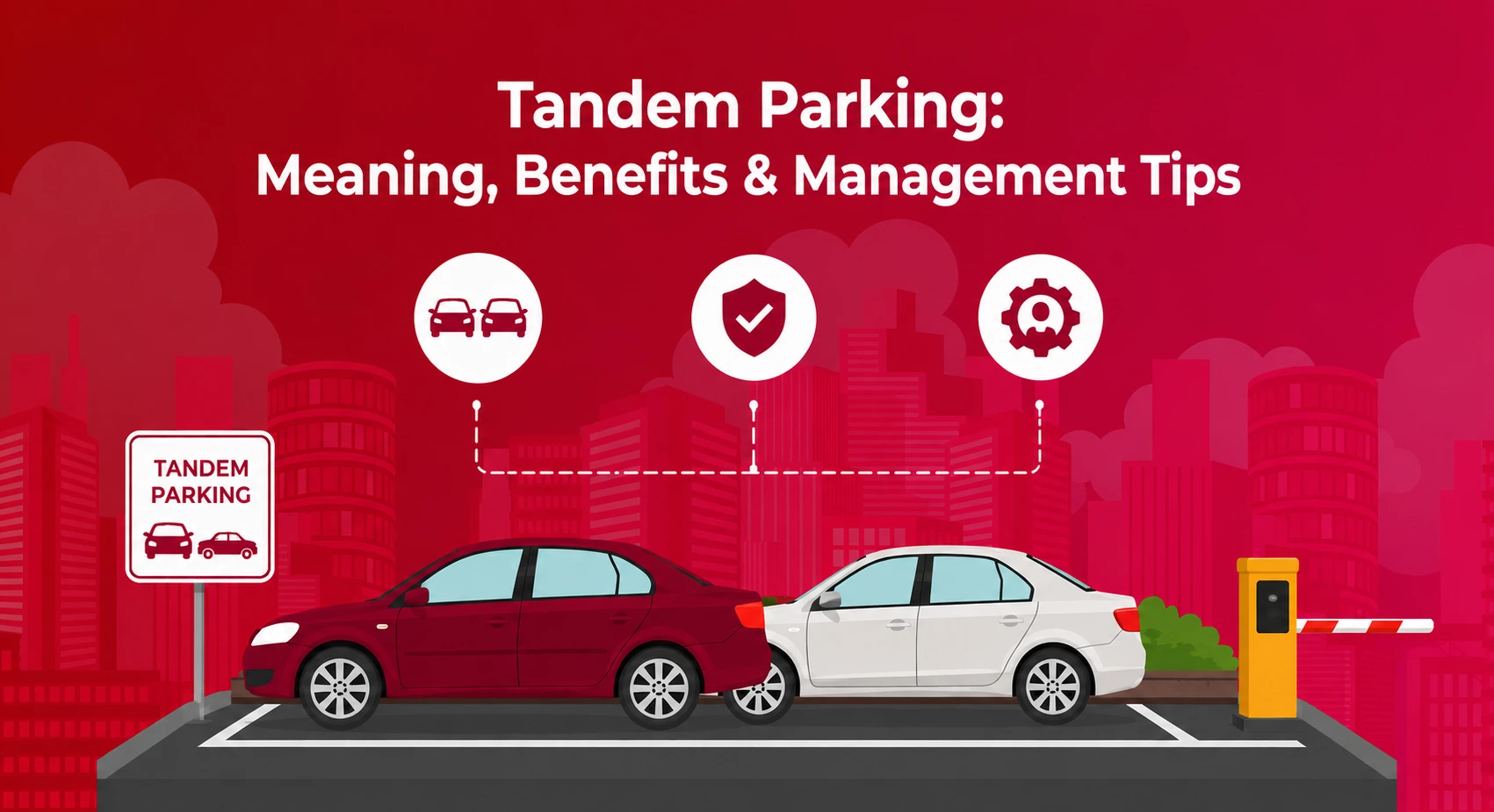


Tandem parking refers to a unique car parking arrangement where two or more vehicles are parked one behind the other instead of side by side. Tandem car parking is commonly seen in residential complexes, office buildings, and urban areas where space is limited. While it can be a practical solution to maximize parking areas, it comes with its own set of benefits and challenges. Through this blog, let’s dive deep into tandem parking meaning, explaining its need, benefits, issues, and tips for management. If you are someone who is struggling with car parking issues, this guide will help you understand how tandem car parking can be a practical solution.

What is Tandem Parking?
Tandem parking is a parking arrangement where two or more vehicles are parked one behind the other in a single elongated space, rather than side by side. It is a practical and space-saving solution commonly used in housing societies, apartment complexes, and urban areas where parking space is limited. Despite requiring coordination between users, tandem parking effectively maximises available space and accommodates multiple vehicles without the need for additional land or infrastructure.
Tandem Parking vs. Side-by-Side Parking: What's the Difference?
| Feature | Tandem Parking | Side-by-Side Parking |
| Layout | Cars parked one behind the other | Cars parked next to each other |
| Access | Rear car blocked until front car moves | Both cars can enter/exit independently |
| Space Required | Less width needed | More width needed |
| Coordination Needed | Yes, especially if cars belong to different people | No |
| Convenience | Lower - can cause delays | Higher - quick, independent access |
| Cost/Space Efficiency | More space-efficient, often cheaper | Less space-efficient, often pricier |
| Best For | Households sharing both cars, tight urban lots | Multiple unrelated users, priority on convenience |
| Common In | Older buildings, dense urban housing, driveways | Modern apartment complexes, larger lots, dedicated garages |
Why Do People Need Tandem Parking?
Parking problems have become a universal challenge, especially in cities where space is limited, and the number of vehicles continues to grow. Here’s why tandem car parking is becoming a necessity:
1. Space Constraints
In densely populated areas, conventional parking systems are often impractical due to lack of space.
2. Cost Considerations
Constructing separate parking slots for every vehicle can be expensive for property developers and residents.
3. Growing Demand
With more families owning multiple cars, the need for creative parking solutions like tandem parking has grown significantly.
By using tandem car parking systems, property owners can cater to the parking needs of multiple residents without overhauling their infrastructure.
Benefits of Tandem Car Parking
Tandem parking isn’t just a compromise, it’s a smart and effective solution to parking challenges. Here’s why:
1. Optimizes Space Utilization
Tandem parking allows two or more vehicles to fit in a single elongated space, doubling the capacity without requiring additional land.
2. Reduces Costs
Building fewer, larger parking bays for tandem parking is more economical than creating separate slots for every vehicle.
3. Adds Value to Properties
Properties offering tandem car parking arrangements appeal to buyers and tenants as they provide additional parking options at a reasonable cost.
4. Encourages Collaboration
Shared parking spaces encourage residents or employees to coordinate and communicate, fostering a sense of community.
Also Read: Two wheeler parking rules in housing society
What are the Tandem Parking issues?
While tandem car parking is an excellent solution for space constraints, it isn’t without challenges. Understanding these issues is key to addressing them effectively.
1. Coordination is Key
Since one vehicle blocks another, users must coordinate well to ensure smooth access. A lack of communication can lead to frustration.
2. Time-Consuming
Retrieving the car parked at the back means moving the front car first. This can be inconvenient, especially during rush hours.
3. Limited Accessibility
Elderly individuals or people with disabilities may find it challenging to manage tandem parking setups due to the physical effort involved.
4. Vehicle Size Matters
The dimensions of the tandem parking space must accommodate all vehicle sizes. Larger cars like SUVs may pose a challenge in standard-sized tandem slots.
How Much Tandem Parking Space is Required?
The tandem parking space dimension is crucial for its functionality. These dimensions depend on the number and type of vehicles it will accommodate. Below is a breakdown of the typical tandem parking size:
1. Standard Tandem Parking Dimensions for Two Vehicles
- Length: 30 to 40 feet: A typical sedan requires about 15-18 feet in length. To accommodate two vehicles parked one behind the other, a tandem parking space should be at least 30 feet long. If the cars are larger, such as SUVs, this length should be extended to 35-40 feet.
- Width: 8 to 10 feet: The standard width of a parking spot is around 8 feet, which suffices for most vehicles. However, wider spaces of up to 10 feet may be needed for larger cars or to make parking easier for less experienced drivers.
2. Tandem Parking Dimensions for Larger or Multiple Vehicles
If the tandem parking setup is designed for three or more vehicles or to include larger vehicles like vans or trucks, the length should increase proportionally. For instance:
- Three vehicles: Tandem Parking size should be around 50-60 feet.
- Larger vehicles: Additional length and width may be necessary, with the length exceeding 20 feet per vehicle.
Also Read: EV Charging in Apartment
Considerations When Planning Tandem Parking Dimensions
1. Vehicle Types
Know the size of the vehicles the parking lot will accommodate. Compact cars require less space, whereas larger vehicles like SUVs and trucks need more room.
2. Manoeuvring Space
While tandem parking spaces are elongated, the area surrounding the parking lot must allow enough room for vehicles to maneuver comfortably.
3. Accessibility
Ensure there’s adequate clearance for opening doors and unloading passengers or cargo. This is especially important for parking spots near walls or other barriers.
4. Inclination or Obstructions
The space must be free of inclines, pillars, or other obstructions that could restrict parking or retrieving vehicles.
How to Manage Tandem Parking Effectively
Managing tandem car parking doesn’t have to be a headache. By adopting a systematic approach, you can ensure a hassle-free experience for all users.
Before diving into specific steps, it’s important to understand that the key to managing tandem parking lies in planning and communication. Both users and administrators must align their efforts to create an efficient system.
Steps for Effective Management
1. Set Clear Rules
Define guidelines for using the space, such as who parks where and how to handle situations when one vehicle needs to be moved. Having written rules minimizes misunderstandings.
2. Schedule Parking
Use digital tools or apps to coordinate parking times. These tools notify users when their car needs to be moved, making the process seamless.
3. Prioritize Size and Usage
Allocate tandem parking slots based on the size and frequency of vehicle usage. For example, assign spaces closer to the exit for users who need frequent access.
4. Add Security Features
Install CCTV cameras, proper lighting, and automated gates to ensure the safety of vehicles and users in tandem parking areas.
5. Educate Users
Conduct workshops or share tutorials to familiarize users with tandem parking etiquette, ensuring smoother day-to-day operations.
Types of Tandem Parking Setups
Depending on the level of automation, tandem parking systems can be categorized into two types. Let’s explore both to understand which one suits different needs better.
1. Manual Tandem Parking
In this traditional setup, vehicles are parked manually, requiring drivers to coordinate and move cars as needed. While it’s cost-effective, it depends heavily on user cooperation and time management.
2. Automatic Tandem Parking Systems
Advanced technology has revolutionized tandem parking with automated systems that eliminate manual effort. These systems use mechanical lifts, turntables, or robotic platforms to move vehicles efficiently.
Benefits of Automated Tandem Parking:
For automated tandem parking setups, the space required may be less because mechanical systems like lifts or turntables optimize the arrangement. However, you still need to ensure enough room for the installation and operation of these systems.
- Minimal user intervention.
- Faster retrieval times.
- Increased safety with reduced chances of human error.
Tandem Parking as a Solution to Parking Problems
The rapid urbanization of cities has led to a significant increase in the number of vehicles, making parking spaces harder to find. Tandem parking meaning is rooted in the idea of maximizing limited space, making it a perfect solution for such scenarios. Allows more residents to park their vehicles without expanding the premises in residential complexes.
Tandem parking ensures that property developers, residents, and businesses alike can meet their parking needs without overburdening their budgets or infrastructure.
Simplifies Tandem Parking Management with NoBrokerHood
NoBrokerHood offers an intuitive parking management solution designed to simplify tandem parking in residential societies. It provides real-time notifications to coordinate vehicle movement, enhanced security through CCTV integration, digital tools to schedule and manage parking slots, and automated alerts to ensure a smooth and hassle-free parking experience for all residents.
| Feature | What NoBrokerHood Offers |
|---|---|
| Real-Time Notifications | Alerts residents when their vehicle needs to be moved |
| Parking Slot Management | Digital tools to schedule and allocate tandem parking spaces |
| Security Integration | CCTV cameras and automated gates for vehicle safety |
| Coordination Support | Seamless communication between residents for smooth access |
| Community Management | Centralized platform to manage parking rules and guidelines |
All Solutions by NoBrokerHood:
