





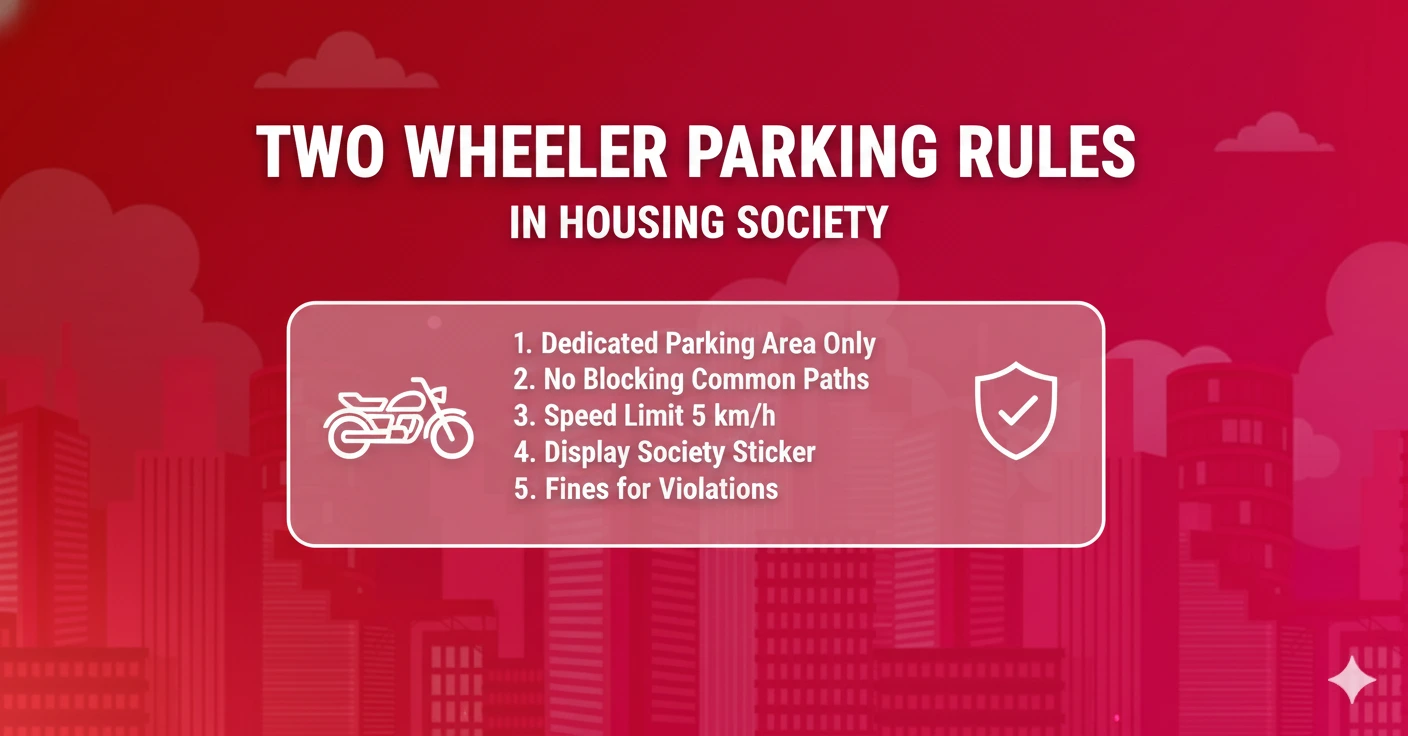


Each two-wheeler needs at least 1.25 square meters of parking space in housing societies. Four-wheelers require 13.75 square meters according to the National Building Code. Many residential complexes face parking issues because standardized reserve parking rules in society don't exist, which leads to random parking habits.

Housing societies must keep 5% of their parking space for visitor parking in apartments. This requirement comes directly from parking norms. The Real Estate Regulatory Authority (RERA) Act of 2016 makes it clear that builders cannot charge extra for parking spaces since they count as common amenities.
Two Wheeler Parking standard Size
The standard parking space for a two-wheeler (motorcycle or scooter) is typically 1.2 m x 2.25 m (approximately 4 ft x 7.4 ft), though this can vary slightly based on local building codes and municipal parking regulations. Some guidelines specify a slightly more compact size of 0.75 m x 2 m for scooters and smaller bikes, while larger motorcycles may require closer to 1.5 m x 2.5 m to accommodate handlebar width and comfortable maneuvering space.
When designing a parking layout, it's also important to factor in:
- Aisle width for two-wheeler movement, usually kept between 1.5 m and 2.5 m depending on whether parking is angled or perpendicular
- Circulation space to allow riders to safely enter and exit without obstructing neighboring vehicles
- Angled parking (30°- 45°), which is often preferred for two-wheelers as it maximizes the number of vehicles per unit area compared to perpendicular parking
These dimensions are commonly referenced in urban planning and building bylaws (such as India's URDPFI guidelines), but you should always check your local municipal or authority-specific parking norms, as exact requirements can differ by city or country.
Two Wheeler Parking Standards in India
"According to the National Building Code (parking regulations in residential areas in India), one parking space for a four-wheeler must be at least 13.75 square meters. In the case of two-wheelers, it must be at least 1.25 square meters." — Times Property, Real estate information platform
Housing societies need the right parking space dimensions to help vehicles move smoothly and make the best use of space. The National Building Code sets clear minimum space requirements for different types of vehicles.
A two-wheeler's standard parking space needs 1.25 square meters at minimum. Each parking slot requires a width of 1.2 meters and length of 2.5 meters that fits most motorcycles.
Everything in parking space requirements breaks down like this:
| Vehicle Type | Minimum Area | Standard Dimensions |
| Two-Wheeler | 1.25 sq m | 1.2m x 2.5m |
| Four-Wheeler | 13.75 sq m | 2.5m x 5m |
Driveways that connect parking areas need a minimum width of 3 meters so vehicles can move easily. The design should leave enough space between parking slots. Two-wheelers specifically need about twice their length to maneuver properly.
The Ministry of Housing and Urban Affairs requires residential premises to provide 2 Equivalent Car Spaces (ECS) for every 100 square meters of floor area. This means 3BHK apartments get one parking space while 4BHK units get two spaces.
Also Read: How Parking System Works In A Gated Society
Two Wheeler Parking Rules in Housing Society - Space Allocation
Housing societies use two main methods to allocate two-wheeler parking spaces among residents. The first method works on a first-come-first-serve basis for all unsold and available spaces. This ensures fair distribution among eligible vehicle-owning members.
Each member can park only one vehicle in their designated space. The Managing Committee assigns parking spaces only to registered members, which includes family and associate members.
Societies with space constraints use a yearly lottery system. Many communities have implemented a rotation-based system that ensures all residents get fair access.
Here are the key eligibility criteria for parking allocation:
- Tenants can access parking spots if their landlords are eligible
- Members must display parking stickers or ID cards for vehicle identification
- Additional vehicles need the Managing Committee's approval
- Commercial vehicles face restrictions in residential complexes
Societies must keep 5% of their total parking area for visitor parking in apartments. Time limits apply to these visitor spaces to prevent extended use. Some communities need guest vehicles to register in advance.
Societies mark and number different zones for bicycles, two-wheelers, and four-wheelers to manage parking effectively. Members who want extra parking slots can submit annual applications. This depends on availability and whether other eligible members are waiting for their first slot. No you can easily manage, solve and eliminate all the parking related problems with NoBrokerHood Parking Management System.
Key Two Wheeler Parking Rules in Housing Society
Housing society management committees set clear two wheeler parking rules in housing society to keep everyone safe. These rules focus on authorized usage and give all residents fair access to parking facilities.
Residents can only park their vehicles in spots assigned to them. The management committee must approve any extra vehicle parking, even when space is available. Every parking area needs proper markings and numbers that separate two-wheelers, four-wheelers, and bicycles.
Here are the key two wheeler parking rules in housing society:
- All vehicles need valid society-issued parking permits
- No parking allowed in unmarked or unauthorized areas
- Residents can't modify or cover their parking spots
- Reckless driving inside society premises is not allowed
Tenants get the same parking rights as permanent residents if their landlords qualify for parking spaces. The management committee uses a penalty system to deal with violations, especially when someone parks without permission or misuses common areas.
These rules help prevent conflicts and keep parking operations smooth. The society can tow away vehicles that break institutional rules at the owner's cost. Multiple violations could lead to extra penalties or temporary loss of parking rights.
Also Read: EV charging in society
Two Wheeler Parking Rules in Housing Society - Enforcement and Penalties
- Monetary fines are an effective way to ensure compliance with two-wheeler parking rules and discourage unauthorized parking
- Housing societies use a structured fine system with penalties that increase for repeat violations
- Fines act as a stronger deterrent than verbal warnings, while also contributing to society maintenance funds
- Rules apply equally to residents and their guests; flat owners are responsible for parking violations committed by their visitors
- Societies must clearly communicate all parking rules to residents
- The managing committee can suspend or cancel parking privileges for continued violations
- Vehicles blocking pathways or parked in restricted areas may have their wheels locked or be towed away
- All fines collected go into the society's welfare fund
- This system helps maintain discipline and supports community development
- Rules must be implemented fairly and transparently to avoid conflict among residents
Two Wheeler Parking Rules in Housing Society - Best Practices for Residents
Good two-wheeler parking practices create harmony in residential communities. We focused on safety and security to protect your vehicle and show respect to fellow residents.
Your two-wheeler needs to be parked in well-lit areas under surveillance cameras. Covered parking spaces work best for long-term parking. A strong security system has high-quality chains and locks that secure your vehicle to fixed anchor points 600mm above ground level.
This detailed guide explains security measures:
| Security Feature | Purpose | Recommendation |
| Lighting | Visibility | Well-lit areas |
| Anchoring Points | Vehicle Security | 600mm height rails |
| Surface Type | Stability | Non-slip, even ground |
| Space Buffer | Damage Prevention | 2-3 feet between vehicles |
Your bike's stand should not sink into wet or uneven surfaces. A minimum gap of 2-3 feet between motorcycles prevents domino-effect accidents effectively.
Good parking etiquette means you should avoid roadside or curb parking, respect designated spaces, and keep pathways clear for pedestrians. Park your two-wheeler at 45 degrees in car-sized spots to maximize visibility and use space efficiently. Multiple locking mechanisms boost security during extended parking periods, and parking near other motorcycles helps too.
Check out these pages to know more about different types of parking options.
| Tandem Parking: A Complete Guide |
| What is Podium Parking and How It is Different From Stilt Parking |
| Stilt Parking: Understanding The Modern Parking Solution |
Simplify Two Wheeler Parking Management with NoBrokerHood
Manually tracking parking permits, visitor slots, and rule violations can quickly become a headache for Managing Committees and a source of daily friction for residents. NoBrokerHood's Parking Management System takes the guesswork out of enforcing two-wheeler parking rules, giving your society real-time visibility and automated control over every parking space.
- Real-time slot availability - Residents and security staff can instantly check which two-wheeler spots are free or occupied
- Automated entry/exit logging - Every vehicle movement is recorded via camera and verification tools, reducing disputes over unauthorized parking
- Visitor parking made easy - Guests can book slots in advance, keeping your mandated 5% visitor parking area organized and time-bound
- CCTV & sensor-based monitoring - Detect unauthorized parking or rule violations as they happen, not after the fact
- Instant violation alerts - Get notified the moment someone parks outside their assigned spot or overstays a visitor slot
- Centralized admin dashboard - MC members can manage permits, approvals, and fines from a single panel instead of paper records
- Built for multi-level parking - Scales easily for larger societies with tiered or multi-level two-wheeler parking zones
- Usage analytics & reports - Track peak parking hours and slot occupancy to plan better allocation over time
All Solutions by NoBrokerHood
