





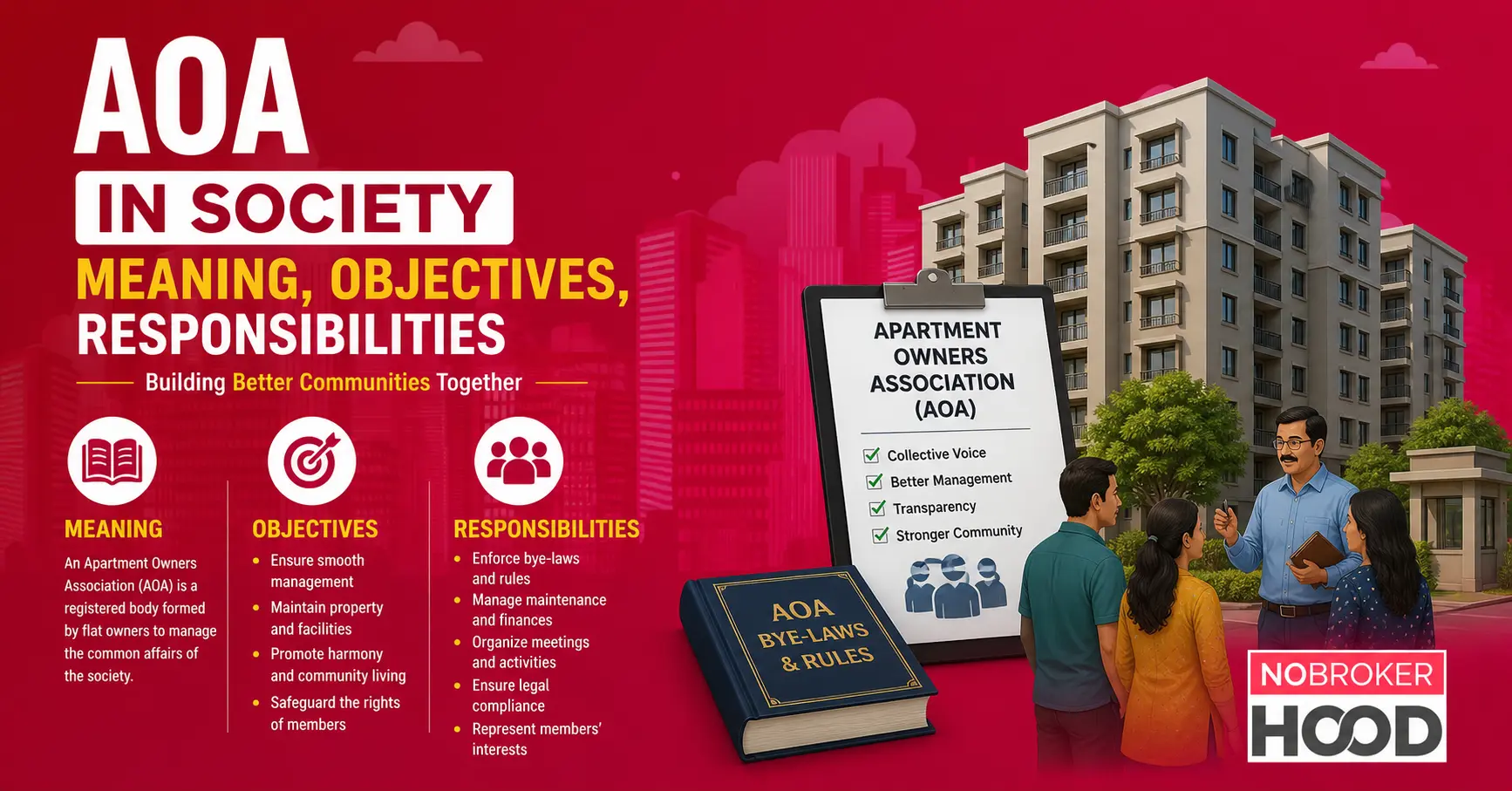


Managing a residential community is never just about living under the same roof; it’s about creating a space that feels organised, safe, and fair for everyone. That’s precisely where an Apartment Owners Association (AOA) steps in. An AOA acts as the backbone of an apartment community, ensuring smooth maintenance, transparent financial management, and peaceful coexistence among residents. Without a legally registered AOA, even the most well-planned housing society can struggle with disputes, confusion, and mismanagement.

This blog walks you through everything you need to know about an AOA in society: its meaning, structure, responsibilities, and the process of forming and registering one. Whether you’re a homeowner, committee member, or someone preparing to set up an AOA, this guide is your starting point.
What is AOA in Society?
An Apartment Owners Association is a legally recognised group formed by apartment owners to manage and maintain a housing society. The term carries significant legal significance because AOAs derive their authority from the Apartment Ownership Acts enacted by various states in India. These acts empower the association to oversee common areas, enforce rules, maintain records, and collect funds.
In simple terms, the AOA's meaning in society is that of a democratic body. It represents homeowners collectively, ensures everyone’s voice is heard, and works in the best interests of the entire community. Every major decision goes through the AOA, making it central to society's governance.
Objectives and Functions of an AOA in Society
The core purpose of forming an AOA is to create a structured system for managing daily operations in a housing complex. Although every community has its own way of functioning, most associations tend to look after a few core responsibilities, such as:
Key Roles of the AOA
- Maintenance management: Ensuring regular upkeep of lifts, water systems, generators, pathways, gardens, and other shared spaces.
- Fund collection: Handling maintenance fees, sinking funds, and emergency funds in a transparent, accountable manner.
- Community welfare: Promoting initiatives that improve quality of life—be it security enhancements, events, or sustainability projects.
Responsibilities of AOA Members
- Managing essential facilities such as security, waste disposal, and water supply
- Overseeing repair and renovation work within the society
- Enforcing society bylaws and ensuring residents follow community rules
- Resolving disputes between owners or between residents and the management
- Keeping financial and administrative operations transparent
A well-functioning AOA creates a culture of accountability. It ensures that the money collected from residents is utilised responsibly and every decision is made through a democratic process.
Structure and Composition of an AOA Society
Every AOA usually follows a standard administrative structure to ensure smooth functioning. While the number of members may differ by society size, the core committee typically includes:
- President: Heads the association, oversees meetings, and makes key decisions.
- Secretary: Handles records, documentation, communication, and coordination.
- Treasurer: Manages society finances, maintenance billing, and accounts.
- Committee Members: Support decision-making and take responsibility for various sub-areas, such as amenities, security, and cultural activities.
Members of the AOA are elected through voting at a general body meeting. Their tenure usually lasts one or two years, depending on the bylaws. The association also conducts periodic conferences and maintains detailed minutes to ensure clarity and proper record-keeping.
Read More on: Society Treasurer Roles and Responsibilities
Apartment Association Members Roles and Responsibilities
An apartment owners association (AOA) runs a housing society according to a set of rules and regulations, usually laid out in its bye-laws and the state's Apartment Ownership Act. These rules apply to every owner and resident, and they keep the community orderly, safe, and fairly managed.
Membership and voting
Every flat owner is a member of the association, with voting rights on major decisions such as budgets, repairs, and committee elections.
Maintenance charges
Owners must pay monthly or quarterly maintenance and sinking fund contributions on time, and late payments may attract interest or penalties.
Managing committee
The committee is elected by members, holds regular meetings, and is responsible for accounts, vendors, and day-to-day administration.
Use of common areas
Rules govern parking, lifts, clubhouse, terraces, and gardens, so that shared spaces are used fairly and not blocked or misused.
Alterations and renovations
Structural changes, balcony enclosures, or exterior modifications usually need prior written approval from the association.
Rental and resident conduct
Owners who rent out their flats must follow tenant registration rules, and all residents must follow norms on noise, pets, waste disposal, and visitors.
Dispute resolution
Conflicts over dues, violations, or committee decisions are handled through internal mediation, arbitration, or the registrar and courts.
Difference Between RWA and AOA
| Point of Difference | Apartment Owners Association (AOA) | Resident Welfare Association (RWA) |
| When It’s Formed | Formed after the apartment ownership deeds are registered. | Formed during the early possession stage, usually when the developer still manages the property. |
| Legal Backing | Governed by the State’s Apartment Ownership Act. | Registered under the Societies Registration Act. |
| Primary Purpose | Manages common areas, enforces bylaws, handles finances, and oversees maintenance. | Focuses on welfare, community-building activities, and basic coordination. |
| Legal Authority | Holds stronger legal authority for maintenance, disputes, and financial decisions. | Has limited legal power and mainly acts as a welfare body. |
| Control Over Common Areas | Full authority to manage common spaces, assets, and shared facilities. | Limited or no legal control over common property. |
| Role in Dispute Resolution | Can legally enforce rules and resolve disputes based on bylaws. | Can mediate disputes but cannot enforce legally binding decisions. |
| Member Eligibility | Only apartment owners can become members. | Both owners and residents (in some cases, tenants) may participate. |
| Scope of Work | Operational, administrative, financial, and legal responsibilities. | Community welfare, cultural events, and basic coordination. |
| When It Becomes Essential | After the builder handover and deed registration. | During builder occupancy or interim phases before formal AOA formation. |
Read Also: How to form Resident Welfare Association
Steps for AOA Society Registration
Registering an AOA involves a series of formal steps. Once property ownership is established, the association can be legally registered by following these procedures:
- Drafting the AOA bylaws: These rules outline responsibilities, election procedures, membership norms, and financial policies.
- Collecting ownership documents: Compiling sale deeds or proof of ownership from members.
- Preparing the Memorandum of Association (MOA): This document includes the objectives, details of the committee members, and information about the society.
- Submitting documents: All paperwork is submitted to the Registrar of Cooperative Societies or the designated Apartment Ownership Authority (varies by state).
- Approval and certificate: Once verified, the authority issues an official registration certificate.
It’s essential to ensure the entire process complies with your state’s specific apartment ownership act to avoid delays or rejection.
Read Also: Housing Society Registration
Legal Documents Required for AOA Registration
To complete the registration process smoothly, the following documents are typically required:
- Sale deeds or ownership proof of all participating members
- Identity proofs such as Aadhaar or PAN
- Building plan and occupancy certificate
- Society’s memorandum and drafted by-laws
- Minutes of the general body meeting approving the AOA formation
Accurate and complete documentation can significantly speed up approval.
Common Challenges Faced by AOAs
Even after registration, many AOAs face operational roadblocks, such as:
- Low owner participation during meetings or elections
- Poor record-keeping or financial mismanagement
- Disputes between committee members and residents
- Lack of digital tools, leading to manual errors in maintenance billing or communication
These issues can affect trust, transparency, and the overall functioning of the society.
Read Also: Haryana Apartment Ownership Act 1983
Simplify Apartment Management by NoBrokerHood Apartment Management System
Tools like NoBrokerHood Apartment Management System help societies run efficiently by automating most administrative tasks. Designed specifically for gated communities, it brings together everything an AOA needs into a single, seamless platform.
This is how it helps:
- Digital accounting & maintenance collection
- Automated visitor and security management
- Complaint ticketing and tracking
- Staff and facility management
- Polls, announcements, and communication tools
If your AOA wants smoother operations and more transparency, adopting NoBrokerHood is an effortless way to make society management smarter and stress-free.
All Solutions by NoBrokerHood
