





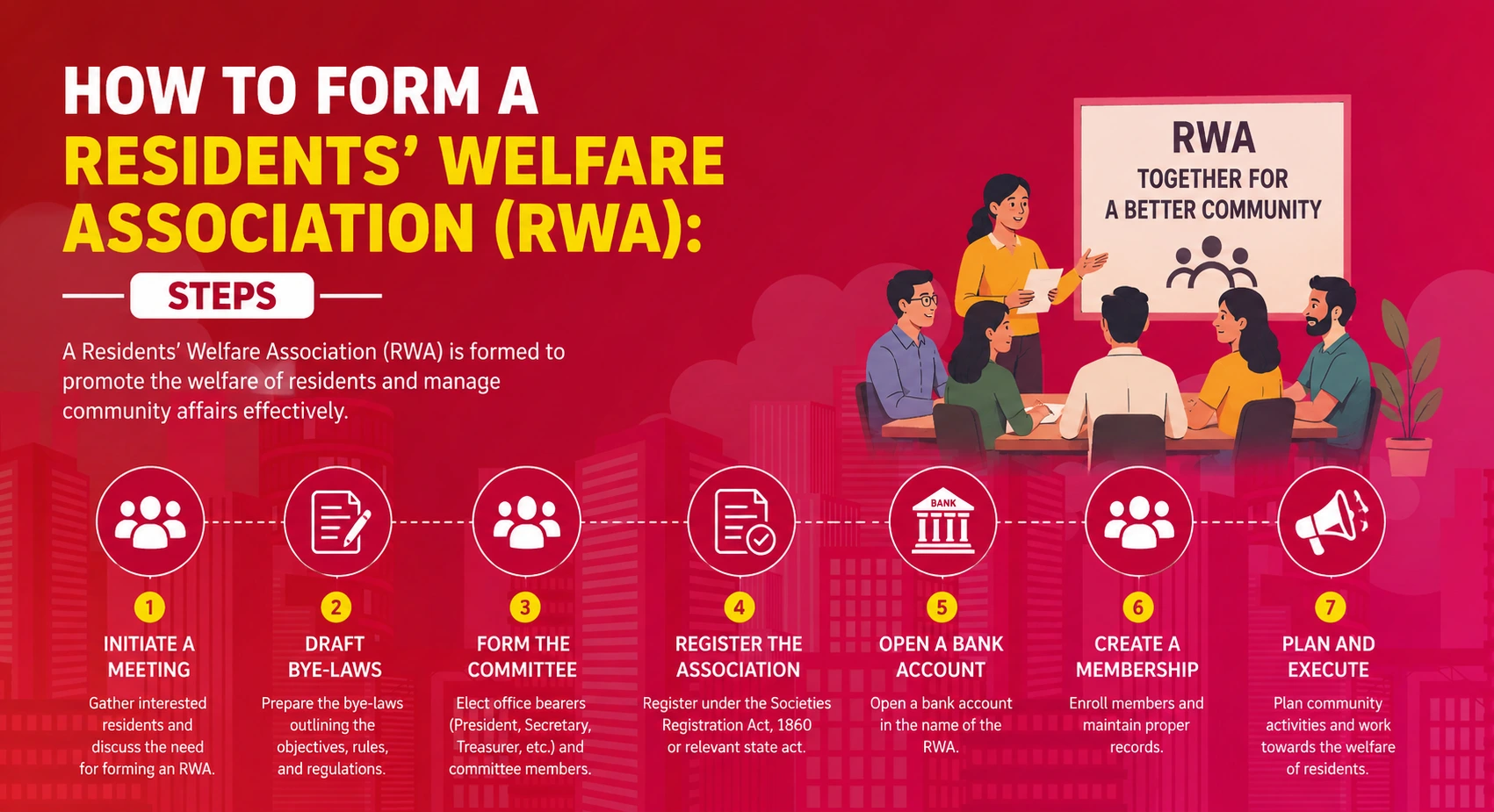


To improve the quality of life in your society, the first step is forming a Residents’ Welfare Association (RWA). It is a group of responsible residents who come together to manage and enhance community living. An RWA ensures cleanliness, safety, and proper management of resources. To form one, start by gathering like-minded residents who care about the community. Make your apartment living smooth and comfortable with NoBrokerHood

Once resident welfare association registration is done, they can address key issues like waste management, security, and maintenance while fostering a sense of community. It’s not just about solving problems but about creating a well-managed and harmonious living space for everyone.
What is Resident Welfare Association ?
A Resident Welfare Association (RWA) is a registered, voluntary body formed by residents of a housing society, apartment complex, or residential colony to manage common amenities, maintenance, security, and day-to-day administration of the community. RWA stands for "Resident Welfare Association," and it also represents residents' collective interests before builders, municipal authorities, and local government bodies.
An RWA is also commonly known as a residents association, welfare association, or residential welfare society; these terms are used interchangeably across India, though "RWA" remains the most widely recognised term for housing societies and apartment complexes.
Forming an RWA gives residents a legally recognised platform to resolve disputes, manage shared funds transparently, and ensure smooth, organised community living.
State-Wise Legal Framework
RWA formation in India is regulated under different laws depending on the state:
| State / Union Territory | Relevant Act | Notes |
| Karnataka | Karnataka Apartment Ownership Act (KAOA) | Recommended for apartment owners’ associations |
| Maharashtra | Maharashtra Ownership Flats Act (MOFA) | Governs apartment societies and registrations |
| Tamil Nadu | Tamil Nadu Societies Registration Act | Used for registering housing societies |
| Delhi / NCR | Societies Registration Act, 1860 | Used for RWA registration in non-apartment societies |
| Others | State-specific Apartment/Cooperative Societies Act | Minimum member requirements may vary |
Minimum Members Required:
- Typically 7 founding members from the same state for RWA.
- For Buyers Association at state or central level, requirements may differ; check local regulations.
Check Also: Societies Registration Act 1860 Delhi
Resident Welfare Association Registration Process
The Resident Welfare Association registration process involves a series of clearly defined legal steps from forming a founding group of residents to obtaining official recognition from the Registrar of Societies. Whether referred to as RWA registration, welfare association registration, or residential association registration, the core process remains largely the same across Indian states, with minor variations as per local regulations.
Here's how the RWA registration process works, step by step:
Step 1: Form a Founding Group
Bring together at least 7 residents of your society or apartment who share a common goal of improving community living.
Step 2: Draft a Memorandum of Association (MoA)
This foundational document includes the society's name, its objectives, and details of the founding members.
Step 3: Create Bye-Laws
Bye-laws act as the rulebook covering membership guidelines, election procedures, financial policies, and dispute resolution mechanisms.
Step 4: Submit Documents to the Registrar of Societies
File the MoA, bye-laws, and required documents (ID proofs, address proof, affidavits) along with the registration fee. Once approved, the RWA gains legal recognition.
Step 5: Elect Office Bearers
After registration, members elect a President, Secretary, and Treasurer to manage the association.
Step 6: Open a Society Bank Account
This ensures financial transparency for maintenance funds, salaries, and other expenses.
Step 7: Begin RWA Operations
With legal formalities complete, the RWA can start managing common areas, security, and resident concerns.
Read Also: Housing Society Registration Process
Document Required for RWA Registration
- Covering Letter.
- List of Body members (name, Full address, Occupation and Signature on the list).
- Address proof of all Body Members (Voter ID/Aadhar/Driving License).
- Address proof of Society Registered Address (Utility Bill/ Rent agreement with NOC from Owner).
- PAN card of all Body members.
- Memorandum and Bye-Laws of the proposed Association.
- One Affidavit from the President (on stamp paper, notarized).
- Power of Attorney.
- Building Completion certificates issued by concerned authority (if apply for Apartment owners association in some states).
- Builders Consent and/or Representation (if apply for Apartment owners’ association in some states).
- Home Registry copy (apply for RWA formation only).
- Buyers Association Essential requirement: If form at State Level – minimum 7 body members from same state OR format central Level: Minimum 7 members from each state.
- RWA/Apartment Owners Association Essential requirement: Minimum 7 body members from the same state. In case of AOA, this minimum number varies state to state as per the state apartment ACT.
How to Form Resident Welfare Association - Steps
Residents’ Welfare Association is like a mini-government for your society, ensuring everything runs smoothly. By following these steps, a residential society can do an RWA registration that works for the welfare of all residents.
Step 1: The first step is to bring together at least seven residents of your apartment or society, who share a common goal of improving their living conditions.
Step 2: Draft a Memorandum of Association (MoA). This document is like the foundation of your RWA. It must include details like the society’s name, its objectives, and information about the founding members.
Step 3: Create Bye-laws as it acts as the rulebook in the formation of a resident welfare association. These cover membership guidelines, election procedures, financial policies, and dispute resolution mechanisms.
Step 4: Submit the MoA and bye-laws to the local Registrar of Societies, along with the required documents and registration fees. Once approved, the RWA gains legal recognition.
Step 5: After registration, the members must elect key representatives, such as a President, Secretary, and Treasurer, who will be responsible for running the association smoothly.
Step 6: Now, the next step is to open a Housing Society Bank Account. It ensures financial transparency, manages maintenance funds, salaries, and other expenses efficiently.
Step 7: Once all legal formalities are completed, the RWA can start its duties, such as maintaining common areas, ensuring security, and addressing residents’ concerns.
Residents Welfare Association Rules and Regulations
These rules are framed to ensure smooth functioning of the society, maintain harmony among residents, and safeguard common facilities. All members, tenants, and their guests are expected to adhere to the following guidelines.
- Membership: Mandatory for all owners; one vote per unit; tenants need owner NOC
- Maintenance: Pay charges by the 10th of each month; late fees apply for delays
- Common Areas: No personal storage or alterations without committee approval
- Parking: Park only in allotted spots; no blocking fire lanes/driveways
- Security: Register all visitors, vendors, and domestic help at the gate
- Noise: No loud music/construction between 10 PM – 7 AM
- Pets: Keep leashed in common areas; owners clean up after them
- Renovation: Prior written permission needed; work only 9 AM – 6 PM
- Waste: Segregate wet/dry waste; dispose only in designated bins
- Meetings: AGM held yearly; committee elected periodically; accounts audited
- Grievances: Submit complaints in writing; resolved within 7 working days
- Penalties: Fines for violations; repeated breaches restrict amenity access
Read more: Residents Welfare Association Rules
Check out the roles and responsibilities of other members in the society:
| Roles and Responsibilities | |
| Secretary | Housing society secretary responsibilities |
| Treasurer | Role of treasurer in housing society |
| Tenants | Housing Society Rules and Regulations for Tenants |
What does the Residents’ Welfare Association do?
With great power comes great responsibility. Here’s a closer look at what an RWA must do to ensure a well-functioning society. By fulfilling these responsibilities, an RWA helps create a secure, fair, and well-managed living environment for everyone.
1. Ensure Transparency
Transparency is key to maintaining trust among residents. An RWA must keep proper records of all financial transactions, decisions, and policies. This includes maintaining receipts for maintenance collections, details of expenses, and updates on society projects. Regular financial reports should be shared with residents so that everyone knows how funds are being used.
2. Act Fair
Every resident, whether an owner or tenant, should be treated equally. RWAs must avoid favouritism in decision-making, whether it’s related to parking allocations, maintenance requests, or dispute resolution. Fairness builds harmony and trust within the community.
3. Be Accountable
Accountability means taking responsibility for the decisions made by the RWA. This is best done by holding regular general body meetings (GBMs) along with Annual General Body Meeting, where residents can voice their concerns and receive updates on ongoing projects. Minutes of these meetings should be documented and shared with everyone to ensure complete transparency.
4. Plan for the Future
A good RWA doesn’t just focus on daily management but also thinks ahead. This includes implementing long-term initiatives like installing solar panels to reduce electricity costs, setting up rainwater harvesting systems to manage water scarcity, or creating green spaces to improve air quality. Future planning helps build a sustainable and well-maintained community.
5. Ensure Safety
One of the most crucial responsibilities of an RWA is to ensure the safety of all residents. This means working closely with security agencies, installing CCTV cameras, setting up emergency response teams, and ensuring proper lighting in common areas. It also includes coordinating with local authorities to enhance law enforcement in the neighbourhood.
Common Challenges During RWA Formation
- Uncooperative Builders or Residents: Delays in asset handover or a lack of resident support can slow down registration.
- Issues with the Deed of Declaration (DOD): Missing signatures or errors can cause legal problems or delays.
- Towers Without Occupancy Certificates (OC): Including unapproved towers can create legal and operational issues.
- Choosing the Wrong Legal Act: Picking the wrong act may lead to conflicts and compliance issues.
Mitigation Tips
- Consult a legal advisor to review the MoA, Bye-laws, and DOD for compliance.
- Check occupancy certificates (OCs) and asset handover before including any towers.
- Involve residents early through meetings to explain responsibilities and gather consensus.
- Maintain proper records of approvals, meeting minutes, and handovers for transparency.
Templates and Resources
- Sample MoA and Bye-laws to help structure the RWA governance.
- RWA Registration Checklist to make sure all documents and signatures are in order.
- Government and NGO Resources for guidance, legal advice, and model documents.
Read Also: Societies Registration Act Andhra Pradesh
Digitize Your New RWA from Day One with NoBrokerHood
Registering your RWA is just the beginning, running it smoothly day-to-day is the real challenge. NoBrokerHood's Society Management System helps newly formed RWAs digitize operations from day one, making it easy for Managing Committees and residents to stay organised and transparent.
What you can do:
- Securely store and access your MoA, bye-laws, and registration documents in one digital repository
- Maintain a complete member database with owner/tenant details, contact info, and voting eligibility
- Conduct transparent online elections for office bearers like President, Secretary, and Treasurer
- Collect maintenance charges digitally and track financial transactions with full transparency
- Send instant notices, circulars, and AGM/GBM updates to all residents without physical paperwork
- Manage visitor entries, security staff, and complaints through a single app
- Generate ready audit reports and meeting minutes for compliance and record-keeping
All Solutions by NoBrokerHood:
