





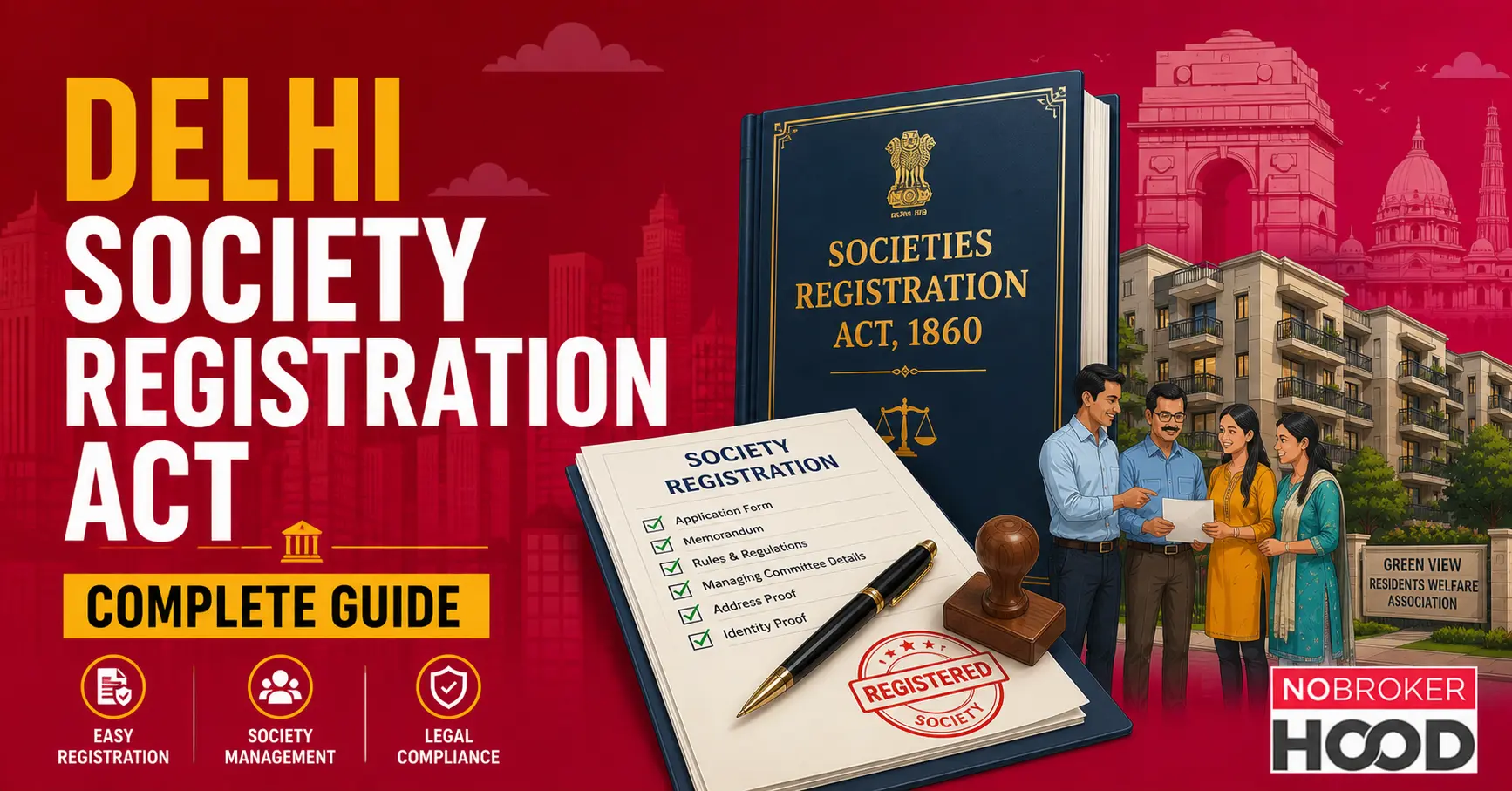


If you want to set up a formally registered society in Delhi, the Societies Registration Act, 1860 (as applicable in Delhi), gives a clear legal framework. This guide explains what the law requires, how to register, and how housing societies or Resident Welfare Associations (RWAs) can benefit from it.

Why Registration under the Delhi Society Registration Act is Important?
Registering your society under the Delhi Society Registration Act is not just paperwork, it's what gives the community real framework. Here's why it matters:
- Legal identity: When a society is registered it becomes a legal entity. The society can own property, make contracts, sue or be sued. It does not act as individuals; it acts as the society itself.
- Non-profit nature: The society must pursue aims such as charitable, literary scientific, educational or social welfare. The society cannot distribute profit among its members.
- Structured governance:The society must have a governing body, like a committee or board that manages the society’s affairs. For a community or residential society this structure provides transparency, clear roles and proper accountability. It helps with maintenance, decision‑making and legal clarity.
For a community or residential society, this ensures transparency, defined roles, and proper accountability, which help in maintenance, decision-making, and legal clarity.
Who Can Form a Society: Eligibility Under Delhi Society Registration Act
To register under the Delhi Society Registration Act, you need:
- At least seven people need to come together. The law allows any seven or more persons to form a society.
- Common purpose: The objectives should be non-profit (charity, education, community welfare, culture, etc.) and not for generating profits for members.
- Registered office within Delhi: The registration is handled by the local Registrar of Societies, so the society’s official address must be within the NCT of Delhi.
If you are a resident in a housing society or a community of flats and neighbourhoods, this structure works well since families already join together for shared needs.
Read also: Delhi Apartment Ownership Act 2009
Key Provisions under the Delhi Society Registration Act
When you register, these are some important features the law enforces:
- The society must be a non-profit. No member can claim profit from the society’s assets on dissolution.
- The society’s work should be handled by a defined governing body like a Committee, Council, or a group of Directors, as set in the MoA and rules. The MoA must be supported by bylaws that guide membership, meetings, financial audits, decisions, and the process to close the society if ever required.
- Each year, the society must provide an updated list of the governing body (office-bearers) to the Registrar.
These provisions ensure the society remains transparent and accountable, which is important for residents to trust a housing society’s governance.
Societies Registration Act 1860 Delhi Rules and Regulations
- A society must be formed by a minimum of seven persons associated for a literary, scientific, charitable, educational, or welfare purpose.
- The society's registered office must be located within the National Capital Territory of Delhi.
- A Memorandum of Association (MoA) must be filed, stating the society's name, objectives, and the names, addresses, and occupations of the governing body.
- A copy of the Rules & Regulations (bylaws) must be filed along with the MoA, covering membership, meetings, audits, and dissolution procedures.
- Identity and address proof of all founding members must be submitted with the application.
- Proof of the registered office must be provided, such as ownership documents, or a rent agreement with a No Objection Certificate if the premises are leased.
- An affidavit from the president or secretary must confirm the chosen name and the members' consent.
- The proposed name must not be identical or similar to that of an existing registered society.
- The name must not suggest government affiliation or use restricted emblems under the Names and Emblems (Prevention of Improper Use) Act, 1950.
- The society must be managed by a governing body, such as a committee, council, or board, as defined in its bylaws.
- No profit or asset of the society may be distributed among its members, even upon dissolution.
- Any surplus funds must be applied toward the society's stated objectives.
- The society must file an updated list of its governing body with the Registrar every year.
- Proper financial records and accounts must be maintained at all times.
- A registration fee must be paid at the time of filing, originally set at ₹50, though current rates should be confirmed with the Registrar's office.
Society Registration in Delhi: Step-by-Step Process
If your community or group wishes to register under Delhi Society Registration Act, here’s a typical process flow:
Choose a unique name
- The proposed name must not conflict with the existing registered societies.
- The name should not suggest any link to a government body or use restricted emblems as stated in the Names and Emblems (Prevention of Improper Use) Act, 1950.
Document Required for society registration in Delhi
- A formal application letter requesting registration.
- Two sets of Memorandum of Association (MoA) specifying the society name, objectives, address, and names, addresses, and occupations of the founding members or governing body.
- Two sets of Rules & Regulations (bylaws) detailing how the society will function (membership criteria, meetings, decision-making, audit, dissolution, etc.).
- Identity and address proofs of all founding members (Aadhaar, passport, voter-ID, etc.)
- Proof of registered office address (ownership documents or rent agreement + NOC from landlord if rented) for the society’s registered office.
- An affidavit on non-judicial stamp paper, signed by the President or Secretary, should confirm the selected name and the member's consent. Notarization may be needed in some states.
Submit the application to the Registrar
The application should be submitted to the district-level Registrar of Societies under whose jurisdiction the registered office falls.
Society Registration Fees in Delhi
Pay the prescribed registration fee as per state rules. The original Act mentions Rs. 50, but states may update fees.
Verification & Issuance of Certificate
The registrar reviews the submitted documents. If everything is in order, a certificate of registration is issued. The society now becomes a legally registered entity.
Post-Registration Compliance
- Maintain proper financial records and books of account.
- Prepare for internal audits if required.
- File an updated list of the governing body annually with the Registrar.
Read also: How to Register Your Housing Society in 2025
Online Society Registration in Delhi
- Visit the e-District Portal - Go to Delhi's official e-District website https://edistrict.delhigovt.nic.in/.
Create an Account - Register with your basic details to get a login ID. - Fill the Application Form - Enter society details, member information, and objectives online.
- Upload Documents - Attach scanned copies of the MOA, Rules & Regulations, ID/address proofs, and office proof.
- Pay the Fee Online - Pay the ₹2,000 registration fee through the portal's payment gateway.
- Submit the Application - Review and submit; you'll receive an acknowledgment/reference number.
- Track Status - Use the reference number to track approval status on the portal.
- Download Certificate - Once approved, the Certificate of Registration is issued and can be downloaded from the portal.
How to Check Society Registration Online in Delhi?
You can check society registration online in Delhi through the Delhi Registrar of Societies portal by tracking your application status or verifying an existing society's registration details.
Steps to check:
- Step 1 - Visit the official Delhi Registrar of Societies website.
- Step 2 - Select the application status or society search option.
- Step 3 - Enter the application number, society name or registration number.
- Step 4 - View the status (pending, approved or registered) along with the registration details.
If the society does not appear online, or the status is unclear, you can request verification or a certified copy from the Registrar's office.
Society Registration Certificate Download Delhi
After your society is approved, you can complete the society registration certificate download in Delhi from the Registrar of Societies portal. The certificate is the official proof of your society's legal existence and is needed for opening a bank account, applying for 12A/80G exemption and receiving grants.
Steps to download:
- Log in to the Delhi Registrar of Societies portal with your application ID.
- Check that the status shows "Approved" or "Registered."
- Click the certificate option and save the PDF.
Verify the society name, registration number and address on the certificate. If the download option is not working, you can request a certified copy from the Registrar's office.
Benefits of Registering Under the Delhi Society Registration Act
Registering under the Delhi Society Registration Act offers practical benefits:
- Legal clarity: The society can own property such as common areas or a community hall, manage bank accounts, and enter into agreements to handle maintenance, repairs, and shared costs.
- Transparent governance: With defined rules and a governing body, decisions around maintenance fees, usage of common facilities, and community rules become transparent.
- Accountability: Members have clarity on conduct, audits, and dissolution norms, avoiding disputes.
- Credibility: A registered society gains legitimacy when dealing with banks, government agencies, or service providers for utilities, maintenance contracts, and other similar services.
For residents, this structure ensures smoother community living and fair governance.
Practical Tips Before You Begin Registration
- Choose your founding members carefully: Ensure they are residents, have valid identification or address proofs, and share a clear, common goal.
- Draft clear, realistic objectives: Make sure the objectives in the MoA reflect your society’s welfare, maintenance, culture, and common facility management. Avoid overly vague or ambitious objectives.
- Keep documentation ready: Identity proofs, address proofs, office address proof, and No Objection Certificate (if the office premises are rented).
- Define bylaws that suit your society: Make practical membership rules, maintenance dues collection, managing committee roles, and meeting norms.
- Compliance plan: Annual filing of the governing body list and basic record-keeping should be built into your routine.
If your society has features of a co-operative structure, consider whether the Delhi Co-operative Societies Act, 2003 applies, and ensure your objectives align accordingly
Digital Solutions for Society Management by NoBrokerHood
Running a residential society smoothly means staying compliant with the Societies Registration Act while managing daily operations efficiently. NoBrokerHood's society management app simplifies this with digital tools for records, communication, and overall governance.
| Requirements under the Act | How NoBrokerHood Supports |
| Maintain Records and Documents | Stores all key society documents like agreements, NOCs, minutes, resolutions, and certificates digitally. |
| Transparent Financial Management | ERP for billing, maintenance, ledgers, automation of dues, and downloadable audit-ready reports. |
| Notice & Communication | Share updates instantly with a digital notice board, send push notifications, and collect member decisions through polls. |
| AGM / Meeting Compliance | Schedule meetings, share agendas, circulate minutes, and gather quorum via polls. |
| Access for Members | Residents can access society rules, policies, and bylaws using the app. |
| Complaint & Dispute Handling | A centralised complaint system helps with tracking, escalation, and resolution history. |
| Visitor & Security Management | Register vendors, service staff, and contractors to ensure security compliance. |
| Digital NOC & Approval Workflow | Capture digital approvals, permissions, and NOCs for renovation, commercial use, etc. |
| Role-based Access | Helps define and restrict access based on management hierarchy and roles. |
| Transparency & Audit Trail | Every action is recorded with a timestamp, creating a clear and accountable history. |
All Solutions by NoBrokerHood:
