





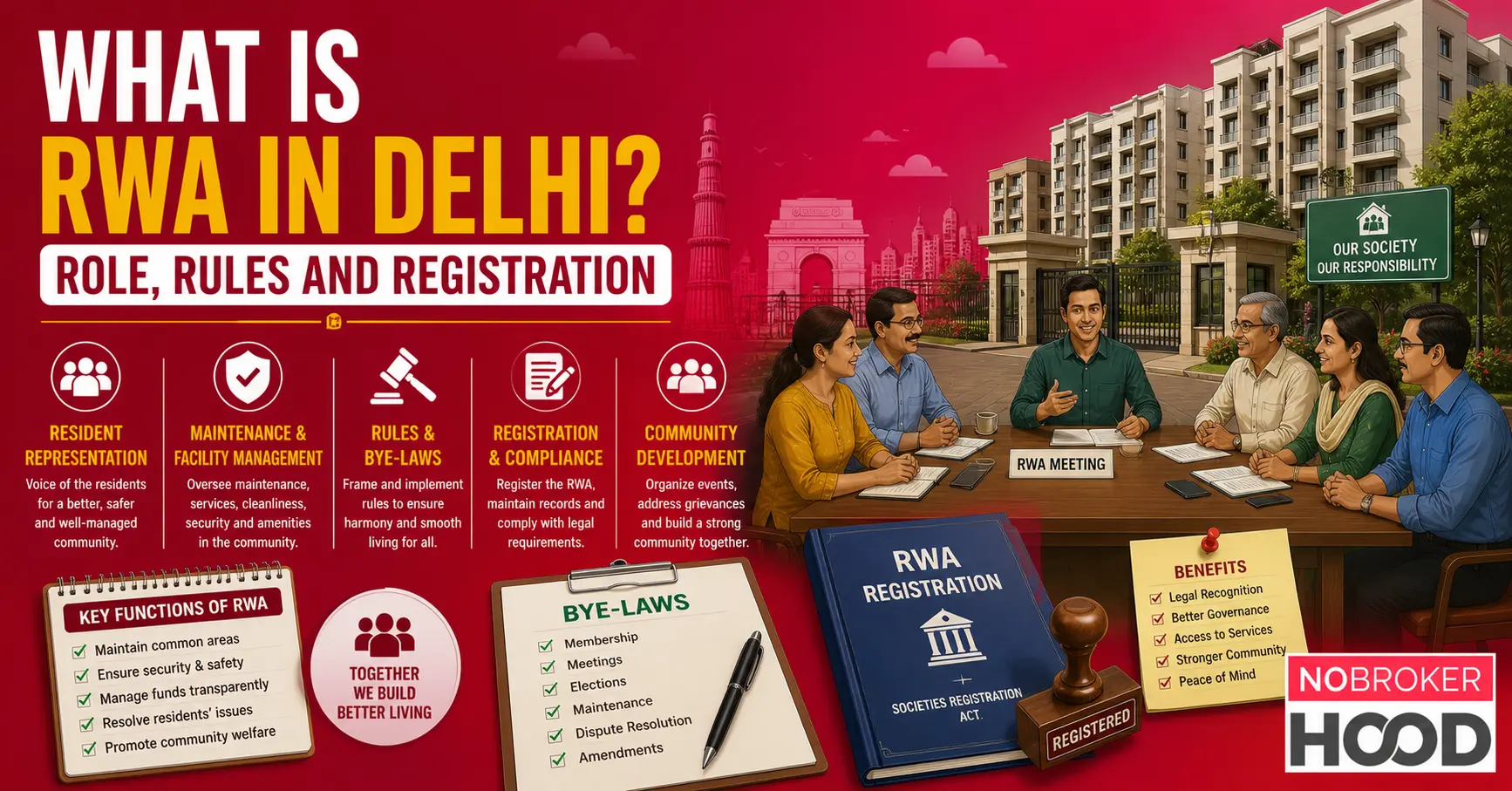


A Resident Welfare Association in Delhi is a registered community body formed by residents to manage common facilities, address civic issues, and coordinate with government authorities. These associations play a key role in maintaining neighbourhood order, safety, finances, and everyday community needs across Delhi.

What is RWA in Delhi?
A Resident Welfare Association in Delhi, commonly known as RWA, is a legally registered body that represents people living in a defined residential area. It acts as a collective voice for residents and handles local governance matters related to housing societies, apartment complexes, and colonies.
An RWA in Delhi is usually registered under the Societies Registration Act, 1860. Once registered, they can officially communicate with civic authorities such as the Municipal Corporation, Delhi Development Authority, and utility departments. This legal standing allows the association to raise complaints, submit applications, and participate in local development programs. In daily life, an RWA in Delhi helps maintain shared spaces, ensures proper use of funds, and resolves resident concerns through structured meetings and agreed-upon rules.
Why are Resident Welfare Associations Important in Delhi Communities?
With dense populations and diverse housing layouts, Delhi requires organised local management. This is where RWA in Delhi plays a practical role.
RWA in Delhi helps communities by:
- Coordinating with authorities for water supply, sanitation, and street lighting
- Representing residents during civic or infrastructure issues
- Managing common areas and shared amenities
- Supporting peaceful conflict resolution within neighbourhoods
A functioning RWA Society in Delhi ensures decisions are taken collectively rather than individually, which helps reduce confusion and repeated follow-ups with authorities.
RWA Rules and Regulations in Delhi
An RWA Society in Delhi handles multiple responsibilities that directly impact daily living conditions.
1. Maintenance of Common Areas
RWAs oversee parks, internal roads, drainage systems, streetlights, lifts, and community halls. Regular inspections and vendor coordination are part of this role.
2. Financial Management
Maintenance charges are collected, expenses are recorded, and bank accounts are operated in the association’s name. Transparent accounting and annual audits are standard practices.
3. Security and Safety
Many RWAs manage entry systems, visitor logs, security guards, and CCTV installations to maintain resident safety.
4. Representation
A Resident Welfare Association in Delhi communicates with civic bodies for garbage collection, water supply, electricity issues, and road repairs.
Legal Framework Governing Resident Welfare Association In Delhi
Every Resident Welfare Association in Delhi functions within a defined legal structure. Most RWAs are registered under the Societies Registration Act, 1860, which gives them legal identity and accountability.
For apartment projects, developers are required under RERA 2016 to facilitate the formation of an association within three months of majority unit bookings. Once formed, the RWA can open bank accounts, apply for grants, and enter into contracts. RWAs have the authority to create bylaws, conduct elections, and enforce community rules, provided these do not violate individual property rights or privacy laws.
Read also: Bye laws of Resident Welfare Association
How to Register an RWA in Delhi?
To form an RWA in Delhi, residents must follow a simple registration process.
Basic requirements include:
- Minimum of seven residents as founding members
- Memorandum of Association and bylaws
- Identity and address proof of members
- Office address of the association
Documents are usually submitted to the Registrar of Societies, Delhi. Once they are approved, the association receives a registration number, enabling it to operate officially. Registration allows RWAs to apply for civic schemes, open bank accounts, and be recognised by municipal bodies.
Read also: How to Form a Residents’ Welfare Association
Online RWA Registration Delhi: Step-by-Step Process
You can apply for RWA registration in Delhi online through the Registrar of Societies (RoS), Delhi portal. Follow these steps.
Step 1: Open the official RoS Delhi portal
Go to the Registrar of Societies, Delhi website https://dda.gov.in/housing/housing-rwas and select the option for new society registration.
Step 2: Create a user account
Sign up with the name, mobile number and email ID. Verify the OTP sent to your phone or email, then log in.
Step 3: Start a new application
Choose "Registration of New Society" and select the RWA or society category.
Step 4: Enter the society details
Fill in the RWA's name, complete address, area of operation, aims and objectives. Check the spelling carefully, because errors are hard to correct later.
Step 5: Add the governing body members
Enter the name, father's or spouse's name, address, designation and ID details of each member, including the President, Secretary and Treasurer. At least 7 founding members are required.
Step 6: Upload the documents
Upload scanned copies in the format and size the portal specifies:
- Memorandum of Association and Rules & Regulations, signed by all members
- Covering letter and affidavit
- ID and address proof of all members
- Passport-size photographs
- Address proof of the RWA office, with an NOC if the premises are not owned
- Minutes of the general body meeting
Step 7: Pay the registration fee online
Pay through the portal's payment gateway using net banking, UPI, or a debit or credit card. Download and save the payment receipt.
Step 8: Review and submit
Check every detail and document, then submit the application. Note the application or acknowledgement number.
Step 9: Track the application status
Log in with your application number to follow the status. If the Registrar raises an objection, upload the corrected documents promptly.
Step 10: Download the registration certificate
Once approved, download the Certificate of Registration and the stamped MoA from your login dashboard. Keep both safely for banking and other official work.
RWA Registration Fees in Delhi
Registering an RWA in Delhi costs very little. The government fee is just Rs 50, while other states usually charge between Rs 500 and Rs 5,000. This follows the Societies Registration Act, 1860, which sets the fee at Rs 50, or a lower amount if the state government decides so.
RWA Registration Check Online Delhi
You can check whether an RWA is registered in Delhi by searching the Registrar of Societies records online. Follow these steps:
- Open the official portal: Go to the Delhi Registrar of Societies website or the NGO Darpan portal.
- Use the society search: Select "Registered Societies" or "Search NGO/Society".
- Search by name or number: Enter the RWA's name or registration number. If nothing appears, try a spelling variation.
- Review the record: Check the registration number, date, registered address, office-bearers and current status.
- Confirm renewal and filings: Make sure the society is active and its annual returns and office-bearer lists are up to date.
- Match the certificate: Ask the RWA for its Certificate of Registration and compare the number and date with the portal record.
List of Registered Resident Welfare Associations in Delhi
There is no single public master list of registered RWAs across Delhi. Instead, a list of registered Resident Welfare Associations in Delhi is usually available locality-wise through government portals.
Common ways to find verified RWA details include:
- Delhi Government's Societies Registrar Department official portal
- Delhi Development Authority locality records
- Delhi Development Authority (DDA) website.
- Community directories by area
Examples of known RWAs include:
- Panchsheel Enclave RWA
- Nizamuddin East Colony Association
- RWA D Block Saket
- New Friends Colony Residents Welfare Association
- Vasant Kunj C-8 Residents Welfare Association
Residents should always verify registration status through official portals.
How RWAs Coordinate with Government Bodies in Delhi?
The Resident Welfare Association in Delhi acts as the primary link between citizens and authorities. RWAs regularly interact with municipal corporations, police departments, water boards, and electricity providers.
Many planned colonies participate in programs such as the Bhagidari Scheme, where RWAs collaborate directly with the Delhi Government on civic improvements. This structured coordination reduces individual complaints and ensures faster collective action. Clear documentation and recorded communication help RWAs track requests and responses effectively.
Key Performance Indicators for a Well-Functioning RWA
Residents often evaluate an RWA in Delhi using practical indicators such as:
- Timely maintenance and issue resolution
- Transparent financial reporting
- Resident participation in meetings
- Clear communication with authorities
- Updated records of residents and vendors
Tracking these indicators helps RWAs improve accountability and maintain trust within the community.
Common Challenges Faced by RWAs in Delhi
Even an active RWA Society in Delhi faces practical challenges such as:
- Manual record keeping and paperwork
- Difficulty tracking payments and dues
- Lack of visibility into maintenance issues
- Resident participation gaps
- Repeated follow-ups with service providers
Addressing these challenges requires better organisation, shared access to information, and simple digital processes that residents can understand easily.
Read Also: Societies Registration Act 1860 Delhi
Manage Your Resident Welfare Association in Delhi with NoBrokerHood Society Management Software
Running an RWA in Delhi means handling dues, complaints, visitor entries and records for hundreds of households, often through registers and WhatsApp groups. NoBrokerHood Society Management Software brings all of it into one app, so MC members spend less time on follow-ups and residents can see what's happening in their society.
- Automated maintenance billing: Generate invoices, track dues and send payment reminders without chasing residents.
- Transparent accounting: Keep society accounts and financial reports clear and audit-ready.
- Complaint tracking: Log resident issues and monitor each one until it's resolved.
- Smart visitor management: Pre-approve guests and get real-time entry alerts at your gate.
- Digital resident records: Keep owner, tenant and document details updated in one place, with no paper registers.
All Solutions by NoBrokerHood:
