






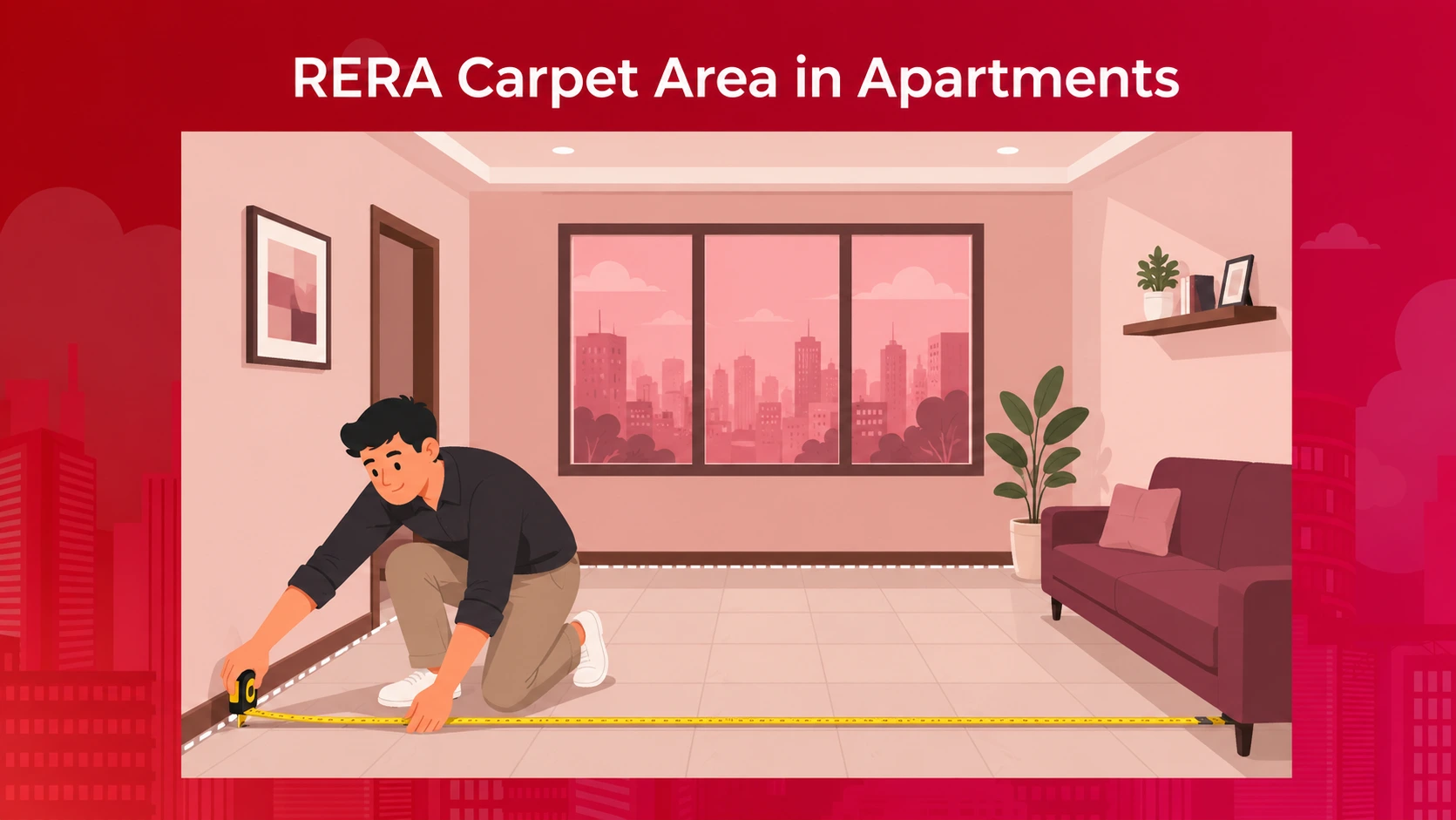


RERA Carpet Area is the total area that you can use in your apartment. It is measured from the inside wall of the apartment. It includes internal partition walls and does not include balconies and terraces. After the implementation of the Real Estate (Regulation and Development) Act, 2016, developers must quote and offer their properties on this basis, which will help buyers understand the price of the property. This guide explains how RERA carpet area is calculated, what it includes and excludes, how it differs from other area measurements, and the key RERA rules every homebuyer should know.

What Is RERA Carpet Area?
Property brochures often use terms like built-up area, super built-up area, and carpet area, which can make it difficult to understand the actual size of a flat. Under the Real Estate (Regulation and Development) Act, 2016, RERA carpet area meaning is defined as the net usable floor area of a flat. It covers the space where you can actually place furniture, walk around, or lay a carpet, along with the thickness of the internal partition walls that divide your rooms.
RERA carpet area does not include:
- External walls
- Balconies
- Verandahs
- Open terraces
- Common areas such as lobbies, staircases, lift shafts, and service ducts
It is basically the space you truly own and use inside your four walls.
Why Was RERA Carpet Area Introduced?
Before this law came into effect, builders often used loosely defined terms such as built-up area or super built-up area. These figures quietly included common spaces like corridors, stairwells, and shafts, making the flat look bigger and more expensive than what a resident actually got to use.
RERA changed this by making it mandatory for developers to quote, market, and sell properties strictly on the basis of carpet area as per RERA. Following this standard is an important part of RERA compliance, ensuring greater transparency and consistency in property transactions. This one change brought a level of honesty to property listings that residents and housing societies had been asking for over the years.
Read also: Society Handover Process
What Is Included and Excluded in RERA Carpet Area?
Knowing exactly what counts toward your flat's size helps you avoid paying for space you cannot really use.
| Included in RERA Carpet Area | Excluded from RERA Carpet Area |
| Bedrooms, living room, kitchen | External walls and structural columns |
| Bathrooms and toilets | Balconies, verandahs, and open terraces |
| Internal partition walls | Common areas like lobbies, stairs, and lifts |
| Internal storerooms or utility closets | Utility ducts and service shafts |
A quick tip for residents: if a builder's quote suddenly looks smaller than what you expected, this is often because it is now based on true carpet area rather than the old inflated figures.
How Is RERA Carpet Area Calculation Done?
The RERA carpet area calculation follows one straightforward formula:
RERA Carpet Area = Net usable floor area inside the unit + Area of internal partition walls
Here is how you or your society's technical team can verify it on the ground:
- Measure each room from the inner face of the walls using a tape or laser measuring tool.
- Multiply length by width for every room to get its area, then add them all up.
- Add the internal wall area, since RERA counts the thickness of walls between rooms.
- Leave out balconies, terraces, ducts, and shared spaces, as these never form part of the final number.
Typically, RERA carpet area tends to run about 3% to 6% higher than the plain "wall to wall" carpet area, simply because it accounts for internal walls that older measurements ignored.
Difference Between Carpet Area and RERA Carpet Area
Knowing the difference between carpet area and RERA carpet area helps buyers compare properties accurately and avoid confusion at the time of purchase. Here's how it differs:
| Aspect | Carpet Area (General Term) | RERA Carpet Area |
| Definition | Loosely used, no fixed legal standard before 2016 | Legally defined under RERA Act, Section 2(k) |
| Internal Walls | May or may not be included depending on the builder | Always included |
| Legal Status | Not enforceable for pricing | Mandatory basis for pricing and sale agreements |
| Consistency Across Builders | Varied widely | Standardised nationwide |
The takeaway for buyers and society committees is simple. Whenever a legal document or price quote is involved, always check that the figure quoted is the RERA carpet area, not just a general "carpet area" claim.
Difference Between RERA Carpet and Usable Carpet Area
The difference between RERA carpet and usable carpet area depends on what these areas consist of and how they are applied:
| Feature | RERA Carpet Area | Usable Carpet Area |
| Internal Walls | Included | Excluded |
| Living Room, Bedroom, Kitchen | Included | Included |
| Balconies and Terraces | Excluded | Excluded (unless enclosed by design) |
| Legal Status | Standardised, enforceable for pricing | An estimate, not a legal pricing standard |
Usable carpet area is the true "clear floor space" where you can place furniture, and it is generally 3% to 5% smaller than RERA carpet area. For legal paperwork, always rely on the RERA figure. For interior planning and furniture layout, the usable carpet area gives a more practical picture.
Read also: What is Plinth Area?
Key RERA Guidelines for Carpet Area
A few RERA guidelines for carpet area are worth remembering, especially for housing society committees dealing with builders or redevelopment projects:
- Mandatory disclosure: Developers must state the RERA carpet area clearly in brochures, allotment letters, and the sale agreement.
- Pricing rule: Total consideration must be calculated only on RERA carpet area, not on super built-up figures.
- Refund on shortfall: If the final delivered area is smaller than promised, the builder must refund the excess with interest within 45 days of possession.
- Cap on increase: If the delivered area is larger, buyers pay extra, but this increase cannot exceed 3% of the agreed carpet area.
- State verification: Residents can check a project's registered details through their state's official RERA authority portal.
These rules exist to protect residents from unexpected shock after possession, and every housing society should keep a copy of the RERA-approved carpet area on file for future reference.
How Residents Can Verify Their Apartment's Carpet Area?
Here are a few practical steps residents and society committees can follow together:
- Compare the carpet area mentioned in your sale agreement with the figure listed on your state's RERA website.
- Physically measure a sample flat during possession, especially in a new project, before final documentation is signed.
- Keep all builder communication, including brochures and floor plans, as they may be needed if a dispute arises later.
- Raise the matter collectively through your society's management committee rather than individually, since builders tend to respond faster to registered societies.
Small steps like these save residents from confusion and disputes down the line, and they also build a habit of transparency that benefits the whole community.
What Should Managing Committees Do About RERA Carpet Area?
If you're on your society's managing committee, this isn't just a buyer's concern; it affects the whole community. A few things worth doing:
- Verify the RERA carpet area in sale agreements: Pull out the original documents and check if the carpet area as per RERA actually matches what residents have on the ground. Builders sometimes hand over flats with small variations.
- Raise carpet area disputes collectively: It's far easier for a society to flag a discrepancy together than for one resident to take on a builder solo.
- Maintain digital records of RERA carpet area: Keep every unit's approved carpet area, floor plan, and RERA registration number in one file, physical or digital. It helps during resale, disputes, or redevelopment talks.
- Assign a point person for RERA compliance: One committee member, or a small team, should coordinate with the builder or the state RERA office whenever something doesn't add up.
- Recheck RERA carpet area before redevelopment: If your society is heading into redevelopment, insist the new carpet area figures are shared and verified before anyone signs off.
Keep Important Property Documents Organised with NoBrokerHood
Understanding your apartment's RERA carpet area is much easier when important documents are readily available. Sale agreements, approved floor plans, possession letters, and society records are often needed to verify measurements or resolve future queries.
NoBrokerHood helps housing societies securely maintain and share important documents through its Document Management feature. This allows committees to store society records digitally while giving residents easy access to documents whenever required.
How it helps residents and committees:
- Store important society and property documents in one place
- Share approved floor plans, notices, and circulars digitally
- Reduce the chances of misplaced paperwork
- Make it easier to retrieve records during audits, redevelopment, or ownership-related discussions
When property records are organised and easily accessible, residents can verify important details like carpet area with greater confidence and avoid unnecessary confusion in the future.
All Solutions by NoBrokerHood:
