





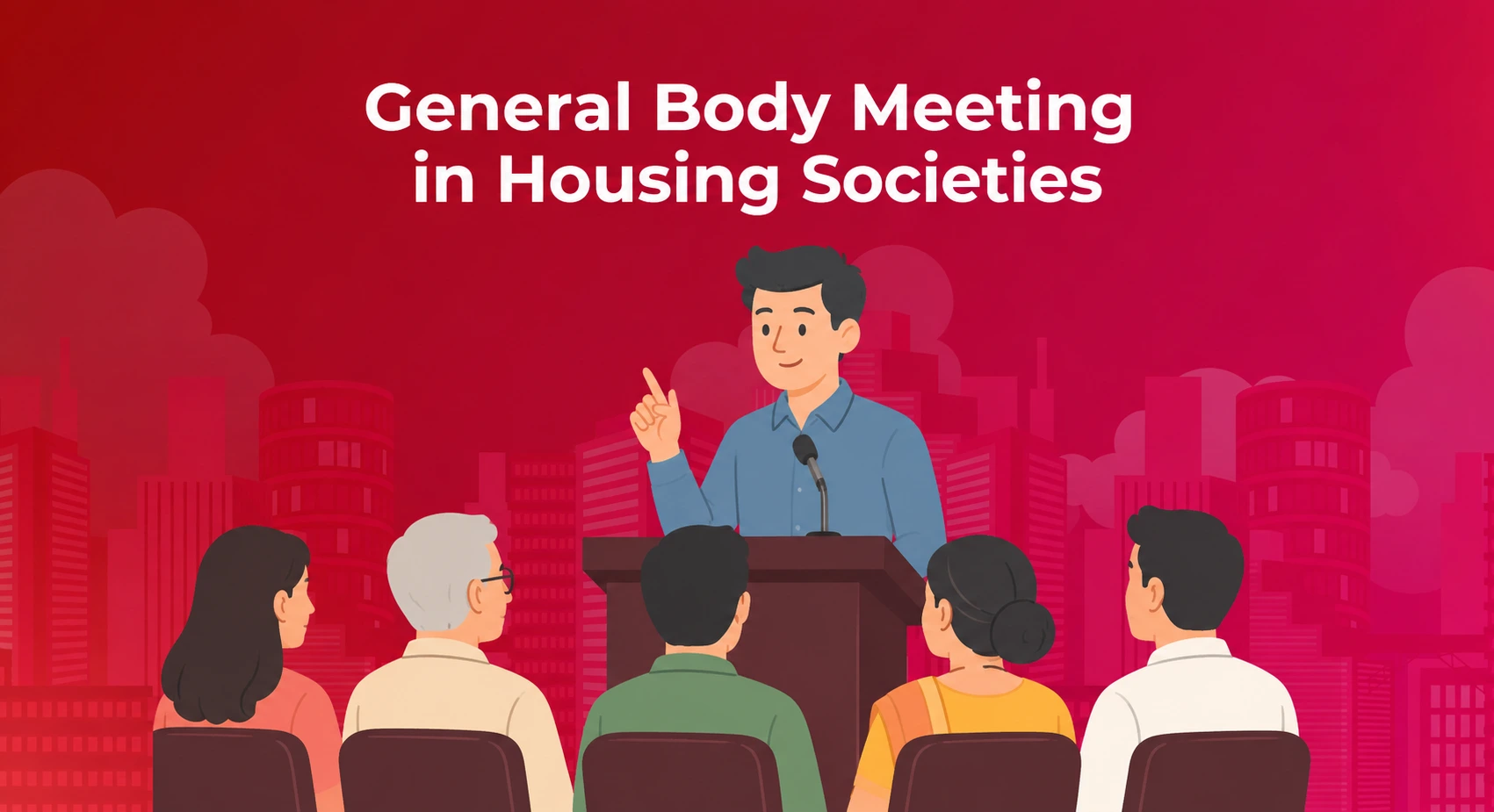


Residents often get frustrated with the lack of transparency around financial decisions, confusion around maintenance charges and disagreements with community rules. Without a formalised medium to discuss and decide, important issues of society may go unresolved. The General Body Meeting is the foundation of democratic governance in a housing society. Members get a chance to review finances, vote on key proposals, elect committee members and participate in decisions that affect the entire community. Knowing how these meetings are conducted, residents can keep themselves informed, protect their interests and help improve the management of society.

What is GBM in Society and Why Does It Matter?
A General Body Meeting is the highest governing forum in a housing society, resident welfare association, or cooperative housing community. It brings together eligible members to discuss society matters, review financial performance, approve budgets, elect committee members, and vote on important proposals.
Every major society decision that affects residents collectively is generally discussed during a General Body Meeting. This creates a transparent process where members can understand how the community is being managed and participate in decision-making.
Some common matters discussed include:
- Annual budgets
- Maintenance charges
- Major repair projects
- Parking policies
- Community rules
- Committee elections
- Auditor appointments
A well-conducted General Body Meeting ensures that society management remains accountable to its members.
Difference Between AGM and GBM in Society
| Basis | AGM (Annual General Meeting) | GBM (General Body Meeting) |
| Meaning | A yearly meeting of all members that is mandatory by law or bye-laws | A meeting of all members that can be held at any time, as needed |
| Frequency | Once every year, within a fixed time after the financial year ends | No fixed schedule; held whenever required |
| Purpose | Routine, statutory business of the society | Specific or urgent matters that cannot wait for the AGM |
| Typical Agenda | Approval of annual accounts and audit report, budget approval, election of the managing committee, appointment of auditor | Rule or bye-law amendments, major repairs or redevelopment, special levies, removal of office bearers |
| Compulsory? | Yes, failure to hold it can attract penalties or action by the registrar | Only when the situation demands it |
| Notice Period | Longer notice, typically 14 to 21 days as per bye-laws | May be shorter, depending on urgency and bye-laws |
| Called By | Managing committee or secretary | Managing committee, or on a written request from a set percentage of members (called a requisition) |
| Also Known As | Annual meeting | Special General Meeting (SGM) or Extraordinary General Meeting (EGM) |
Why Is a General Body Meeting Important for Apartment Communities?
Apartment communities run effectively if decisions are made collectively instead of by a few individuals. The General Body Meeting provides an official forum for such participation. Key benefits are:
Financial Transparency
Members can review income, expenses, audit reports, and upcoming budgets.
Democratic Decision-Making
Important proposals are discussed openly before being approved.
Better Community Participation
Residents gain a clear understanding of society operations and future plans.
Legal Compliance
Many housing society regulations require periodic meetings and proper record-keeping.
Reduced Conflicts
When decisions are documented and approved through a formal process, misunderstandings are less likely to occur.
A strong General Body Meeting culture often leads to greater trust between residents and managing committees.
Types of General Body Meeting of Housing Society
Housing societies may conduct different types of meetings depending on the purpose.
Annual General Meeting (AGM)
The AGM is mandatory and usually held once every financial year.
Common AGM agenda items include:
- Approval of audited accounts
- Budget discussions
- Auditor appointments
- Committee updates
- Election-related matters
- Review of society performance
Read also: Housing Society AGM Meeting Rules
Special General Meeting (SGM)
An SGM is conducted when urgent matters require immediate attention.
Examples include:
- Major repair approvals
- Redevelopment discussions
- Emergency fund requirements
- Significant policy changes
- Dispute-related resolutions
Read also: Special General Body Meeting Rules
First General Body Meeting (FGBM)
This meeting is conducted after the formation of a newly registered society.
It generally covers:
- Adoption of bylaws
- Election of the provisional committee
- Initial administrative decisions
Each type of General Body Meeting serves a different purpose while supporting effective community governance.
Read Also: Annual General Meeting Report
What Are the Legal Requirements for Conducting a General Body Meeting in India?
Housing society regulations vary across states, but certain principles are commonly followed.
Notice Period
Members should receive a formal notice along with the meeting agenda in advance. In many cases, the notice period ranges between 14 and 21 days.
Quorum Requirement
A minimum number of eligible members must be present for decisions to be legally valid.
If quorum is not achieved:
- The meeting may be adjourned
- Another meeting may be scheduled
- State-specific bylaws determine the next steps
Agenda Circulation
The agenda should clearly outline all discussion and voting items before the meeting.
Minutes of Meeting (MoM)
The secretary or authorised representative records discussions and decisions.
Minutes generally include:
- Date and venue
- Attendance details
- Resolutions passed
- Voting outcomes
- Action items
Maintaining proper records is essential for legal compliance and future reference.
How Often Should a General Body Meeting Be Conducted in a Housing Society?
Most housing societies are required to conduct at least one General Body Meeting every year through the Annual General Meeting process. Additional meetings may be organised whenever major decisions require member approval.
Factors that may trigger additional meetings include:
- Large infrastructure projects
- Redevelopment proposals
- Changes in society policies
- Emergency financial approvals
Regular meetings help societies remain transparent and responsive to community needs.
What Should Be Included in a General Body Meeting Agenda?
A clear agenda helps members prepare for discussions and improves meeting efficiency. A typical General Body Meeting agenda may include:
Administrative Updates
- Welcome note
- Confirmation of previous meeting minutes
- Committee updates
Financial Matters
- Annual accounts review
- Audit report discussion
- Budget approval
- Maintenance charge revisions
Elections and Appointments
- Managing committee elections
- Auditor appointments
- Committee vacancy updates
Policy Discussions
- Parking regulations
- Renovation guidelines
- Pet policies
- Common area usage rules
Future Projects
- Security upgrades
- Infrastructure improvements
- Sustainability initiatives
- Major repair work
Sharing the agenda early helps members participate meaningfully during discussions.
Read also: How to Fill Casual Vacancy in Housing Society
How Are Major Decisions Approved in a General Body Meeting?
Most society resolutions are approved through voting after discussions.
The approval process generally includes:
- Presentation of the proposal
- Member discussion
- Clarification of concerns
- Voting process
- Documentation in meeting minutes
Examples of decisions commonly approved include:
- Annual budgets
- Maintenance charges
- Capital expenditure projects
- Rule amendments
- Community development initiatives
The exact voting requirements may vary according to society bylaws and applicable regulations.
What Rights Do Residents Have During a General Body Meeting?
Property owners play an important role in society's governance. Common member rights include:
Right to Attend
Eligible members can participate in discussions and understand society affairs.
Right to Access Information
Members can review financial reports, agenda items, and meeting records as permitted under society rules.
Right to Raise Concerns
Residents may ask questions regarding finances, operations, maintenance, or governance.
Right to Vote
Voting rights are generally reserved for property owners or registered members.
Right to Suggest Proposals
Members can recommend improvements and request consideration of community matters.
These rights help ensure fair representation during a General Body Meeting.
Read also: Society Management Committee Roles and Responsibilities
What Happens If a Housing Society Fails to Conduct a General Body Meeting?
Failure to conduct a General Body Meeting can create governance challenges and compliance concerns.
Possible consequences include:
- Lack of financial transparency
- Delayed decision-making
- Resident dissatisfaction
- Increased disputes
- Difficulty approving budgets
- Regulatory scrutiny depends on state laws
Without regular meetings, residents may not see much of how community funds are spent. Accountability and trust can be established by regular meetings.
What Is the Difference Between an Annual General Body Meeting and a Special General Body Meeting?
| Annual General Meeting (AGM) | Special General Meeting (SGM) |
| Conducted every year | Conducted when required |
| Mandatory in most cases | Called for specific issues |
| Reviews annual performance | Addresses urgent matters |
| Approves accounts and budgets | Focuses on a particular resolution |
| Covers multiple agenda items | Usually covers limited topics |
Both meeting formats play important roles in effective housing society governance.
How Can Digital Tools Simplify General Body Meeting Management for Housing Societies?
Managing meetings manually can become difficult as societies grow. Digital society management tools help streamline several processes.
Benefits include:
- Digital meeting notices
- Agenda sharing
- Resident communication
- Attendance tracking
- Secure document storage
- Resolution tracking
- Digital record management
Modern platforms also make it easier for residents to stay informed and participate in society matters. In larger communities, technology can significantly reduce administrative workload while improving transparency.
Manage Society Communication and Meetings with NoBrokerHood
As apartment communities grow, keeping residents informed and managing society meetings can become increasingly challenging. Committees often spend considerable time sharing notices, addressing resident queries, tracking complaints, sending meeting agendas, and maintaining records of important decisions.
NoBrokerHood society management app simplifies both communication and meeting management through a single platform. It enables committees to share announcements, conduct discussions, manage complaints, send meeting notices, record meeting minutes, and gather resident feedback digitally, helping communities operate in a more organised and transparent manner.
How does this improve society communication and meeting management?
- Important notices, announcements, and maintenance updates can be shared through a Digital Notice Board.
- Residents can discuss common concerns and community matters through dedicated Society Forums.
- Neighbours can communicate securely without sharing personal phone numbers.
- Complaints and service requests can be raised and tracked digitally until resolution.
- Meeting notices, agendas, and supporting documents can be shared with residents in advance via the Digital Notice Board and Email.
- Committee administrators can log the Minutes of Meeting (MoM) in the admin dashboard.
- Polls and voting features help committees gather resident feedback and support community decision-making.
When communication, complaint management, and meeting administration are managed through a single platform, societies can improve transparency, increase resident participation, and ensure important information remains easily accessible to everyone.
All Solutions by NoBrokerHood:
