






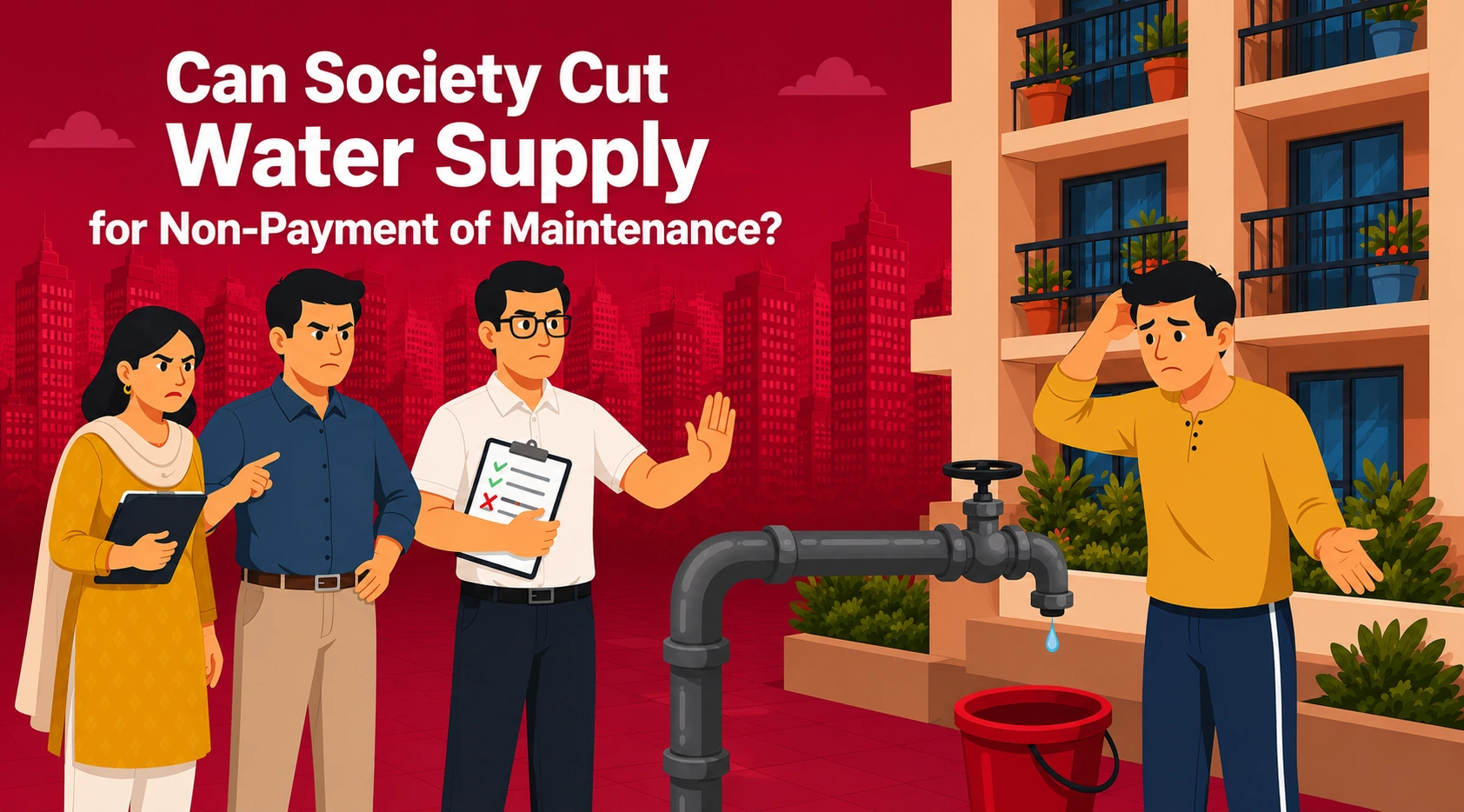


One of the most common questions raised by housing societies is whether they can cut off a resident's water supply to recover unpaid maintenance charges. While delayed payments can strain a society's finances and disrupt essential services, disconnecting water is not as simple as it may seem. Indian courts have consistently treated water as an essential service, placing clear legal limits on the actions a society can take against defaulters. This guide explains whether a society can cut water supply of a member for not paying the maintenance, the legal position under Indian law, relevant court rulings, the limited exceptions, and the lawful ways societies can recover outstanding dues without violating residents' rights.

Why Maintenance Defaults Are a Common Society Problem?
In India, almost every housing society has a handful of residents who delay or don’t pay their monthly maintenance dues. Sometimes it’s real financial hardship, and sometimes residents just forget or ignore reminders.
The unpaid dues can create pressure on the whole community. The society still has to pay for water pumps, security staff, lift maintenance and housekeeping, and the shortfall is often passed on to paying members.
This is exactly when frustrated management committees start wondering if they could stop the water supply of a member for not paying the maintenance. It sounds like a quick fix, but Indian law does not support it.
Can Society Cut Water Supply of a Member for Not Paying the Maintenance?
No, a society or resident welfare association cannot initiate the disconnection of water supply for non payment of maintenance charges, no matter how large the pending dues are. In most Indian cities, the water connections are controlled by the municipal corporations or water boards and not by the housing society. The water is already there. The society only controls the distribution of water inside the building or complex.
Even if the maintenance bylaws say that disconnection is a penalty, that provision doesn’t hold up in court. Utility cutoffs cannot be used as leverage by societies, as made clear in several rulings and regardless of how the bylaws are worded.
Why Water Is an Essential Service Under Indian Law?
Indian courts consistently treat water as a basic human necessity rather than a discretionary amenity. This view comes from Article 21 of the Constitution, which protects the right to life and, by extension, the right to a livelihood.
Depriving someone of water is seen as interfering with that basic right, not just as a billing dispute. This is why the question of whether a society can cut water supply of a member for not paying the maintenance keep on coming up in consumer forums and courts across the country.
Because water sits in this protected category, private bodies like management committees or apartment associations simply do not have the authority to switch it off, even temporarily.
Supreme Court Judgement on Disconnection of Water Supply by Society
The Supreme Court judgement on disconnection of water supply by society and related High Court rulings form the legal backbone of this rule. Courts have held that disconnecting water is a deprivation of the fundamental right to life and livelihood, not an ordinary recovery tactic.
The Madras High Court, in a widely cited case involving an apartment owners' association, observed that cutting water supply amounted to interference with a fundamental right and was not a lawful way to recover dues. This principle has since guided similar disputes nationwide.
Even recently, a resident in the Bombay High Court owed several lakhs in dues, and the court was still discussing whether disconnection was justified. This shows how seriously the courts take this issue, no matter how much due is left.
Is Disconnection of Water Supply for Non Payment of Maintenance Charges Ever Allowed?
Disconnection of water supply for non payment of maintenance charges is generally not permitted, but there are a few narrow exceptions worth knowing about.
- If the water itself is a paid commodity supplied through private tankers arranged by the society, and this is clearly stated in the bylaws, some local courts have allowed limited restriction after due process.
- A civil court or the Registrar of Cooperative Societies can, in rare cases, pass a specific order permitting disconnection as part of a larger recovery judgment.
- Municipal authorities, not the society, can disconnect the primary water connection to the building if the underlying municipal water bill itself goes unpaid.
Outside these specific situations, disconnection of water supply for non payment of maintenance charges carried out unilaterally by a committee remains legally risky and can invite complaints or court action against the office bearers.
Read also: Non Payment of Society Maintenance Charges
What Can a Society Legally Do Instead of Cutting Water Supply?
Once it is clear that a society cannot cut water supply of a member for not paying the maintenance, the natural question becomes what committees should do instead. Fortunately, there are several lawful and effective options to recover pending dues without touching essential services.
- Send formal notices: Written reminders and legal notices create a paper trail and often prompt payment on their own.
- Charge late payment interest: Most society bylaws allow interest on overdue maintenance, commonly up to 21% per year, to encourage timely payment.
- Restrict non-essential amenities: Access to the clubhouse, gym, swimming pool, or parking beyond the allotted spot can be paused for defaulters.
- Approach the Cooperative Registrar: Societies can file a recovery application with the Registrar of Cooperative Societies for a binding order.
- File a civil suit: For larger or long-pending amounts, a civil suit allows the society to recover dues along with interest and legal costs.
- Use arbitration: Many state Cooperative Societies Acts provide for arbitration as a faster alternative to full civil litigation.
These steps keep the recovery process within legal boundaries while still putting real pressure on defaulters.
Read also: Water Meter for Apartment
What Should a Resident Do If Water Is Cut Off Unfairly?
Even though the law does not allow a society to cut water supply for unpaid maintenance, such incidents still occur. If your water supply has been disconnected over pending maintenance dues, the following steps can help you resolve the issue.
- Raise the issue in writing with the management committee, referencing that such disconnection is not legally permitted.
- Escalate to the Registrar of Cooperative Societies if the committee does not restore the connection promptly.
- Approach the local police or consumer forum if the disconnection continues, since this can be treated as an offence in some states.
- Keep records of notices, payment history, and communication, as these help build a strong case if the matter goes further.
- Offer a payment plan where genuine financial difficulty is the reason for the delay, since most committees prefer a resolution over a dispute.
How Societies Can Prevent Maintenance Defaults?
Since a society cannot cut water supply of a member for not paying the maintenance, prevention becomes far more valuable than recovery. A few practical habits can reduce defaults significantly.
- Send maintenance reminders a week before the due date, not just after it is missed.
- Offer digital payment options so residents can pay in a couple of taps instead of writing cheques.
- Share clear, itemised bills, so residents understand exactly what they are paying for.
- Set a transparent, written late fee policy and apply it consistently to everyone.
- Hold a friendly conversation with repeat defaulters before escalating matters, since many delays come from oversight rather than refusal.
Read also: Housing Society Maintenance Due Notice Format
Reduce Maintenance Defaults with NoBrokerHood
Most maintenance disputes don't begin with deliberate non-payment. They start with missed due dates, forgotten bills, or residents not having a convenient way to pay. NoBrokerHood simplifies this through its digital maintenance billing and payment system, making it easier for both residents and managing committees to stay on top of maintenance collections.
Here's how it helps:
- Automated maintenance bills are shared digitally with residents.
- Payment reminders are sent before and after the due date, reducing missed payments.
- Residents can view their current bill, payment history, and outstanding dues anytime through the app.
- Maintenance charges can be paid using UPI, net banking, credit cards, or debit cards, making the payment process quick and convenient.
- Managing committees get a real-time view of pending collections, making follow-ups more organised and transparent.
When billing is transparent and payments are convenient, societies spend less time chasing dues and are less likely to face situations where drastic measures are even considered. The focus shifts from recovering unpaid maintenance to preventing defaults in the first place.
