





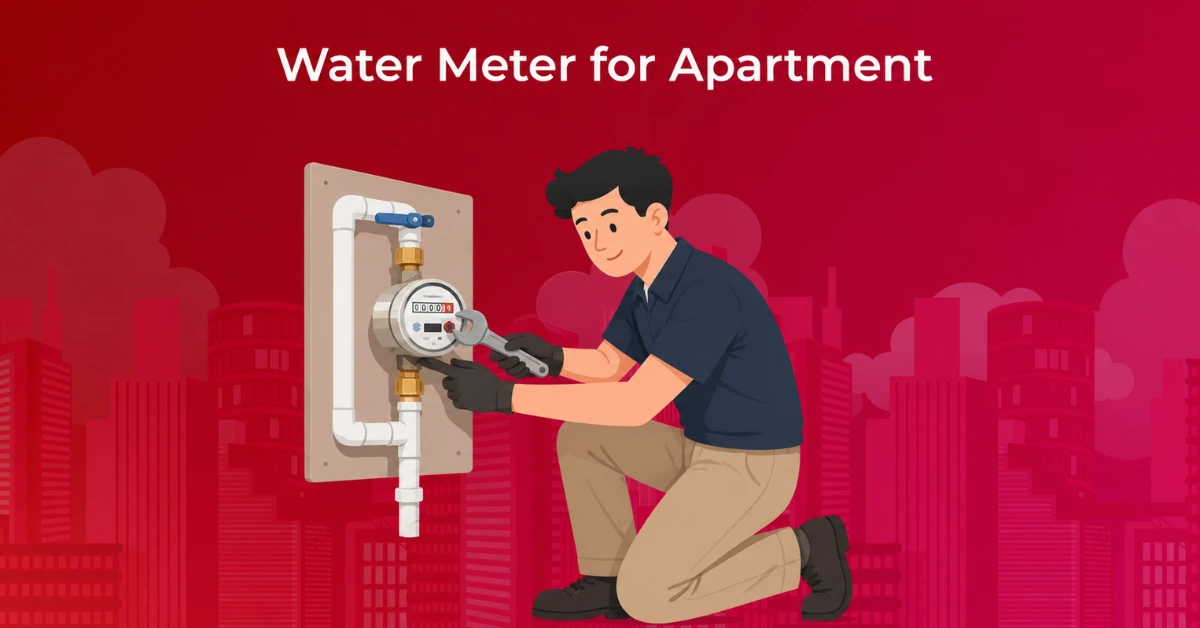


Many flat residents are frustrated when water bills are divided evenly, despite the fact that each family uses a different amount of water. This can cause arguments, overconsumption and problems with leak detection. Installation of water meters for apartment complexes enables monitoring of actual consumption, promotes responsible consumption, allows equitable billing, provides societies better control over their water resources and can reduce overall water consumption by 20-40%. The guide explains how flat water meters work, costs, installation requirements and the benefits of smart metering systems.

What Is a Water Meter for an Apartment?
Water meter for an apartment is used to measure the quantity of water used by the apartments, or entire blocks or buildings. Rather than dividing the total bill of water equally amongst all the members, societies could calculate the cost according to consumption. In most Indian apartment societies, there is only one master meter installed, which will record the total quantity of water used by the society. But this system often causes disputes because the manner in which it is employed varies widely from one household to another.
Installing individual meters helps societies:
- Track flat-wise consumption
- Improve billing transparency
- Reduce unnecessary water wastage
- Identify unusual consumption patterns
- Encourage responsible water usage
As water costs continue to increase across Indian cities, many RWAs are adopting apartment metering systems to manage resources more efficiently.
Why Are Apartment Societies Moving Towards Individual Metering?
Water is a common resource, but households use it in different ways. A family of two is not going to use the same amount of water as a family of six. For this reason, many societies are moving from equal cost billing to consumption-based billing. Some key advantages include:
Fair Billing
Residents pay only for the water they actually use.
Better Accountability
When people can see their own consumption, they tend to use water more carefully.
Lower Overall Consumption
Many communities report noticeable reductions in water usage after introducing individual metering.
Easier Leak Identification
Unexpected increases in consumption can indicate hidden leaks.
Improved Budget Planning
Society committees can better estimate future water expenses and tanker requirements.
Types of Water Meters Used in Apartments
Choosing the right water meter for apartment projects depends on budget, infrastructure, and management goals.
Traditional Mechanical Meters
These are the most commonly used meters in residential buildings.
Features:
- Brass body construction
- Mechanical dial display
- Manual reading required
- Affordable and durable
Typical cost: ₹600 to ₹3,000 per unit.
Smart Water Meter for Apartments
A smart water meter for apartments transmits consumption data automatically through wireless communication systems.
Features:
- Real-time monitoring
- Mobile app access
- Automated readings
- Leak alerts
- Cloud-based dashboards
Typical cost: ₹5,000 to ₹10,000+ per inlet.
Digital Water Meters
A digital water meter for apartments uses electronic measurement systems to provide highly accurate readings.
Features:
- Digital display
- Better accuracy
- Long operational life
- Reduced reading errors
Prepaid Water Meters
These systems operate on a recharge model.
Features:
- Pay-before-use structure
- Automatic cut-off after balance exhaustion
- Helps improve collection efficiency
Smart Water Meter for Apartments: Why Demand Is Growing?
The popularity of the smart water meter for apartments has increased significantly because societies want better visibility into water consumption.
Smart meters use technologies such as:
- Wi-Fi
- LoRaWAN
- Zigbee
- LPWAN networks
These systems send water consumption data directly to software dashboards, allowing residents and facility managers to monitor usage without manual readings.
Major benefits include:
- Real-time consumption tracking
- Automated monthly billing
- Leak detection alerts
- Reduced administrative work
- Historical usage reports
- Better water conservation planning
For large apartment communities, smart metering also simplifies maintenance and reduces dependence on manual record keeping. Many societies adopting smart systems have reported noticeable reductions in unnecessary water usage due to increased visibility and accountability.
Digital Water Meter for Apartments: Features and Working
A digital water meter for apartments measures water flow electronically rather than just mechanically.
Modern digital systems often use ultrasonic technology, which offers several advantages:
- No moving parts
- Higher accuracy
- Less wear and tear
- Longer lifespan
- Better performance in varying water conditions
The meter records water flow continuously and displays consumption data digitally. Many digital meters can also integrate with apartment management platforms, enabling automated reporting and billing.
For newly constructed residential projects, digital systems are increasingly becoming the preferred choice because they offer both accuracy and scalability.
Read also: Water Supply in Housing Societies
Water Meter Installation in Apartments
Successful water meter installation in apartments starts with understanding the building's plumbing layout.
Step 1: Assess Existing Plumbing
Each flat should ideally have a dedicated inlet pipe.
If multiple flats share the same supply line, plumbing modifications may be required.
Step 2: Select the Meter Type
Choose between:
- Mechanical meters
- Digital meters
- Smart IoT meters
- Prepaid meters
Step 3: Determine Meter Size
Most apartments use:
- 15 mm (½ inch)
- 20 mm (¾ inch)
meters.
Step 4: Install the Meter
The meter is installed on the main inlet line before water enters the flat.
Step 5: Configure Monitoring Systems
For smart meters, connect the device to the society's monitoring platform or dashboard.
Step 6: Test and Calibrate
Ensure readings are accurate before the system goes live.
However, when installing water meters in apartments, societies should always opt for certified products which are as per the quality standards for accuracy and durability.
Individual Water Meter vs Shared Water Billing
| Individual Metering | Shared Billing |
|---|---|
| Residents pay based on usage | Equal cost distribution |
| Promotes conservation | Encourages overconsumption |
| Better transparency | Frequent disputes |
| Easier leak detection | Difficult to identify wastage |
| Accurate consumption data | Limited visibility |
Individual metering creates a direct connection between usage and cost. This often results in more responsible consumption and improved satisfaction among residents.
Water Meter for Apartment Buildings: How It Works?
A water meter apartment building system usually consists of:
- A master meter at the building level
- Individual meters for each flat
- Data collection mechanism
- Billing process
Water first enters the building through the master connection. From there, it is distributed to individual flats through dedicated pipelines. Each apartment meter records consumption separately. The readings are then used to calculate flat-wise water charges.
In smart metering systems, this entire process can be automated, reducing manual work for facility management teams.
Can Water Meters Detect Water Leaks?
Yes. Modern water meters can help identify leaks. If a meter continues recording water flow even when all taps are turned off, it may indicate:
- Pipe leakage
- Running flush tanks
- Dripping taps
- Hidden plumbing damage
Smart meters can even take it one step further by offering notifications of any abnormal consumption. The early detection of any leakages avoids unexpected high bills, reduces wastage of water and prevents any harm to your property.
Read also: Supreme Court Decision on Water Leakage from Upper Floor Flat
Water Meter for Apartments Cost and Factors Affecting Pricing
Water meter for apartments costs change based on the type.
Typical Cost Range
| Component | Approximate Cost |
|---|---|
| Mechanical Meter | ₹1,500 - ₹3,000 |
| Smart Water Meter | ₹7,999 - ₹11,000 |
| Installation & Labour | ₹300 - ₹1,500 |
| Retrofitting Work | ₹3,000 - ₹15,000 |
| Gateway/Hub (Smart Systems) | ₹10,000 - ₹25,000 |
Factors Affecting Cost
Building Age
Older buildings often require additional plumbing modifications.
Meter Technology
Smart and digital systems cost more than mechanical meters.
Number of Inlets
Some flats require multiple meters.
Software Integration
Smart systems may include dashboard or maintenance fees.
While the initial investment can appear significant, many societies recover costs over time through lower water consumption and improved billing accuracy.
Read also: How to Soften Hard Water in Housing Societies
How Apartment Water Charges Are Calculated Using Water Meters
Once a water meter for apartment system is installed, billing becomes straightforward.
For example:
- Flat A consumes 12,000 litres
- Flat B consumes 8,000 litres
- Flat C consumes 20,000 litres
Rather than splitting the building’s water bill equally, each household pays according to how much it actually uses. This approach encourages transparency and motivates residents to be more attentive to their usage.
Read Also: How to Make Hard Water Soft
Track Water Consumption with NoBrokerHood
Installing a water meter for apartment complexes is only the first step. The real challenge is managing readings, monitoring consumption patterns, and ensuring transparency for residents.
NoBrokerHood helps societies simplify this process by integrating water consumption data into a single platform. Instead of relying on manual records, management committees can maintain better visibility into usage trends and identify unusual consumption patterns early.
Why this matters for apartment communities:
- Water consumption data becomes easier to monitor
- Sudden spikes in usage can be identified quickly
- Residents gain greater transparency into water-related charges
- Management committees can make more informed decisions about water conservation
As a society billing software, NoBrokerHood helps societies move from reactive water management to a more data-driven approach, making it easier to promote responsible consumption and improve resource planning across the community.
All Solutions by NoBrokerHood:
