





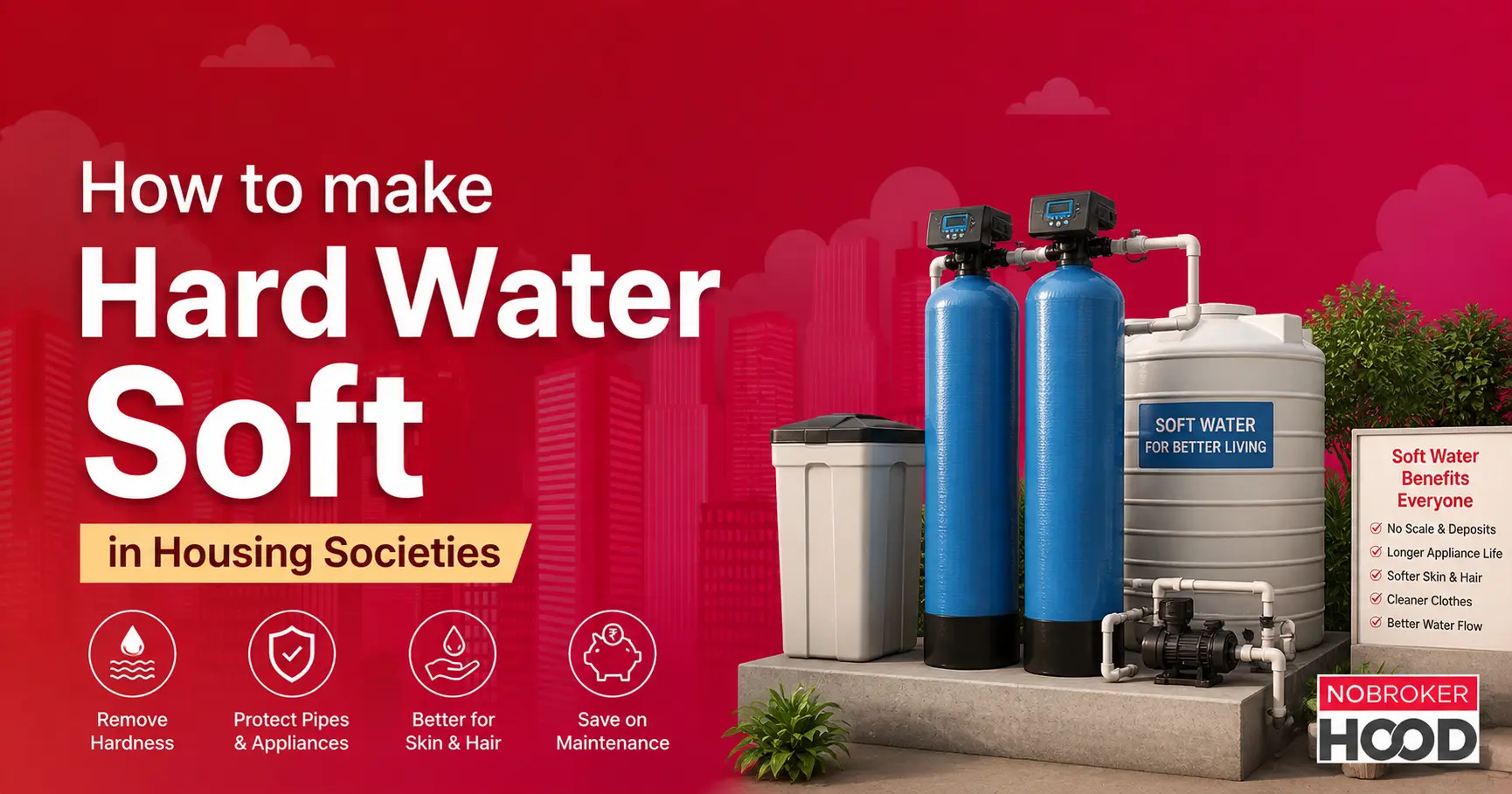


Hard water is a common issue in many housing societies, affecting appliances, plumbing, and personal care. It contains high levels of calcium and magnesium that leave residue on surfaces, damage machines, and dry out skin and hair. Understanding how to soften water in an apartment is essential for comfortable daily living. Effective solutions include installing a water softener for apartment use, opting for a centralised water softener for society, or using simple home remedies to treat hard water. By choosing the right method, residents can reduce scaling, protect appliances, and enjoy cleaner water throughout their homes.

Understanding Hard Water and Its Effects
Hard water is known to leave white spots on dishes, make soap form a scum, and sometimes even dry hair and the skin after bathing. Over time, this can also cause blockages in pipes and damage appliances, leading to huge repair and replacement costs. It becomes a point of concern for housing societies not only due to resident comfort but also as it impairs the maintenance of the overall infrastructure of the building.
Also Check: Ways to Prevent the Water Pollution in Gated Society
Why Do We Need to Treat Hard Water?
Hard water affects several aspects of everyday life in housing societies. Here are a few common problems resulting from hard water:
1. Health of Skin and Hair
Hard water dries out the skin, making it feel itchy; hair seems brittle. Many residents seek solutions on how to soften hard water for bathing for a more comfortable experience.
2. Life Span of Appliances
Water softeners used in washing machines, dishwashers and water heaters scale easily and become less efficient due to built-up minerals. Proper softening of hard water helps extend appliance life.
3. Maintenance
In the case of hard water, the pipes get affected, thereby requiring higher rates of maintenance and pipe replacement. It doesn’t really work well as it is costly and a pain in the neck for housing societies.
Now that the problems are clear, let’s explore softening of hard water using practical and scalable solutions.
Water Softener for Apartment
A water softener for an apartment is one of the most effective ways to tackle hard water issues caused by excess calcium and magnesium. Depending on your space, budget, and water hardness level, there are several types of water softeners suited for apartment living.
- Salt-Based Water Softeners use ion exchange to replace calcium and magnesium with sodium ions, delivering consistently soft water - ideal for apartments with severe hard water problems.
- Salt-Free Water Softeners don't remove minerals but alter their structure to prevent scale buildup, making them a low maintenance option for apartment residents.
- Inline or Under Sink Softeners are compact units that fit easily in small apartments without taking up much space, connecting directly to your water supply line.
- Shower Head Filters are a budget-friendly softening option that reduces the impact of hard water on skin and hair without requiring any plumbing changes.
- Portable Water Softeners are great for renters who can't make permanent modifications, offering flexibility with no installation required.
- Regular maintenance - such as refilling salt and periodic cleaning - ensures your apartment water softener continues to perform efficiently and extends its lifespan.
Cost Comparison: Shower Filter vs. Softener vs. Centralised System
| Solution | Best For | Upfront Cost (₹) | Ongoing Cost | Coverage |
| Shower filter / faucet filter | Renters, single-point relief | 500-3,000 | Cartridge replacement every 3–6 months (₹300–800) | One tap/shower only |
| Portable/inline domestic softener | Individual flats, no plumbing changes | 1,500-10,000 | Salt refills (~₹50–100/month) | Single unit's connected point |
| Whole-flat water softener (salt-based, ion exchange) | Flats with severe hardness | 15,000-30,000 | Salt + periodic servicing (~₹500–1,000/quarter) | Entire flat |
| Centralised society-level softener | Housing societies, shared supply | 20,000-1,50,000+ | AMC/servicing, salt at scale (society-shared cost) | Entire building/society |
How to make Hard Water Soft in Housing Society?
By various means, the hard water in housing societies can be softened. Let’s briefly describe each one of the most effective ways below:
1. Install a Water Softener for an Apartment or Flat
The most direct method of softening of hard water is installing an apartment water softener. These function on the premise that the ions of calcium and magnesium are removed from the water and replaced with sodium or potassium ions. This process is described as ion exchange, and it results in water that does not produce buildup or residue.
Water softeners can be installed at the flat level or at a building’s source of water supply. Some popular types include:
- Salt-based water softeners: Classic water softeners that use salt to remove hardness minerals. They are highly effective, but require regular replenishment with salt.
- Salt-free water softeners: These do not remove the minerals but alter its structure in such a way that it cannot build scales. Quite good for people who look for maintenance-free solutions.
This is one of the most reliable compact solutions for hard water in apartments.
2. Centralised Water Softener System
For big housing societies, centralised water softening systems are perfect. This system can be mounted at the water supply point of the building as a whole; thus, the water will be softened before hitting each apartment. A centralised water softener for society and apartments can save money in the long term since individual water softeners would not be needed. It also ensures that all the tenants get soft water, hence making their living experience better and all shared infrastructure unaffected by mineral buildup.
Also Check: How to Purify Water in Your Apartment
How can we Remove Hardness of Water at Home
If installing a full system is not possible, here are some simple methods of how to treat hard water at home.
1. Boil the Water
Boiling can be used to remove temporary hardness caused by the bicarbonates of calcium and magnesium. This is a very easy, inexpensive solution and can be applied on a small scale, consider, for example, the needs for cooking or bathing water. Not applicable for a whole-house solution.
2. Vinegar Solution
Where some work is required, it appears that adding a few drops of vinegar to hard water is enough. For instance, it may be a good solution to rinse dishes or remove soap scum in the bathroom. Vinegar seems to neutralise some of the minerals contributing to hardness.
3. Add Baking Soda for Softened Water
If you add baking soda to laundry, the water will soften a little, making clothes feel softer and cleaner. It’s a great alternative for those who want to avoid installing a water softener for apartment.
4. Shower Filters
For those wondering how to soften water in an apartment for bathing, installing a shower filter can be an effective solution. Shower filters reduce the worst effects of hard water on skin and hair and are easy to install, providing instant relief from the harsh effects of hard water.
Also Check: How to Apply for Cauvery Water Connection
How NoBrokerHood Helps to Manage Hard Water in Housing Societies
Hard water can cause pipe scaling, appliance breakdowns, and increased maintenance costs for housing societies. Using a society management app like NoBrokerHood, societies can track water quality issues, streamline maintenance, and improve resident satisfaction. Below is a clear comparison of how NoBrokerHood supports hard water management.
| NoBrokerHood Feature | How It Helps with Hard Water Issues | Benefit to Society |
|---|---|---|
| Water Usage Dashboard | Shows trends in community water use to detect anomalies | Helps identify leakage or scaling early |
| Maintenance Scheduler | Automates reminders for tank cleaning, RO servicing | Ensures regular maintenance without manual tracking |
| Vendor Management | Manages contracts & service history for water softeners/RO repair | Saves time, reduces cost, ensures timely service |
| Society Billing Software | Records water-related maintenance charges | Transparent cost sharing for residents |
| Accounting & Expense | Tracks expenses on repairs & replacement of parts | Helps budget for long-term water system upkeep |
| Complaint Management | Residents submit hard water complaints directly | Faster resolution and centralized tracking |
| Asset Management | Records equipment details: pumps, softeners, tanks | Track age & service history to avoid breakdowns |
| Visitor & Delivery Tracking | Logs water tanker entries and external suppliers | Prevents unauthorized or low-quality water supply |
All Solutions by NoBrokerHood:
