






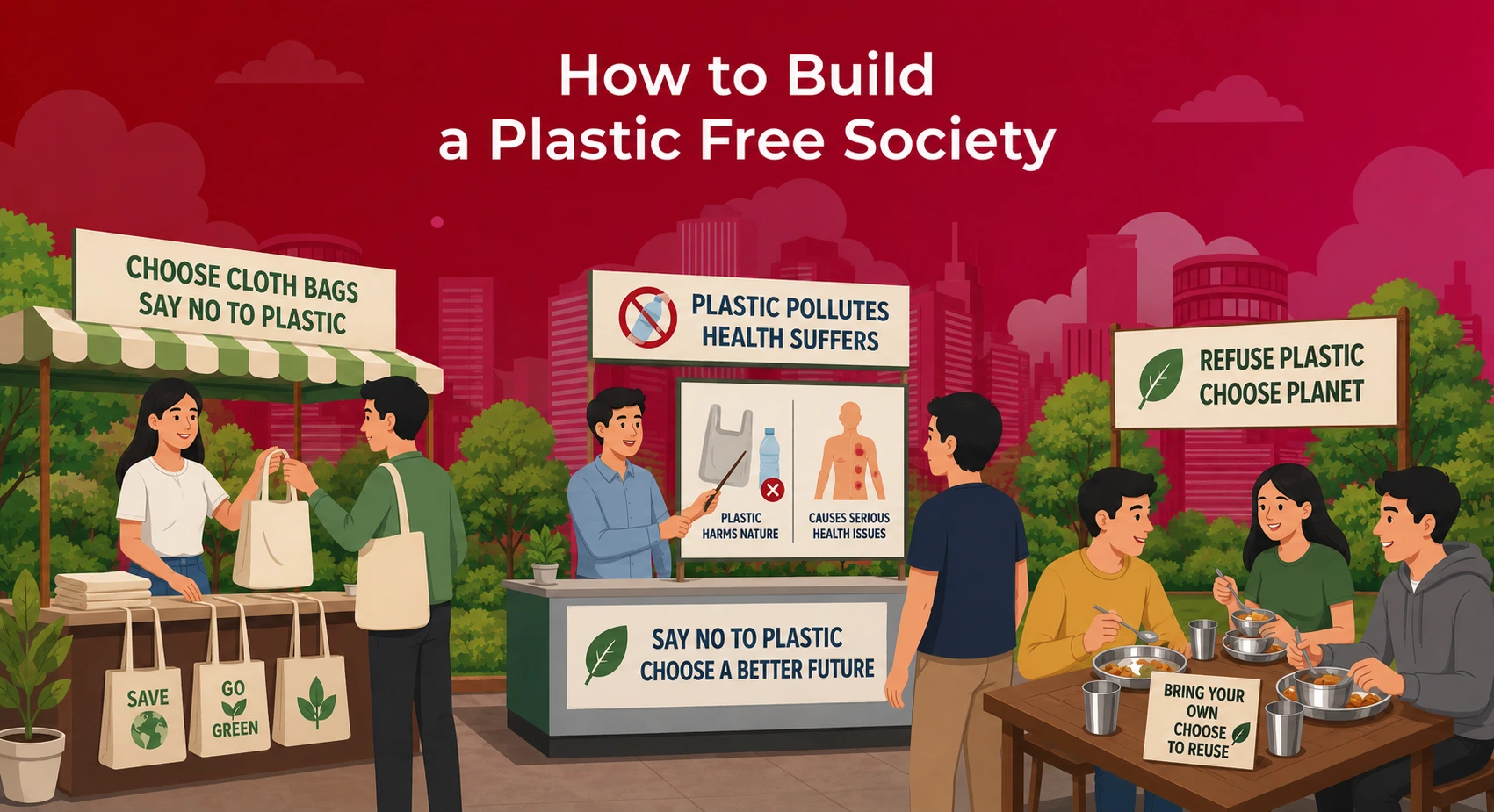


Most housing societies in India talk about going green around Diwali, maybe start a WhatsApp thread about it, and by February, everything is back to normal. The thermocol keeps showing up at society events. The security guard is still collecting mixed waste. Vendors still show up with plastic bags. A plastic free society does not happen because residents care more. It happens because someone builds the right structure and makes it easy to follow. This guide will help you understand what to do first, what actually works, and what most committees miss entirely.

Why Every Housing Society Should Become a Plastic Free Society?
India produces over 4 million tonnes of plastic waste annually. People generally consider plastic pollution as a problem for the government to tackle. However, a housing society of 200 families produces around 500 and 800 kg of waste each month. Plastic accounts for a large part of this waste, including the plastic carry bags purchased from a nearby grocery store, delivery waste that lies around the gates of the society each day, and thermocol and plastic crockery items used at festivals and birthdays in the clubhouse.
The NITI Aayog's 2023 study has reported that only 17 out of 100 Indian households segregate their waste properly. This implies that recyclable plastic produced by most societies is thrown into landfills along with the wet waste, and is headed for landfills.
The other part of this issue, which doesn’t receive enough attention, is the health aspect of this problem. There have already been cases where microplastics were detected in human blood, and even in the groundwater near the landfills. People who live near locations where plastic waste is burnt or openly disposed of inhale fumes of a substance that doesn’t disintegrate easily.
What Does a Plastic Free Society Really Mean?
A plastic free society does not mean zero plastic on the premises. Medical equipment, electrical insulation, certain safety gear, some of these need plastic, and there is no sensible alternative yet. Chasing zero is the wrong goal, and it leads to burnout. The goal is to phase out the plastics that are used only for convenience and don't serve any real purpose. Bags you use for ten minutes. Cups that sit in a landfill for 400 years. Thermocol that crumbles into tiny beads the moment someone touches it. These are the targets.
Think of it in three parts. What enters the society? What gets created inside it? And how what remains is handled so it does not just disappear into a pile somewhere. Get those three things working, and you are building a plastic free community in a way that lasts.
Step-by-Step Guide to Build a Plastic Free Society
Step 1: Start with an RWA Resolution
Your Resident Welfare Association needs to pass a formal resolution. Not a guideline, not a suggestion in the society newsletter. A resolution, in writing, that bans single-use plastic bags, disposable cups and plates, thermocol decorations, and plastic banners from all common areas and society-hosted events. It should also say clearly that any vendor or caterer working inside the society must comply with this rule as a basic condition of access.
Why does this matter so much? Because without it, every attempt to enforce anything runs into the same wall: "Who decided this? Was it voted on?" A formal resolution removes that argument. The RWA has legal standing to govern common areas and vendor access. Use it.
Once the resolution is passed, put it everywhere: notice boards in each building lobby, the society management app. A message in every building's WhatsApp group, and a physical letter under doors if needed. The more official it looks, the more seriously people take it.
Step 2: Set Up Waste Segregation at Every Level
Proper garbage segregation is the most impactful way to truly make your society plastic free, or just appear to be doing so. They put bins in the lobby or by the lift and call it segregation. Residents dump everything together at home, the housekeeping staff collects it, and by the time it gets to those lobby bins, wet food waste and dry plastic are a sloppy mess. Mixed waste is non-recyclable.
The Solid Waste Management Rules 2016 already require this. Housing societies must use colour-coded bins:
| Bin Colour | Waste Type | Examples |
| Green | Wet & Organic Waste | Food scraps, vegetable peels, tea leaves, leftover food |
| Blue | Dry Recyclable Waste | Plastic bottles, tins, cardboard, paper, glass |
| Red | Hazardous & Domestic Biomedical Waste | Batteries, expired medicines, chemical containers, old paint, syringes without needles |
| Yellow | Sanitary Waste | Used sanitary pads, diapers, tampons, bandages, cotton swabs, tissues contaminated with bodily fluids |
| Black | Inert Waste | Dust, broken tiles, sand, construction debris |
Housekeeping staff should collect segregated waste from each floor landing every day. Not from a central point. Every floor. When residents see that the process is reliable and the staff actually keep the categories separate during collection, the habit forms. When the system is inconsistent, people stop bothering within two weeks.
Step 3: Create a Dry Waste Hub Within the Society
Here is a step that gets overlooked almost everywhere, and the absence of it undoes all the segregation effort. Even when residents do segregate properly, where does the dry plastic go? In most societies, it piles up near the gate or sits in a general store room until someone figures out what to do. Eventually, it gets mixed back in with the rest.
Set up a dry waste collection room inside the compound. A ventilated corner in the basement works well. A section near the compound wall also works. Label separate bins inside it for: Hard plastics and PET bottles. Multilayered packaging like chip packets, coffee pouches, and sachets. E-waste and batteries. Paper and cardboard. Glass.
Then tie up with a certified scrap dealer or a recycling NGO for regular pickup, fortnightly or monthly, depending on your society's size. In cities like Bengaluru, Pune, and Hyderabad, there are NGOs that pick up segregated dry waste for free because they recover value from the material.
How Residents Can Contribute to a Plastic Free Society?
The committee-level stuff matters enormously. But so do small daily habits. Here are a few that are genuinely easy to stick with:
For grocery shopping: Keep cloth or jute bags near the main door, not tucked away in a drawer. When the bags are visible, they get used. Most vegetable vendors and kirana shops will pack into your own bag without any fuss.
For cleaning: Switch plastic scrubbers out for coconut coir or loofah options. Replace bottled liquid soap with bar soap. Bar soap comes in paper packaging or none at all, and it usually costs less. Same cleaning result, far less plastic.
For daily groceries: Look for local bulk stores or delivery services that let you bring your own containers for staples like grains, dals, and oil. Some cities now have glass-bottle milk delivery as well. It is not available everywhere, but worth checking.
For society events: Festivals and cultural programmes are where plastic use jumps. One of the most practical things a managing committee can do is buy a set of steel plates, cups, and cutlery for the clubhouse. Residents borrow it for birthday parties and family functions, return it clean, and the cycle continues. One purchase, used for years. Much better than a new bag of disposable crockery for every gathering.
Sustainable Construction Materials for a Plastic Free Society
Not every society is in a position to renovate right now. But when your RWA is planning maintenance or when flat owners are doing interior work, there are material choices that reduce plastic significantly over time.
Plumbing: Cast iron, copper, and stainless-steel pipes have been used for generations. They are durable, long-lasting, and free of the health concerns linked to uPVC or CPVC. The upfront cost may be slightly higher, but the longevity makes them more economical.
Flooring: Vinyl and synthetic laminate are common but avoidable. Bamboo, solid timber, or traditional linoleum made from linseed oil rather than petroleum are comfortable, durable options that hold up well over time.
Insulation: For common area walls or roof insulation, wood fibre board and mineral wool are breathable alternatives to foam-based plastic panels.
Electrical wiring: Mineral-insulated copper-clad cables last longer and pose no risk of the toxic fumes that PVC-coated wires release when they degrade or catch fire.
The trick is to raise these alternatives before materials are ordered. Once a contractor has already procured something, it is very difficult to change. A green committee that sits in on procurement discussions makes a real difference here.
Setting Up a Green Committee in Your Society
A sustainability committee within the managing body does not need to be large. Four or five motivated residents can cover a lot of ground.
Their responsibilities might include:
- Tracking how much plastic waste society generates each month
- Running awareness workshops and putting up informational posters
- Coordinating with local NGOs and certified scrap vendors
- Reviewing vendor agreements and adding plastic-free conditions
- Organising community events like zero-waste potluck dinners or swap-and-share fairs
Some societies have had success with a light incentive system. Families that demonstrate consistent waste segregation earn small perks, such as a minor reduction in maintenance charges or priority access to amenities. It is a simple idea, and it tends to work.
Read also: Zero Waste Events
Plastic Free Communities Across India: Success Stories
Sometimes the best motivation is seeing that other communities have already figured it out.
- Societies in Pune have built localised housing society waste management systems that divert nearly all recyclable material away from landfills. They run onsite composting programmes and partner with NGOs for specialised waste streams like multilayer plastics and sanitary waste.
- Mahindra Eminente in Mumbai processes more than 140 kg of organic waste daily using bio-culture composters. The resulting compost is used in the complex's own landscaped gardens.
- Navjeevan Vihar in South Delhi formally declared itself a zero-waste zone. Disposable plastics were removed from common areas entirely, and composting became a daily routine rather than a project.
- Mawlynnong in Meghalaya, recognised as the cleanest village in Asia, replaced plastic waste bins with bamboo alternatives and channels collected waste into compost pits used as manure. The whole community treats cleanliness as a shared responsibility rather than someone else's job.
None of these started with a perfect plan. They started with a committed group of people and clear rules.
Build Plastic-Free Communities with NoBrokerHood
Going plastic free is not just about setting rules. Residents need regular reminders, updates, and participation to make small habits stick.
NoBrokerHood helps to make this easier through its community communication features. Managing committees can share waste segregation guidelines, announce plastic collection drives, promote recycling campaigns, and notify residents about sustainability events through a single platform.
This helps communities:
- Share plastic reduction initiatives and waste segregation reminders with all residents
- Announce collection drives, recycling campaigns, and community clean-up events
- Keep sustainability updates visible and easy to access
- Encourage greater resident participation through timely communication
When everyone receives the same information at the right time, it becomes easier for the entire community to work towards a common goal of reducing plastic waste.
All Solutions by NoBrokerHood:
