






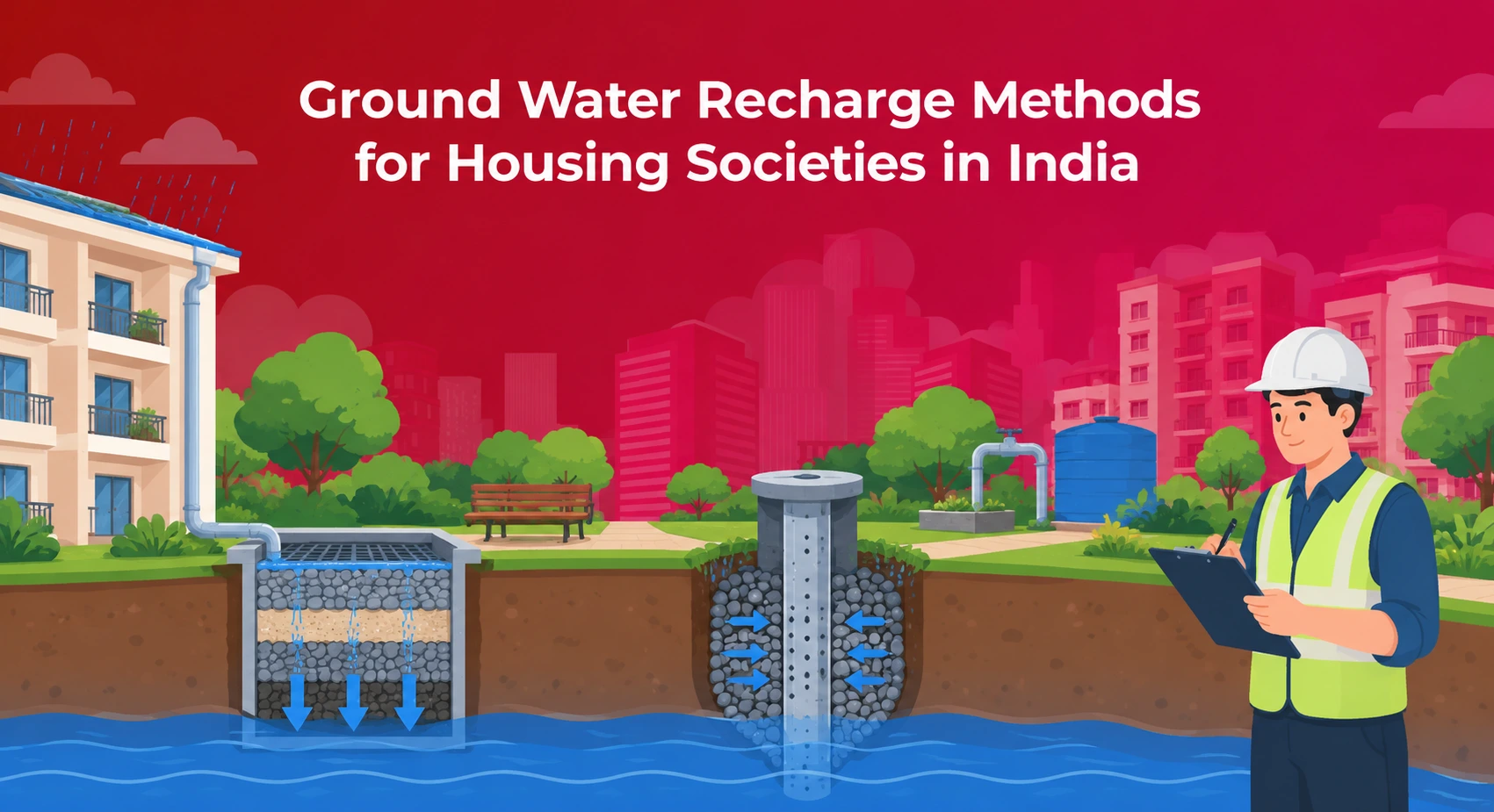


Groundwater recharge helps housing societies make better use of rainwater and reduce pressure on local groundwater sources. This guide explains ground water recharge methods, including surface and subsurface techniques, and how rooftop rainwater harvesting can support them. It also covers suitable recharge options for different society conditions, factors to consider before installation, and practical maintenance steps to keep recharge systems working effectively.

What Is Groundwater Recharge?
Groundwater recharge is the natural or planned movement of water from the surface into underground water-bearing formations called aquifers. Rainwater can enter the soil through infiltration and move deeper through the unsaturated zone until it reaches the water table. There are two broad ways this happens:
- Natural recharge: Rainfall, surface water and other natural sources seep into the ground without a constructed recharge system.
- Artificial recharge: A planned structure captures water and helps direct it into the ground.
Artificial recharge is useful in places where paving, construction, water extraction or changing rainfall patterns have reduced natural recharge. The Central Ground Water Board recommends selecting recharge structures based on factors such as soil, terrain, rainfall, runoff, aquifer conditions and water quality. For a housing society, this means a recharge pit should not simply be dug wherever there is empty space. The structure needs to match the site's conditions.
Why Does Groundwater Recharge Matter for Housing Societies?
Many apartment communities depend on a mix of municipal water, borewells and tankers. During dry months, heavy dependence on groundwater can put pressure on local aquifers. Well-planned recharge can help a society:
Many apartment communities depend on a mix of municipal water, borewells and tankers. During dry months, heavy dependence on groundwater can put pressure on local aquifers. This makes water supply in housing societies an important part of long-term water planning. Well-planned recharge can help a society:
- Reduce the pressure on groundwater sources
- Make better use of monsoon runoff
- Reduce water flowing into storm drains
- Support local water-table recovery
- Reduce dependence on tankers over time
- Manage rainwater within the property
- Reduce waterlogging in suitable areas
Recharge should also be treated as part of a larger water management system for society. Reducing leaks, monitoring consumption and reusing treated water can work alongside recharge measures. These practices can also be included among eco-friendly housing society tips, helping communities manage water resources more responsibly.
What Are the Main Types of Ground Water Recharge Methods?
The main ground water recharge methods can be grouped into surface and subsurface techniques.
Surface techniques
They keep water at or near the ground surface for some time so that it can infiltrate naturally. Examples include percolation basins, flooding, ditch systems, check dams and nala bunds.
Subsurface techniques
They use pits, shafts, wells or similar structures to move filtered water deeper into the ground.
There are also combination systems. For example, a surface basin can be connected to a recharge shaft or well where local conditions make that suitable.
What Are the Surface Ground Water Recharge Methods?
Surface recharge is generally useful where sufficient open land and suitable soil conditions are available. Some common techniques include:
1. Flooding or Water Spreading
- Water is spread as a shallow layer over suitable land. Keeping water in contact with the ground for longer gives it more opportunity to infiltrate.
- This technique is more common in larger open areas and agricultural or watershed settings than in apartment complexes.
2. Percolation Tanks and Basins
- A percolation basin or tank temporarily stores runoff. Water then moves slowly through the bottom and sides into permeable soil or fractured formations.
- For a society, a landscaped detention or infiltration area may be considered where there is enough open space and the soil and groundwater conditions are suitable.
3. Check Dams and Nala Bunds
- Small barriers across seasonal streams or drainage channels slow the movement of water. This gives runoff more time to spread and infiltrate.
- These structures are more relevant to larger land parcels, rural areas and watershed projects than most apartment premises.
4. Ditch and Furrow Systems
- Shallow channels are created along contours or slopes to distribute runoff and slow its movement.
- They can be useful on irregular terrain where a large basin is not practical.
5. Permeable Pavements
- Permeable paving allows some rainwater to pass through the surface instead of sending all runoff into conventional drains.
- In a housing society, it can be considered for selected parking areas, walkways or open spaces after checking the soil, drainage and groundwater conditions.
What Are the Subsurface Ground Water Recharge Methods?
Subsurface techniques can be more useful in built-up areas because they need less surface space. However, they require careful design and filtration.
1. Recharge Pits
Recharge pits are shallow excavated structures filled with suitable filter materials such as gravel, pebbles and sand. Rainwater or runoff enters the pit after passing through a suitable filtration or silt-removal arrangement. The water then percolates into the surrounding soil. CGWB guidance notes that recharge pits are particularly suitable for shallow aquifers and require periodic cleaning.
2. Recharge Trenches
A recharge trench is a long, narrow version of a recharge pit. It can collect runoff from a larger area and allow water to infiltrate gradually. This can work well for apartment complexes where there is more runoff but limited space for several individual pits.
The Chennai groundwater rules, for example, specifically recognise recharge trenches and shallow recharge wells as options for apartment and commercial complexes, with the structure selected according to subsoil conditions.
3. Recharge Wells and Shafts
Recharge wells and shafts provide a vertical route for filtered water to reach deeper permeable formations. They can be considered where shallow infiltration is slow or where deeper aquifer conditions make such a system appropriate.
These are not simple DIY structures. A qualified groundwater or water-management professional should assess the location, aquifer, water quality and construction requirements before installation.
4. Recharge Through Existing Dug Wells
A suitable existing or abandoned dug well can sometimes be converted into a recharge structure after cleaning and proper preparation. The incoming rainwater needs to be filtered and kept free from sewage, waste and other pollutants. The structure also needs periodic inspection and cleaning.
5. Injection Wells
Injection wells can send suitably treated water into a suitable aquifer through a designed well system. They are generally more complex than recharge pits or trenches.
Because the method creates a direct connection with underground formations, water quality is especially important. Injection systems should only be designed after proper hydrogeological assessment and according to applicable requirements.
How Does Rooftop Rainwater Harvesting Help?
Rooftop rainwater harvesting is one of the most practical ways for an apartment society to collect rainfall before it becomes runoff. A basic system can follow these steps:
- Collect: Gutters and pipes collect rainwater from the roof.
- Screen: Mesh screens keep leaves and larger debris out.
- First flush: The initial runoff can be diverted to remove accumulated dust and surface contaminants.
- Filter: A suitable filter or silt-removal chamber removes suspended material.
- Recharge or store: The cleaner water can be sent to a suitable recharge structure or storage system, depending on the design.
The Central Ground Water Board recommends rooftop rainwater harvesting and structures such as recharge pits, trenches, shafts and wells in urban settings, while stressing the need to follow technical parameters to prevent aquifer contamination. A society should also keep sewage lines, chemical storage, waste areas and other possible contamination sources away from recharge structures.
Which Ground Water Recharge Methods Suit a Housing Society?
There is no single structure that works for every apartment community. The choice should be based on the site's conditions.
| Society situation | Possible option |
| Small open area and suitable soil | Recharge pit |
| Large roof runoff | Recharge trench |
| Limited surface infiltration | Recharge shaft or suitable well |
| Existing suitable dug well | Dug-well recharge |
| Large landscaped/open area | Infiltration or percolation basin |
| Parking or walkway redevelopment | Permeable pavement |
| Large site with seasonal drainage | Check dam or nala bund, where appropriate |
Before construction, the society committee should assess soil type, groundwater depth, rainfall, roof area, runoff volume, existing drainage and aquifer conditions. The objective is not to build the biggest structure. It is to build a structure that can safely accept the available water and recharge the appropriate formation.
How Can Societies Maintain Recharge Systems?
Even well-designed ground water recharge methods can stop working properly when filters become clogged with silt. So before the rainy season begins, the society can include recharge-system checks in its monsoon checklist for housing society committees. A simple maintenance checklist can include:
- Clean roof gutters before the monsoon.
- Inspect first-flush arrangements.
- Remove silt from recharge pits and trenches.
- Check filter media periodically.
- Keep waste and sewage away from recharge points.
- Inspect pipes for blockages and damage.
- Check whether water is entering the structure properly during rainfall.
- Record borewell water levels at regular intervals.
- Test groundwater quality as required.
- Schedule major cleaning before the monsoon.
Maintenance is particularly important because sediment can reduce infiltration over time.
Track Complaints with NoBrokerHood’s Complaint Management System
Groundwater recharge systems need regular attention to keep them working properly. A clogged filter, blocked rainwater pipe, or damaged recharge structure can go unnoticed if residents do not have a clear way to report the issue. For large apartment communities, tracking these complaints can become difficult when they are shared through different channels.
NoBrokerHood's complaint management system gives residents and committees a structured way to report and follow up on maintenance issues. This can help societies keep water-related complaints organised and ensure that recurring problems are not lost among routine community requests.
Key features include:
- Complaint Tracking: Record maintenance complaints and keep track of their progress.
- Issue Assignment: Direct reported issues to the appropriate maintenance team or person.
- Status Updates: Keep a record of whether a complaint is pending, being addressed or resolved.
- Complaint History: Refer to earlier complaints to identify recurring maintenance concerns.
A structured complaint process can support the regular upkeep of recharge pits, trenches, filters and rainwater drainage systems.
