






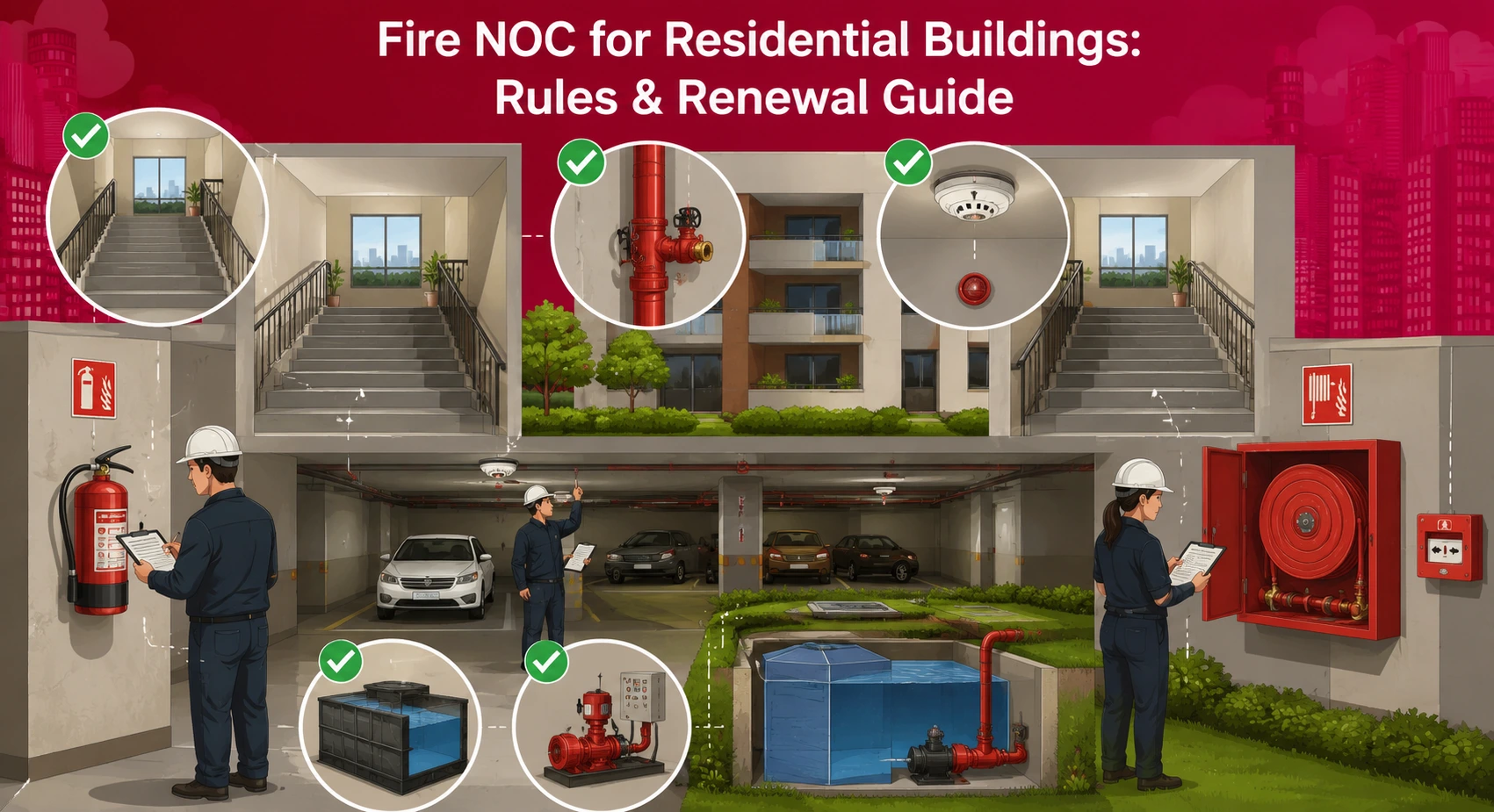


A fire NOC for residential buildings is a document that certifies that a housing society has the necessary fire safety standards for evacuation, firefighting systems and emergency access. But receiving the certificate is just the start. This guide explains when a fire NOC is required, the main rules societies should follow, the documents needed, the application and renewal process, the most common reasons for rejection and practical ways for committees to keep fire safety records and systems up to date.

What Is a Fire NOC for Residential Buildings?
A fire NOC for residential buildings is a legal document issued by the State Fire and Emergency Services department. It certifies that a housing society has fire prevention systems, exits and water storage as required in the National Building Code.
Most states consider this mandatory for high rise apartments, which is usually anything over 15 meters or about Ground plus 4 floors. Without a valid certificate, a society cannot legally receive its occupancy certificate, and residents may run into trouble with insurance claims after an incident.
Many owners assume this certificate is only a builder's responsibility. In reality, the housing society or the resident welfare association usually has to renew it, since fire NOC validity is limited in duration and not a single approval. This is one of the most common gaps committees discover only when a resale, a loan application, or an insurance claim brings the paperwork under scrutiny.
Read also: Emergency Response Team
When Is a Fire NOC for High Rise Building Required?
Not every residential property needs this clearance. State rules vary a little, but the general triggers are fairly consistent across India.
A fire NOC for high rise building is typically needed when:
- The building height crosses 15 metres, or roughly G+4 floors, though some states set the limit at 12 metres.
- The complex has a large built-up area or a high number of dwelling units.
- The society is applying for a completion certificate or occupancy certificate from the local municipal body.
- The building undergoes major structural changes, additional floors, or a change in usage after the original approval.
Smaller low-rise housing blocks are often exempt from a formal fire NOC for high rise building requirements, but they are still expected to follow basic building bylaws around exits and fire extinguishers. It’s worth checking with the local fire department directly because the exact height and area thresholds differ from state to state, and a handful of cities have also begun asking mid-rise societies to comply.
Fire NOC Rules Every Housing Society Should Know
Fire NOC rules exist to make sure a building can be evacuated safely and that a fire can be controlled before it spreads. Knowing the basics will help committees during inspections and audits. Some of the core fire NOC rules include:
- Two clear exits: Each floor should have at least two wide, unblocked staircases so residents can't get trapped if one way out is blocked.
- Working firefighting equipment: Wet risers, fire extinguishers, hose reels and manual call points should be installed and serviced regularly.
- Water Storage: Underground and terrace static tanks need to hold enough water for firefighting, with pumps of adequate capacity.
- Open access around the building: Enough space must be maintained around the structure so that fire engines can get to every side.
- Electrical safety: Wiring should have a valid completion certificate, and emergency lighting should show exit routes.
- Smoke and Fire Alarms: Install automatic detection systems that cover common areas, basements and parking levels.
These fire NOC rules are drawn from the National Building Code along with the respective state Fire Services Acts, so a society's exact checklist can vary slightly depending on location.
Read also: Fire Safety Measures for Housing Societies
Documents Needed to Apply for Fire NOC for Residential Buildings
Getting the paperwork right the first time saves weeks of back and forth with the fire department. A complete application usually includes:
- Approved building and site plans, with fire escape routes clearly marked
- Structural stability certificate from a licensed engineer or architect
- Electrical wiring completion certificate
- Details of installed firefighting systems, including alarms, extinguishers, and water tanks
- Ownership proof such as a sale deed, along with applicant ID and address proof
- Recent photographs of the building exterior and the fire safety installations
Societies applying for renewal will also need the previous NOC copy and any maintenance or servicing records for fire equipment. Keeping these documents organised in one folder, rather than scattered across the committee's personal emails, makes the next renewal significantly less stressful.
How to Apply for a Fire NOC for Residential Buildings
Most states now accept applications online, which has made the process for a fire NOC for residential buildings noticeably faster than a few years ago.
- Register on the state fire portal. Most states use a single window system or a dedicated fire services website.
- Submit the application and documents. Upload building plans, safety equipment details, and proof of ownership, then pay the applicable fee.
- Wait for the site inspection. A fire officer visits the property to physically check exits, alarms, water storage, and access routes.
- Fix any gaps flagged during inspection. Common issues include blocked staircases, missing extinguisher tags, or non-functional alarms.
- Receive the digitally signed NOC. Once compliance is confirmed, the certificate is issued and should be renewed before it lapses.
Why Fire NOC Applications Get Rejected?
A rejected application usually comes down to a handful of avoidable issues:
- Fire extinguishers that are expired or were never refilled on schedule
- Staircases or exits used for storage, which blocks free movement
- Water tank capacity that does not match the building's occupancy load
- Missing service tags or invoices for installed equipment
- No trained fire safety officer where one is required
Why a Fire NOC Matters for Every Resident?
Residents might think a fire NOC for residential buildings is paperwork that only concerns the management committee. But every resident has a stake in it. A missing or expired NOC can affect home insurance claims, delay resale transactions, and, in the worst case, put lives at risk during an actual emergency.
Residents reporting a blocked staircase, a missing extinguisher, or a locked fire exit is not hard to do; it is genuinely useful. Residents’ small observations often catch problems before an inspection can.
Read also: Emergency Evacuation Plans for Apartments
Fire NOC Renewal: What Housing Societies Should Know?
A fire NOC for residential buildings is not something to sort out once and forget. Committees that stay ahead of it tend to follow a few simple habits, rather than scrambling when a renewal date or a resale suddenly brings it up. A few habits that make this easier to manage:
Assign One Point Person
Someone should be responsible for the NOC file, the renewal date, and keeping track of the equipment and its service requirements. When this is split across several committee members, it usually ends up being nobody’s job.
Centralise the Paperwork
Building plans, electrical certificates, the current NOC, and past inspection notes should live in one shared folder that any committee member can access, so nothing needs to be hunted down under pressure.
Start Renewal Early
Fire departments can take weeks to go from application to inspection. Begin the process two to three months before the current NOC lapses.
Budget for Fire Safety in Advance
Extinguisher refills, alarm servicing, and sprinkler checks are predictable costs. Building them into the annual maintenance budget avoids approving funds only after a complaint.
Run a Yearly Evacuation Drill
This helps residents actually know the nearest exit, rather than just where it is marked on paper. And it also gives the committee an honest sense of whether staircases and signage work in practice.
Keep Dated Service Records
Ask vendors for dated invoices and service tags on equipment. Inspectors specifically look for this, and missing records are one of the most common rejection reasons.
Do Quarterly Walkthroughs
A basic check for blocked staircases, expired extinguishers, or non-working alarms often catches problems before an inspector does.
Explain the Rules to Residents
Let people know why certain areas cannot be used for storage, or why a drill is happening. Compliance works better when residents understand the reason behind it rather than viewing it as a committee rule.
None of this needs a large budget or outside expertise. It mostly comes down to consistency and having someone who does not let the task fall through the cracks between meetings.
Manage Complaints and Emergencies With NoBrokerHood
Fire safety compliance is not a one-time task. It involves regular equipment servicing, renewal dates, inspections, and quick communication when something needs attention. This is where a digital society management platform like NoBrokerHood can fit into the routine work of a housing society. A few ways this can help in day-to-day society management:
- Emergency alerts: The SOS feature allows residents to alert security personnel quickly during emergencies such as a fire or gas leak.
- Digital communication: Notices about fire drills, inspection schedules, or NOC renewals can be shared with residents through the app.
- Complaint tracking: Residents can report issues such as blocked exits, faulty alarms, or damaged fire equipment, while the committee can track their resolution.
- Vendor records: Fire safety vendors and their service activities can be recorded, making it easier to refer back to servicing details when documents are required.
The platform brings these activities into one place, making it easier for committees to keep safety-related communication, complaints, vendor records, and important reminders organised. This can help societies stay prepared for inspections, renewals, and everyday fire safety requirements.
