






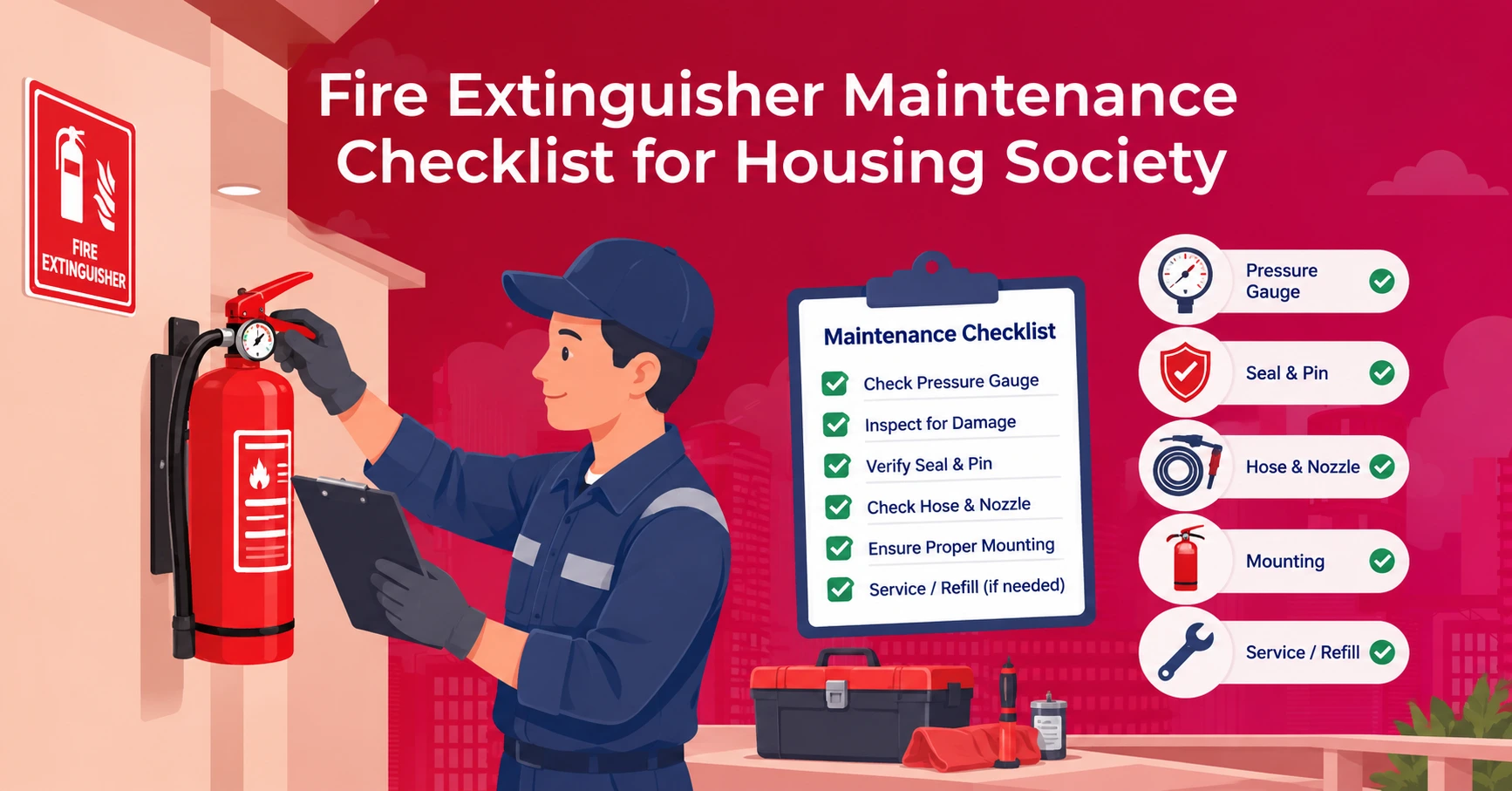


The fire extinguisher will only be effective if it functions on the day you need it. The guide contains the fire extinguisher maintenance schedule for your society. It includes maintenance of fire extinguishers on a monthly basis, quarterly maintenance, annual servicing and hydrostatic testing of the fire extinguishers. It talks about the frequency of servicing each fire extinguisher, how long a refill lasts and when the cylinder needs to be scrapped. It further highlights the expectations of NBC 2016 and IS 2190 by an RWA, positioning of fire extinguishers, AMC and Fire NOC and mistakes to avoid.

Why Does Fire Extinguisher Maintenance Matter for a Society?
Most societies own enough extinguishers. The trouble starts when nobody has looked at them for two years. The gauge is no longer in the green zone, there is an insect nest in the hose, and the cylinder is placed behind the line of two-wheelers.
Fire extinguisher maintenance is also covered by law. In India, it comes under the National Building Code (NBC), 2016, other laws such as the Life Safety Measures Act and the standard set by BIS IS 2190. The managing committee/ RWA will be legally and financially responsible if there is a failure in fire safety equipment. A steady routine protects residents first. It also keeps the society ready when the Fire NOC comes up for renewal.
Monthly Fire Extinguisher Maintenance Checklist
The monthly round is done by the security supervisor or estate manager. Each cylinder needs only a quick look.
- The extinguisher is visible, unblocked, and mounted at the right height.
- The pressure gauge needle sits in the green zone. CO₂ units have no gauge, so they are checked by weight.
- The safety pin is in place, and the plastic tamper seal is not broken.
- The body has no rust, dents, cracks or leaks, especially on the bottom.
- The hose and nozzle have no cracks, clogs or insect nests.
- The instruction label is visible, readable, clean and facing outward.
- The cylinder has an inspection card stamped, signed and dated.
Quarterly Fire Extinguisher Maintenance Checklist
Every three months, the in-house team or a vendor does a little more than look.
- Wipe the body, nozzle, and hose to remove dust, cobwebs, or grease.
- Weigh CO₂ and dry chemical units. A weight drop of more than 10% points to a leak, and the unit needs refilling.
- Turn dry chemical extinguishers over and shake them gently so the powder does not pack down at the bottom.
A simple split works in a tower. The night guard wipes the units down, and the facility manager does the weighing.
Annual Fire Extinguisher Maintenance Checklist
A licensed fire agency handles this one. It is the line on your fire extinguisher maintenance checklist that no volunteer can sign off.
- The technician examines the outside, valves, washers, gaskets, and seals.
- Worn parts are replaced.
- Units are refilled or recharged after any use or pressure drop.
- Each cylinder gets a service tag with the technician’s name, licence or certification, service date, and next due date.
Ask the agency for a written certificate and keep all of them in one folder. You will want them at Fire NOC renewal time.
Fire Extinguisher Refilling, Testing and Replacement Schedule
IS 2190:2024 says an extinguisher must be refilled right after any use, even a partial discharge, or when its test date arrives. The interval depends on the type.
| Type | Refill or test interval | Maximum life |
| Water and foam | Every 3 years | 10 years |
| Dry chemical powder (stored pressure or cartridge) | Every 3 or 5 years, by model | 10 years |
| CO₂ | Every 5 years | 15 years |
| Clean agent | Every 5 years | 10 years |
Hydrostatic pressure testing happens at a certified fire laboratory every 3 to 5 years. The cylinder is tested with water at a higher pressure to find micro-cracks and metal fatigue. Good fire extinguisher maintenance includes retiring a unit that fails the test, shows severe corrosion, or passes its maximum life. A failed cylinder is scrapped, not topped up and hung back on the wall.
Where Should Fire Extinguishers Be Placed in Housing Societies?
Placement belongs on the fire extinguisher maintenance checklist too, because a perfect cylinder behind a parked scooter helps nobody.
- Fit at least one extinguisher per 200 sq m of floor area, with a minimum of two on every floor landing.
- Put dedicated units outside electrical duct rooms, lift machine rooms, diesel generator rooms, and guard cabins.
- Mount each one on a wall bracket or stand with the handle between 1.0 and 1.5 metres above the floor. Never leave one standing on the bare floor.
Fire Extinguishers Maintenance in Housing Societies
Checklists usually fail at the follow-up, not at the first round. These fire safety measures for housing societies keep the routine going after the first month:
- Sign an Annual Maintenance Contract (AMC) with a certified fire safety vendor. The vendor handles periodic refilling and logging, and helps with the Fire NOC renewal.
- Hold at least one live fire drill every year. Teach the PASS method: Pull the pin, Aim at the base, Squeeze the lever, Sweep side to side.
- Name one person per tower for the monthly round, so it never becomes everybody’s job and nobody’s job.
- Print the fire extinguisher maintenance checklist and keep a copy in each tower’s guard cabin.
Track Fire Safety Complaints with NoBrokerHood Complaint Handling System
Fire extinguisher maintenance runs on scheduled checks, but things go wrong between them. A hose gets damaged, a safety pin goes missing, or a cylinder ends up behind a parked car. If residents and guards have no clear way to tell the committee, the problem can sit there unreported.
NoBrokerHood’s complaint handling system gives residents a place to report maintenance issues, and it lets the committee organise and follow those complaints. That makes it easier to log a reported problem and chase it up with the facility team.
Features include:
- Complaint registration: Record the maintenance and facility issues that residents report.
- Issue tracking: See how each complaint is progressing and which requests are still pending.
- Task assignment: Send a reported issue to the right team or person.
- Complaint history: Look back at earlier reports when the same problem keeps returning.
With complaints in one place, the committee can act on a reported fire safety issue sooner.
