






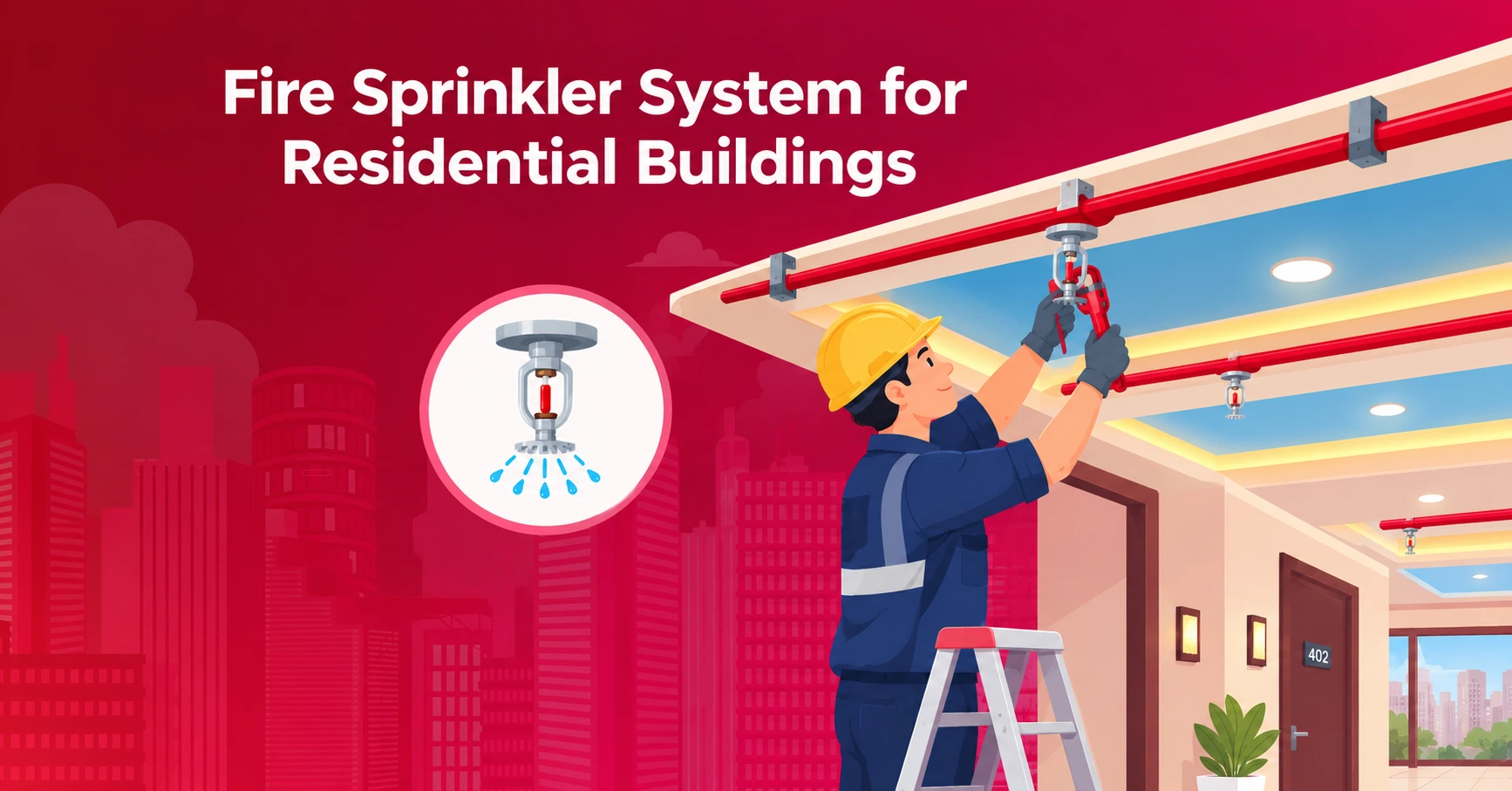


Fire sprinklers for residential buildings help control fires before they get out of hand and provide people in the building enough time to evacuate. However, selecting the right system is not just about putting up sprinkler heads. This guide discusses the functioning of residential sprinklers, different types of systems, and fire safety codes applicable in India. It also talks about the installation procedure and regular maintenance practices for housing societies.

Why Do Residential Buildings Need Fire Sprinklers?
Fire can start in a kitchen, an electrical panel, a parking lot, or in a room full of flammable materials. In apartment buildings, it spreads quickly because residents share corridors, staircases and other common areas. A fire sprinkler system for residential buildings will fight the fire automatically. And it works even when there is nobody to grab an extinguisher.
It helps in four ways. Water comes out right above the heat source, so the fire stays small. Residents get more time to get out. Nearby rooms and belongings take less damage. And sprinklers fit into a bigger plan that also includes alarms, extinguishers, clear exits and firefighting equipment. Sprinklers don’t replace smoke alarms, evacuation plans or the fire brigade. They work best alongside all of those.
How Does a Fire Sprinkler System for Residential Buildings Work?
The system has a water supply, pipes, sprinkler heads and control parts. Depending on the design, it may also have pumps, tanks, valves and water flow alarms.
When a fire starts, heat rises to the sprinkler head. Each head has a small heat-sensitive element, usually a glass bulb or a fusible link. Residential heads are often rated somewhere between 57°C and 74°C, depending on the product and where it’s used. Once the air around the head reaches its rating, the bulb breaks or the link lets go. Water flows out through the open head, and a deflector spreads it into a spray. The water cools whatever is burning and slows the spread.
Standard heat-activated heads don’t react to smoke alone, and burnt toast on the stove won’t set one off. Every head works on its own, so a small fire normally doesn’t make all the sprinklers in a home go off together. If the fire spreads, more heads can open. How many heads can open is usually dependent upon the fire, the system design and the water supply.
Types of Residential Fire Sprinkler Systems
The types of residential fire sprinkler systems differ in how water gets to the heads and how the piping ties into the building’s water supply. The right pick depends on the layout of the property, the climate, the water pressure and the fire safety measures for housing societies that apply. Here are the five types of residential fire sprinkler systems:
Wet pipe system
Water sits in the pipes under pressure. When a head opens, water comes out at once. This suits homes and residential buildings where the pipes won’t freeze. The design is fairly simple and it needs fewer specialised parts than most other types.
In most of India, freezing is less of a worry than in colder countries. Even so, unheated areas and local temperatures still need a look.
Dry pipe system
In place of water, the pipes contain pressurised air or nitrogen. Once the head activates, the pressure will fall, and then the valve will allow the water to enter the pipe. It is used to protect the pipe from freezing when it is used in cold places. However, it is more complex than the basic wet system, and water takes a little longer to come because the air must escape.
Don’t assume dry pipe is automatically right for every garage or terrace. A qualified designer should look at the actual conditions.
Pre-action system
A separate detection mechanism and a controlled valve decide when water enters the sprinkler pipes. The exact sequence depends on the design. These systems are intended for special areas where accidental discharge would cause serious damage and have to fulfil the applicable design requirements. They are more complex; they usually need extra detection and controls, and they cost more to maintain. They aren’t the default for an ordinary flat.
Multipurpose system
Domestic plumbing and the sprinklers share one compatible piping network. Because people use the water every day, it keeps moving through the pipes. This suits certain individual homes that were designed for it from the start. The design has to meet both plumbing and fire protection requirements, and you shouldn’t assume a normal domestic plumbing network can feed sprinklers until a professional has checked it.
Standalone system
Here the sprinklers get their own separate pipe network. It can connect to an approved water source and, where needed, a pump or storage tank. It keeps the sprinklers apart from domestic plumbing, but it needs its own design, water supply and maintenance plan. It suits homes and residential buildings where an independent network makes sense.
Which system should you choose?
- Wet pipe keeps water in the pipes and responds fast in suitable conditions.
- Dry pipe keeps air or nitrogen in the pipes and guards against freezing.
- Pre-action controls when water enters and suits specialised spaces, at the price of more complexity.
- Multipurpose shares domestic piping, so the plumbing design has to be right. Standalone uses dedicated piping and needs its own supply and upkeep.
The types of residential fire sprinkler systems listed above aren’t all direct alternatives to each other. Wet and dry describe how the pipes behave. Multipurpose and standalone describe how the system connects to domestic plumbing. A designer has to pick the right combination for your property.
What Fire Sprinkler Standards Apply to Residential Buildings in India?
The National Building Code of India 2016 (NBC 2016) covers fire protection for different kinds of buildings, mainly in Part 4, Fire and Life Safety. It is a model code. It becomes enforceable only through state and local building regulations.
The requirements for a fire sprinkler system for residential buildings change with the building’s height and occupancy class, its approved plans and use, the local building bylaws and fire service rules, and any conditions the fire department attaches to its approval.
As for the technical aspect, the Bureau of Indian Standards issues the code of practice IS 15105 for design and installation of fixed automatic sprinkler fire extinguishing systems. The latest version is IS 15105:2021. It specifies the minimum requirements for design, installation, and maintenance of such systems in various occupancies of buildings, and the sprinkler designer uses this standard together with NBC 2016.
The housing society committees need to find out what requirements apply to their buildings by consulting a fire protection expert and the local fire authorities. Don’t assume every residential building follows the same sprinkler rules.
How Does Residential Fire Sprinkler System Installation Work?
Residential fire sprinkler system installation needs planning, suitable materials and testing, and it should be done by professionals who know the building’s fire protection requirements.
Step 1: Assess the building
The designer looks at the floor plan, ceiling heights, use of each room, possible fire hazards, and location of the heads. In the case of an apartment complex, the evaluation may also include common areas and building services.
Step 2: Check the water supply
The team measures the available flow and pressure. If the supply falls short, the design may need a fire pump, a storage tank or another approved arrangement. Tank size and pump specifications should come from the flow calculations, not from a rough guess.
Step 3: Plan the pipes and heads
Pipes can run above ceilings, through concealed spaces or through service areas. Materials include approved CPVC, PEX or metal piping, depending on the system and the standards in force. Heads go where the approved design puts them. Coverage depends on the head’s listing, the ceiling, obstructions and spacing rules, so don’t assume one fixed coverage area for every model.
Step 4: Install the equipment
The crew fits the piping, heads, valves and monitoring components, following the approved drawings and the manufacturer’s instructions. Residents shouldn’t paint, cover or move sprinkler heads during renovation. Even a decorative ceiling or a new light fitting can block the spray pattern.
Step 5: Test and get approvals
The contractor runs the prescribed pressure and functional tests, checks for leaks, verifies alarms and flow monitoring where they exist, and prepares the records. The committee or owner should keep the approved drawings, equipment details, test reports and fire authority approvals, including the fire NOC where the local rules require one.
How Can a Housing Society Maintain its Sprinkler System?
Residential fire sprinkler system installation is only the first half of the job. A fire sprinkler system for residential buildings also has to stay accessible and ready to work. Here is a checklist a society committee and facility manager can follow:
- Keep sprinkler heads clear. Don’t hang decorations, storage items or anything else from them.
- Look for visible damage, and report corrosion, leaks, missing heads or damaged pipework quickly.
- Keep valves reachable. Only authorised people should operate them, and required valves must stay in their proper position.
- Maintain pumps and tanks, with inspections and tests on the approved schedule and under the applicable rules.
- Record every service visit. Keep inspection reports, repairs, test results and contractor details in one place.
- Train residents and staff on emergency evacuation plans, alarm procedures and emergency contacts.
- Review renovation work. Any change to ceilings, partitions or room layouts should be checked for its effect on sprinkler coverage.
The committee should hand responsibility to a qualified maintenance provider and follow the schedule set by the system design and the local authority. Residents should never test, take apart or repair sprinkler equipment themselves.
Manage Fire Safety Complaints and Emergencies with NoBrokerHood Society Management System
Installing a fire sprinkler system is only one part of keeping an apartment building safe. Residents need to know what to do in an emergency, the maintenance team has to fix faulty equipment, and the guards have to respond fast. NoBrokerHood society management system helps housing societies handle these daily jobs through its communication, complaint and security features.
Here is what a society can use:
- The SOS or panic button lets a resident raise an alert during an emergency like a fire or a gas leak. Security guards and the designated emergency contacts get a notification, so someone can start coordinating a response.
- Emergency alerts and notices let the committee send fire drill schedules, evacuation instructions and urgent safety updates to residents as digital notices and notifications.
- Complaint management lets residents report a problem with a sprinkler, a fire alarm or an emergency light, then follow the complaint until it’s resolved.
- The GuardHood security app gives guards an alert when an emergency is reported and lets them communicate with the emergency response team.
- Digital entry and exit records log the movement of visitors, staff and vendors. Authorised personnel can check them to review activity around the time of an incident.
Together, these keep the committee, residents and security team informed and clear on who does what.
