






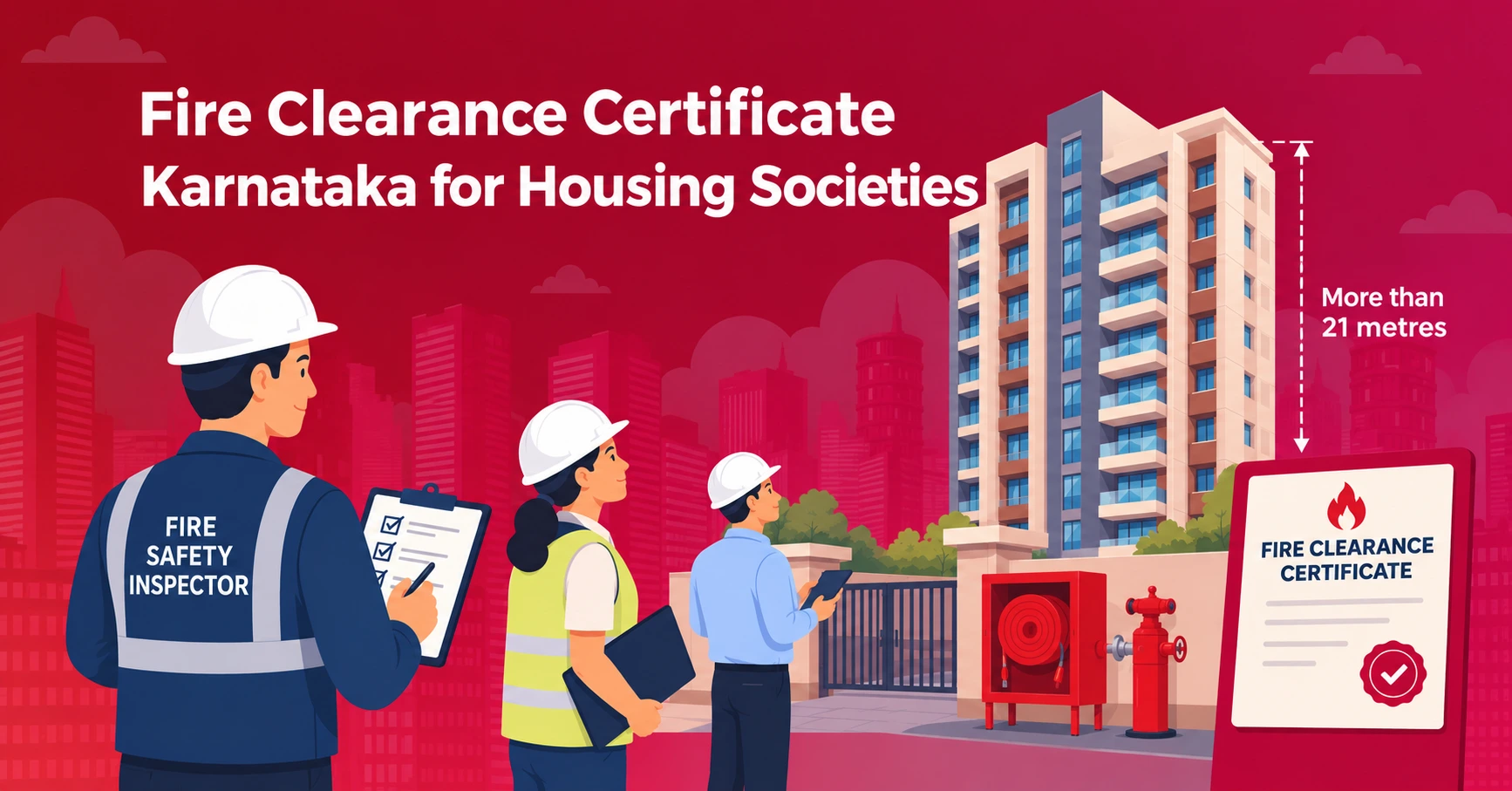


Getting a fire clearance certificate in Karnataka involves more than submitting an application. For housing societies, the process covers building height rules, the Karnataka Fire Force Act, required documents, online application steps, inspections, renewal responsibilities and the consequences of non-compliance. This guide explains the key Karnataka fire NOC rules, who needs the certificate, who is responsible after handover, and the simple checks a society can follow to stay prepared for a fire department inspection.

What Is a Fire Clearance Certificate and Who Needs It in Karnataka?
A fire clearance certificate is the fire department's written confirmation that a building meets fire safety standards. People often call it a fire NOC, but the two documents come at different stages. The NOC is given at the building plan stage. The clearance certificate comes after the fire systems are installed and checked.
Apartment complexes, malls, schools, hospitals and cinema halls all need one. In a housing society, the duty passes through two hands. The builder gets the first NOC, and fire clearance has to be attached to a high-rise occupancy certificate application. After handover, the residents' association renews the certificate and answers to the fire officer.
What Does the Karnataka Fire Safety Act Require from Societies?
The law behind all of this is the Karnataka Fire Force Act, 1964. It’s commonly known as the Karnataka Fire Safety Act. As the title suggests, the act sets up the state fire force and lists what its officers can do at a fire. It also covers how the force is funded and what owners must do to prevent fires. KSFES works under it, and its sections decide what an officer can ask of you. The published Act has 40 sections, and a few matters to the society managing committee:
Section 13: Precautions and the High-rise Rule
Section 13 reaches the society most directly. It lets the state government name the precautions that owners and occupiers of risky premises must take. Once such a notice is out, a fire officer can order flammable goods moved somewhere safe. If the owner does not act, the officer can seize or remove the goods, but only after hearing the owner's side.
The same section changed in 2023, when a new sub-section 13(3) was added. Anyone planning a high-rise must get an NOC from KSFES, and the Karnataka Fire Safety Act now defines a high-rise as 21 metres or more, whatever the building is used for. The amendment took effect on 24 March 2023.
Sections 32 and 33: Information and Entry
Section 32 lets a fire station officer ask an owner or occupier about the building, its water supply and how fire engines can reach it. Section 33 lets the department enter premises covered by a Section 13 notification to check the precautions. Keep your records handy, because a visit can happen.
Section 15: Fire Tax and the Proposed Cess
Section 15 deals with money. It lets the state add a fire tax to your property tax bill, and the surcharge cannot go above 10 per cent of the property tax. A separate change is proposed for new high-rises. The state cabinet has approved a bill for an extra 1 per cent fire cess on their property tax. Ask your local body whether either charge applies to your property.
Penalties Written into the Act
- Section 25 fines anyone who ignores a Section 13 notification or direction, up to Rs 500.
- Section 37 says anyone who knows of a fire must tell the nearest fire station without delay.
- Section 24 punishes a failure to do so with up to one month in jail or a Rs 500 fine.
- Section 26 covers wilful obstruction of firefighters, with up to three months in jail or a Rs 500 fine.
- Section 31 makes a person whose property catches fire through deliberate or negligent action liable to pay compensation for damage caused by firefighting. If a society's neglect starts a fire, that liability can reach the committee's door.
The fines in the Karnataka Fire Safety Act are small, at most Rs 500 for ignoring a Section 13 notice. The higher cost of a lapse can lead to power cuts or trouble with the occupancy certificate.
What Are the Karnataka Fire NOC Rules for Housing Societies?
The Karnataka fire NOC rules depend mainly on a building's height. Whether it is under or above 21 metres decides which office handles the application.
- Up to 21 metres: Regional Fire Officers issue clearances locally, and the department has cut the file movement for these from eight stages to three.
- 21 metres and above: The application goes to the head office, and the Director General of Fire and Emergency Services signs it off.
A 2011 notification set the NOC requirement at 15 metres, and the 2023 amendment later set the high-rise line at 21 metres. For a building between 15 and 21 metres, ask your local fire station which rule applies. BBMP still checks exits and safety on shorter buildings, so a building under 21 metres should not treat the number as an exemption.
Fire Clearance Certificate Validity and Renewal in Karnataka
Every certificate carries an end date, and the Karnataka fire NOC rules do not set the same period for every building. A Belagavi school's certificate issued in January 2024 ran for one year. A Mangaluru school's clearance was renewed in 2025 for two years after the District Fire Officer inspected it. Reports on a dispute at a Yelahanka apartment complex describe a two-year cycle.
In 2017, the department described the Carlton Towers clearance in Bengaluru as an annual renewal. Read the date on your own certificate and plan around it. Each renewal follows a physical inspection of the systems.
Who Renews the Fire Clearance Certificate?
The builder gets the initial NOC before the occupancy certificate. Once ownership passes to residents, the RWA or the property owner is responsible for keeping the fire systems working and the fire clearance certificate Karnataka rules expect from you current.
Documents Required for a Fire Clearance Certificate in Karnataka
The list for a new fire clearance certificate Karnataka application is short and mostly includes paperwork that the builder already holds:
- Approved building plans: site plan, floor plans, elevations, and sections
- Built-up area statement
- Schematic drawings of the firefighting and fire detection systems
- Ownership proof, plus the applicant's ID and address proof
- Structural stability and electrical compliance certificates
For a renewal, keep the previous certificate and your maintenance records ready. Officers look for working hydrants, overhead water tanks, sprinklers, smoke detectors and emergency lighting, and for escape routes and refuge areas marked on the plans.
How to Apply for a Fire Clearance Certificate in Karnataka Online?
You can apply for a fire clearance certificate Karnataka through the official KSFES portal. The steps are:
- Open the Karnataka State Fire and Emergency Services Portal and register as a new public user, or sign in.
- Go to online services and choose the NOC or Clearance Certificate option.
- Fill in the building, applicant and technical consultant details.
- Upload scanned copies of the plans and safety documents.
- Submit the form and pay the fee once it is generated.
- Wait for the site inspection by the jurisdictional officer.
Most committees hire a fire consultant for the technical details in step 3. Businesses can also reach the same service through the Karnataka Udyog Mitra interface.
What Happens If a Fire Clearance Certificate Karnataka Expires?
Kendriya Vihar, a 24-year-old apartment complex in Yelahanka, shows how a lapsed fire clearance certificate Karnataka officers have flagged can play out. The fire department said the complex had not renewed its clearance. After several reminders and a final seven-day notice in March 2025, it asked BESCOM to disconnect power and asked BBMP to withhold or cancel the possession certificate.
The Karnataka High Court stayed the Bangalore Development Authority's attempt to cut power and cancel occupancy certificates. The residents still had months of uncertainty over something a calendar reminder could have prevented.
If an audit finds lapses, the department gives up to three months to fix them. Once that window closes, continued non-compliance can lead to a power cut, a suspended occupancy certificate, a sealed building and criminal cases against those responsible.
How Can Housing Societies Stay Ready for a Fire Inspection?
- Put the certificate's end date in the committee calendar, with a reminder three months before.
- Keep one folder, printed and digital, with the NOC, the last certificate, inspection reports and maintenance bills.
- Check extinguisher refill dates, hydrants, pumps, sprinklers, smoke detectors and emergency lights on a fixed schedule through your maintenance vendor.
- Walk the staircases and refuge areas every month. Shoe racks and cartons in a stairwell are the usual problem.
- Run a mock drill once or twice a year and note how long the evacuation took.
- Put the nearest fire station's number on the notice board and in the resident group.
A society that does these six things finds the renewal inspection a routine visit, and the fire clearance certificate Karnataka officers sign stays valid without a scramble.
Manage Society Safety and Emergency Response with NoBrokerHood's Society Management System
A fire clearance certificate is only one part of keeping an apartment community prepared. The committee still has to keep track of fire-safety complaints, share drill notices, coordinate with security staff and make sure residents know what to do during an emergency. NoBrokerHood society management system can help organise some of these routine tasks through its communication, complaint and emergency-response features.
Key features include:
- SOS/Panic Button: Residents can raise an emergency alert through the app and select the type of emergency, such as fire, medical assistance, gas leak, theft or lift-related incidents. The alert can reach security guards and emergency contacts added by the resident.
- Emergency Alerts and Notices: Committee members can send urgent alerts and notices to residents, including fire-safety updates, mock-drill announcements and other important instructions.
- Complaint Management: Residents can raise maintenance complaints, add photos and track their status. Issues such as a faulty fire alarm or damaged emergency light can therefore be recorded for follow-up.
- Staff and Vendor Records: Staff and vendors can be enrolled with relevant documents and photographs, helping the committee maintain organised records of people working within the community.
- Communication Management: The platform provides a central channel for sharing safety updates, drill schedules and other community announcements instead of relying only on informal messages.
These features can help committees stay organised between inspections and keep residents, security staff and maintenance teams better connected.
