






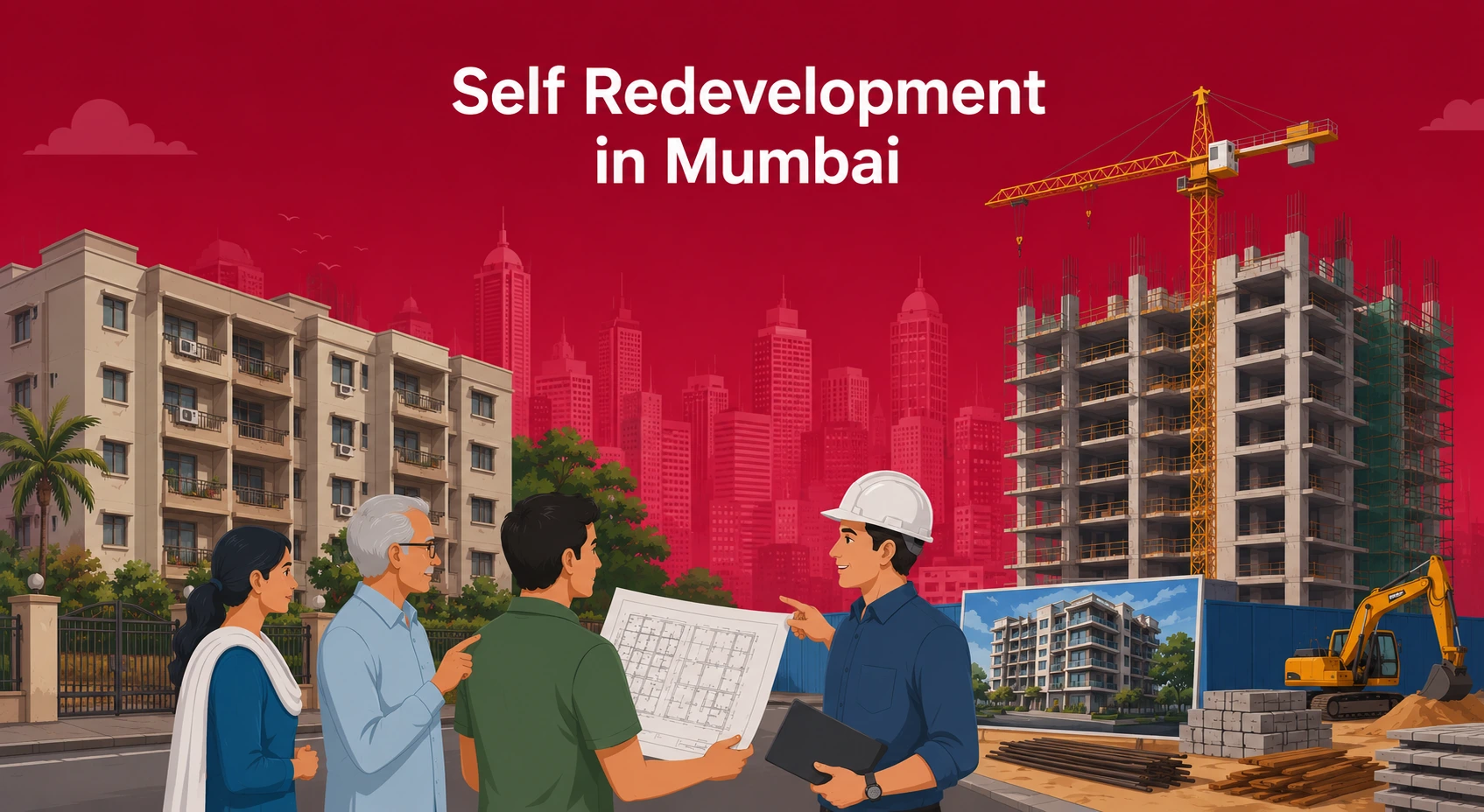


Ageing buildings, rising repair costs, and one too many stalled builder projects have forced many housing societies to look at self redevelopment in Mumbai as a real alternative. Instead of giving the project to a private developer, the society takes control itself, from hiring the architect to selling off any surplus flats. This guide covers eligibility, the approvals you will need, how the MHADA self redevelopment scheme fits in, financing options, and the detailed process, so your managing committee can decide with confidence.

What Is Self Redevelopment in Mumbai?
In a typical redevelopment, a society signs an agreement with a builder who funds and manages the entire project. The builder then sells the surplus flats and pockets the profit. Self redevelopment in Mumbai flips this arrangement. The society itself becomes the developer.
Members raise the funds, appoint their own professionals, and oversee construction from start to finish. Any flats built beyond what current members need are sold in the open market, and that money goes straight into the society's corpus fund. Societies also stand to gain extra Floor Space Index, sometimes up to 10% more than what a private developer route offers, along with larger carpet areas for existing residents.
Why More Societies Are Choosing Self Redevelopment Mumbai Over Builders?
Trust in private developers has taken a hit over the years, with stalled projects and disputes leaving residents stuck for years. This is one reason self redevelopment mumbai has picked up pace across the city's older neighbourhoods.
Here is what draws societies toward this route:
- Full control over layouts, quality of construction, and the pace of work
- Higher returns, since sale proceeds go to the society and not a builder
- Transparency, as members are involved at every decision point
- Better amenities, because the society decides what gets built, not a third party
It does ask for more from the managing committee, in terms of time, coordination, and financial planning. Societies with an engaged committee and the right professional guidance tend to see this through successfully.
Read also: New Rules for Redevelopment of Society in Mumbai
Eligibility Requirements for Self Redevelopment in Mumbai
Not every building qualifies right away, but most older societies in Mumbai meet the basic criteria.
Start by confirming that your society meets the following requirements:
- The society is registered under the Maharashtra Cooperative Societies Act, 1960
- The building is generally 30 years or older, or has been flagged as unsafe by a structural audit
- The society holds a clear conveyance deed, or can obtain a No Objection Certificate if the land belongs to MHADA or another authority
- There is no existing, binding agreement with a private developer
- Members are willing to contribute financially, or the society can secure external funding
If your building ticks most of these boxes, a feasibility study by an architect is usually the next step.
What You Need Before Starting Self Redevelopment in Mumbai?
Once eligibility is confirmed, three things need to fall into place before construction can start.
Member Consent and Approvals
Self redevelopment cannot move forward without the society behind it. A Special General Body Meeting is called to discuss the proposal, and current rules require a minimum of 51% member consent to begin the process. As the project moves toward execution and financial commitments, most societies push for closer to full agreement among members to avoid disputes later. Every meeting should be minuted, and ideally video recorded, to keep the process transparent.
Read more: Special General Body Meeting Rules
Build the Right Professional Team
Since there is no builder managing things, the society hires its own team. This usually includes a Project Management Consultant (PMC), an architect, a structural engineer, a legal advisor, and a chartered accountant. The PMC often becomes the backbone of the project, coordinating between the architect, contractor, and society committee, while the legal advisor handles RERA registration and agreements.
Arrange Financing for the Project
Funding can come from a few sources. Cooperative banks such as the Mumbai District Central Co-operative Bank have supported several self redevelopment projects, and some housing finance companies also offer specific loan products for this purpose. Member contributions, especially in the early feasibility stage, are common too. It helps to get financial commitments in writing before construction begins, so the project does not stall midway.
Self Redevelopment in Mumbai: Step-by-Step Process
While every project has its own timeline, most societies undertaking self redevelopment in mumbai follow a similar sequence:
- Initial consent: Hold a General Body Meeting and secure the required member approval to proceed
- Feasibility report: Appoint an architect to study the plot, assess FSI potential, and estimate costs
- Appoint the team: Bring on board a PMC, legal advisor, and chartered accountant
- Secure approvals: Apply for building permissions from BMC or MHADA, along with any required NOCs
- Arrange financing: Finalise loans or member contributions and open a dedicated project account
- Tender for contractors: Invite open bids and select a contractor through a transparent process
- Sign agreements: Draft agreements covering timelines, rent for temporary accommodation, and penalties for delays
- Construction and monitoring: The PMC and committee track progress through regular site visits and reports
- Occupation Certificate and handover: Once construction is complete, secure the OC and hand over flats to members
Skipping steps, especially legal documentation and RERA registration, is where many projects run into trouble later.
What Is the MHADA Self Redevelopment Scheme?
The Maharashtra Housing and Area Development Authority introduced the MHADA Self Redevelopment Scheme to make this path easier for eligible societies. It works as a single window system, meaning societies can approach MHADA directly for the approvals and support they need, instead of navigating multiple departments on their own.
Under this scheme, societies get access to a curated panel of project management consultants, architects, and contractors who have already been screened for redevelopment work. This cuts down the time societies would otherwise spend on due diligence. The MHADA self redevelopment scheme also opened the door for cooperative banks to lend for these projects, which had previously been a major bottleneck for societies without their own capital.
Key points under the scheme include:
- Streamlined clearances through a dedicated MHADA cell for self redevelopment
- A pre-vetted panel of professionals societies can choose from
- Support in structuring financing through cooperative banking channels
- Applicable mainly to societies on land owned by MHADA, the Collector, or similar authorities, where an NOC is a prerequisite
Societies interested in this route should start by checking with their local MHADA office on current documentation requirements, since these are updated from time to time.
Benefits and Challenges of Self Redevelopment in Mumbai
Self redevelopment in Mumbai comes with real upside, but it is worth going in with clear eyes about what it takes.
Benefits
- Higher carpet area and better amenities for existing members
- Sale proceeds strengthen the society's corpus instead of a builder's balance sheet
- Members decide on design, materials, and pace of construction
- Reduced risk of the project being abandoned midway, since the society is not dependent on a builder's priorities
Challenges
- Requires an engaged, organised managing committee
- Members need to actively participate in decisions and financial planning
- Legal and regulatory paperwork can be extensive without the right advisors
- Delays are possible if consent, funding, or approvals are not managed carefully
Societies that go in prepared, with the right professionals and a committed committee, tend to navigate these challenges without major setbacks.
Simplify Self Redevelopment Communication with NoBrokerHood
Self redevelopment of housing society involves hundreds of decisions over several months, sometimes even years. Keeping every member informed throughout this period is just as important as managing the construction itself. When updates are inconsistent, or discussions happen across multiple WhatsApp groups, misunderstandings and disagreements can slow the project.
NoBrokerHood enables societies to unify communication by providing a single platform for sharing redevelopment updates, meeting notices, documents and announcements to all members. The platform also makes it possible to manage committees to perform digital polls to collect members’ opinions and track responses at critical points of the project.
During self redevelopment, this can help societies:
- Share General Body Meeting notices and redevelopment updates with every member
- Conduct digital polls to collect and monitor member consent for important decisions
- Publish project milestones, timelines, and progress reports in one place
- Keep redevelopment documents and circulars accessible to all members
- Reduce confusion caused by scattered messages across multiple communication channels
A well-informed community is more likely to engage in discussions and make timely decisions. Having communication, documents and member feedback in one place helps the managing committee to stay transparent during the self redevelopment journey.
