





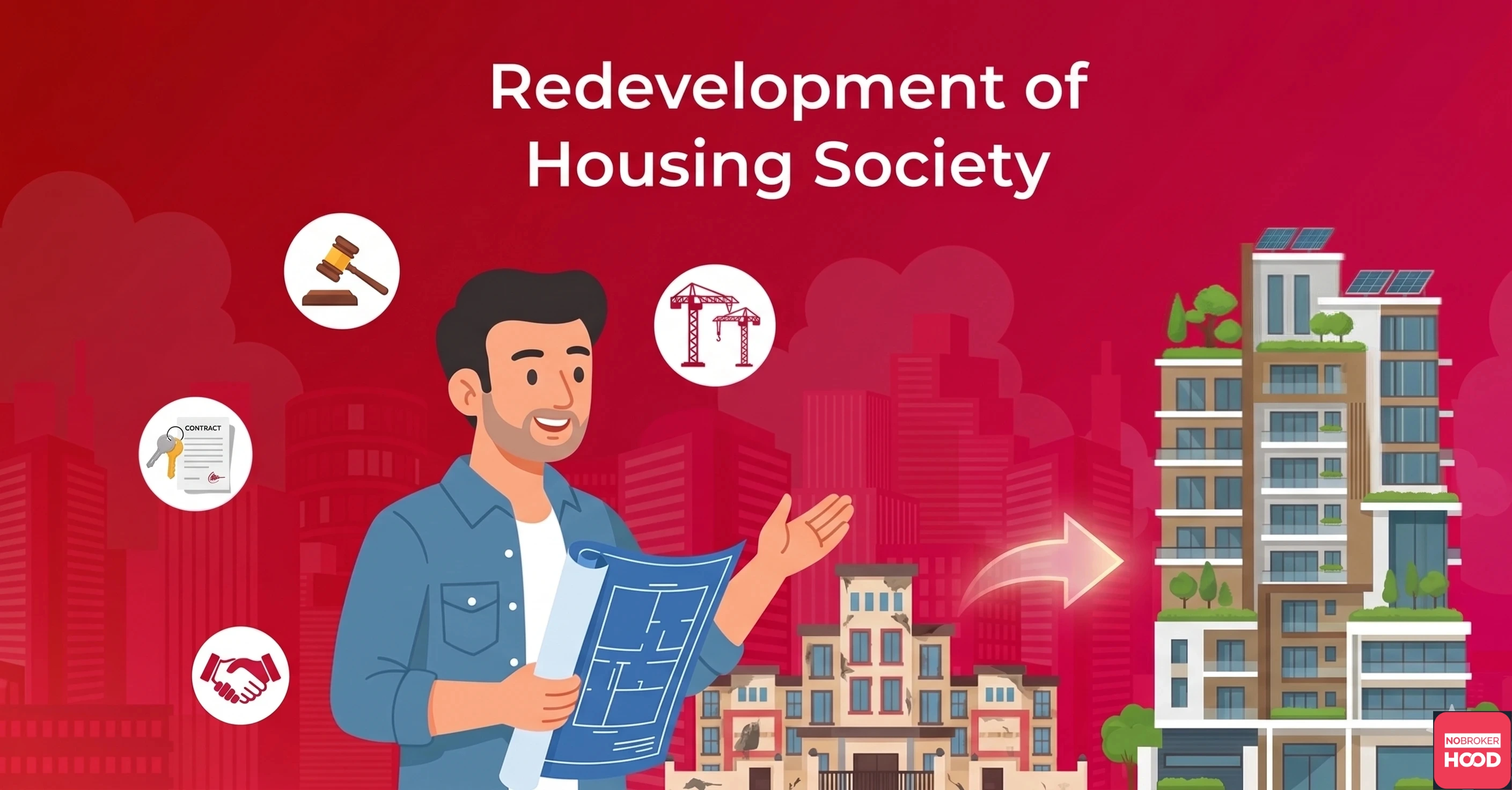


Have you ever wondered how old housing societies transform into modern and useful living areas? Redevelopment of a housing society gives new life to old buildings and makes them safer while providing residents with better services. Let’s have a look at the basics of redevelopment, which include redevelopment of housing society process, its rules, and the importance of terms like what is corpus fund in redevelopment.

What is the Redevelopment of Housing Society?
Redevelopment of housing society refers to rebuilding or repairing old and damaged residential buildings. This process is mostly applied to buildings that have aged significantly or do not meet safety standards. Redevelopment provides better, safer locations to reside in, presents new features, and improves the property’s value.
Procedure for Redevelopment of Society: A step-by-step overview
The redevelopment process is structured and has several steps to ensure everything goes through:
1. Assessments and Feasibility
Members of society inspect the building. A professional review then determines whether it can be rebuilt.
2. Agreement from Members
In a general body meeting, at least 75% of the members must agree to that redevelopment of the housing society plan. Clear communication is very important during this time.
3. Selection of a Developer
The society asks developers to submit bids. After looking at their money situation, experience, and plans, the members choose the best developer.
4. Signing Agreement
The society and the developer make a legal agreement that includes deadlines, money details, and project requirements.
5. Leaving the Property
Residents temporarily moved out to accommodate the construction. The developers usually provided alternative housing or rental for the meantime.
6. Re-construction and Transfer
The developer rebuilds the property according to the agreement, ensuring that it has every safety and quality rule. After finishing, the members enter new, better homes.
Important Rules for Redevelopment of housing society to Follow
The success of redevelopment mostly depends on following the latest society redevelopment rules. These rules vary in each state and are revised from time to time to match the changing needs of urban planning.
1. Approval from Right Authorities
To proceed with the redevelopment work, the project must receive approval from city officials and other important authorities.
Good documentation should always be in place, as well as open communication between the developers and community members.
2. RERA Rules for Redevelopment
The redevelopment projects should adhere to the Real Estate Regulatory Authority (RERA) rules. This would ensure responsibility, timely delivery, and protection of buyers’ interests.
3. Minimum Consent Requirement
This law requires at least 75 percent of members in society to agree to redevelopment.
It is important to know and follow these rules for a smooth redevelopment process.
What is Corpus Fund in Redevelopment of housing society?
The corpus fund in redevelopment is a certain amount given by developers as payment to community members. This fund forms financial assistance for those people during the time the redevelopment is taking place.
This corpus fund is usually used for paying rent, moving cost, or any unexpected expense during the transition period. However, the amount depends on what deal has been struck between the society and the developer. For residents, this fund becomes an important part while talking of redevelopment.
Read Also: What is a Corpus Fund? Benefits, Rules and Calculation
Documents Required for Redevelopment of Society
Before starting the redevelopment process, the housing society must keep all key legal, technical, and approval documents ready.
Documents Needed for Redevelopment:
- Registration Certificate for Society
- Conveyance Deed (essential for self-redevelopment)
- Sale Deed
- Certificate of Title
- Official Property Card (of the society)
- Building Plan
- Structural Survey Report
- Agreement for Redevelopment
- Plan for Building Development
- List of Carpet Areas of Flats
- Development Plan (DP) Comments
- Utility Bills (electricity and water)
- Land documents
Consent Letter for Redevelopment of Society Format
A consent letter for redevelopment is a formal written declaration by individual flat owners/members, giving their approval for the society to undertake redevelopment with a specified developer. Under most state housing society laws (e.g., Maharashtra Cooperative Societies Act), a minimum consent threshold (commonly 51%–75% of members, depending on the applicable Act/GR) is required before the Managing Committee can proceed with appointing a developer and executing the Development Agreement.
Below is a general format that can be adapted to your society's requirements.
CONSENT LETTER FOR REDEVELOPMENT OF SOCIETY
Date: _______________
To,
The Secretary/Chairman,
[Name of Housing Society]
[Registered Address]
[Registration No.]
Subject: Consent for Redevelopment of [Society Name] and Appointment of Developer
Dear Sir/Madam,
I/We, the undersigned, being the registered member(s)/owner(s) of Flat No. _______, situated in [Society Name], located at [Address], hereby give my/our free, voluntary, and unconditional consent for the redevelopment of the said society premises.
I/We confirm the following:
- I/We have read and understood the terms discussed in the General Body Meeting held on _______________ regarding the proposed redevelopment.
- I/We agree to the redevelopment of the society under the terms to be finalized in the Development Agreement/Permanent Alternate Accommodation Agreement (PAAA) between the Society and the appointed Developer, M/s. _______________.
- I/We are aware of the broad terms including area to be offered, corpus fund, rent/hardship compensation, and estimated construction timeline as presented to members.
- I/We undertake to co-operate with the Society and the Developer during the redevelopment process, including vacating the premises within the agreed timeline upon execution of the necessary agreements.
- This consent is given voluntarily, without any coercion, undue influence, or misrepresentation.
I/We understand that this consent shall be considered along with other members' consents for the purpose of achieving the requisite majority as per applicable law/bye-laws for proceeding with redevelopment.
Member Details:
| Particulars | Details |
| Name of Member(s) | |
| Flat No. | |
| Wing/Building | |
| Carpet Area (sq. ft.) | |
| Contact No. | |
| Email ID |
Signature(s) of Member(s):
- _______________________ (if jointly owned)
Witness 1: _______________ Name: _______________
Witness 2: _______________ Name: _______________
New Building Rules Coming to the Community
Recent years have seen major updates on the new rules for redevelopment of society with a motive to make things more transparent and efficient.
1. More Oversight
Local authorities now watch redevelopment projects closely to stop fraud and delays.
2. Mandatory RERA Registration
Projects above certain sizes must be registered under RERA to ensure compliance and accountability.
3. Clear Timelines
The developers are given timelines to complete the project. Penalties are issued for any lateness.
Read Also: New Rules for Redevelopment of Society in Mumbai
Advantages of Redevelopment of housing society
Redevelopment offers many benefits for housing societies:
- Modern buildings are designed with safety provisions to adhere to current standards as well as luxury amenities such as elevator use, car parks, and power-saving mechanisms.
- Redeveloped property is able to command premium prices for all residents.
- Redevelopment optimises land use and promotes eco-friendly construction practices.
- As a corpus fund is under redevelopment, financial assistance is provided to residents during the transition period.
All this advantage makes redevelopment a good option for communities with outdated infrastructure.
Common Challenges in Redevelopment of Housing Society
Redevelopment of a housing society is very much beneficial, but it can come with practical and legal challenges that need careful handling.
1. Achieving All Members Consent
Every neighbour has a different fear or priority. To make a diverse group of families to agree on one plan often leads to heated meetings and fractured friendships. It takes immense patience to bridge the gap between "I want more space" and "I don't want to leave."
2. Legal & Regulatory Issues
The legal side feels like a foreign language to most residents. From sorting out old land titles to understanding shifting FSI rules can feel like a wall. It’s stressful for members to feel they are signing away their rights in a contract that is 100 pages of confusing legal jargon.
3. Selecting a Reliable Developer/ Builder
Understand, Families aren't just looking for a builder; they are looking for a promise that their home won't become a "stalled project." The fear of a developer running out of funds mid-way is a heavy weight to carry, making the selection process feel like a high-stakes gamble.
4. Logistics & Temporary Relocation
Moving is exhausting, especially for elderly residents who have lived in the same place for decades. Finding a rental nearby so kids can stay in the same school and friends can remain close is a massive logistical puzzle. The "rent allowance" rarely covers the emotional cost of being uprooted for three or four years.
5. Conflicts in Design & Amenities
While a gym or a fancy lobby sounds great, they come with a maintenance bill shock. Members often worry if the new lifestyle will be affordable in the long run. Disputes over who gets which floor or which view can also make the transition feel unfair, turning a dream project into a source of resentment.
Note: Redevelopment is 20% construction and 80% management of human expectations. Clear, honest communication is the only way to keep the peace.
After How Many Years Society Goes for Redevelopment
There's no single fixed age at which redevelopment becomes mandatory — it primarily depends on the building's structural condition rather than a rigid year count. However, most housing societies in India typically consider redevelopment after 30 years, since this is when buildings commonly begin showing significant structural wear, and civic bodies mandate periodic structural audits.
General Age-Based Guidelines
- 0-15 years - Buildings are generally structurally sound; redevelopment is rarely considered unless there's specific damage (e.g., poor construction quality, natural disaster impact).
- 15-30 years - Societies are usually required to conduct periodic structural audits (in Mumbai, for instance, buildings over 30 years old need audits every 5 years as per BMC norms). Repairs and reinforcements are common in this phase.
- 30+ years - This is the stage where redevelopment is most commonly initiated, especially if structural audits classify the building under a "C1" (unsafe, requiring demolition) or similar dilapidated category.
- 50+ years - Buildings in this range are often at high risk and, in many municipal frameworks, may face mandatory vacation orders if declared dangerous.
What Actually Triggers Redevelopment (Beyond Age)
- A structural audit report declaring the building unsafe or beyond economical repair.
- Increasing maintenance costs that outweigh the benefit of continued repairs.
- Poor structural condition cracks, water seepage, weakened columns/beams, or foundation issues.
- Availability of higher FSI/TDR in the area, making redevelopment financially attractive for both members and developers.
- Members' collective interest in upgraded amenities, additional area, or higher property value.
Simplify Redevelopment of Housing Society with NoBrokerHood
Redevelopment isn't just a construction project; it's months of consent tracking, document management, developer coordination, and member communication happening at once. A single missed notice or misplaced approval can delay the entire process or spark disputes among members. NoBrokerHood's Society Management app gives Managing Committees and residents one digital platform to run the entire redevelopment journey transparently, from the first SGM to final possession.
- Consent & Voting Tracking - Conduct digital polls for the 51%–75% member consent required at each redevelopment stage, with real-time status visible to the MC.
- Document Vault - Store structural audit reports, Development Agreements, PAAA copies, and approvals securely in one place accessible whenever RERA or the registrar asks for them.
- Real-Time Notices & Announcements - Share SGM schedules, developer tender details, and construction updates instantly with every resident, reducing miscommunication.
- Financial & Corpus Fund Tracking - Monitor corpus fund payouts, rent compensation, and redevelopment-related expenses with full audit trails.
- Meeting Management - Schedule and record AGMs/SGMs required for developer selection and agreement approvals, with minutes stored digitally.
- Helpdesk for Resident Queries - Let residents raise redevelopment-related concerns and track resolutions, cutting down on friction during a stressful transition.
All Solutions by NoBrokerHood
