






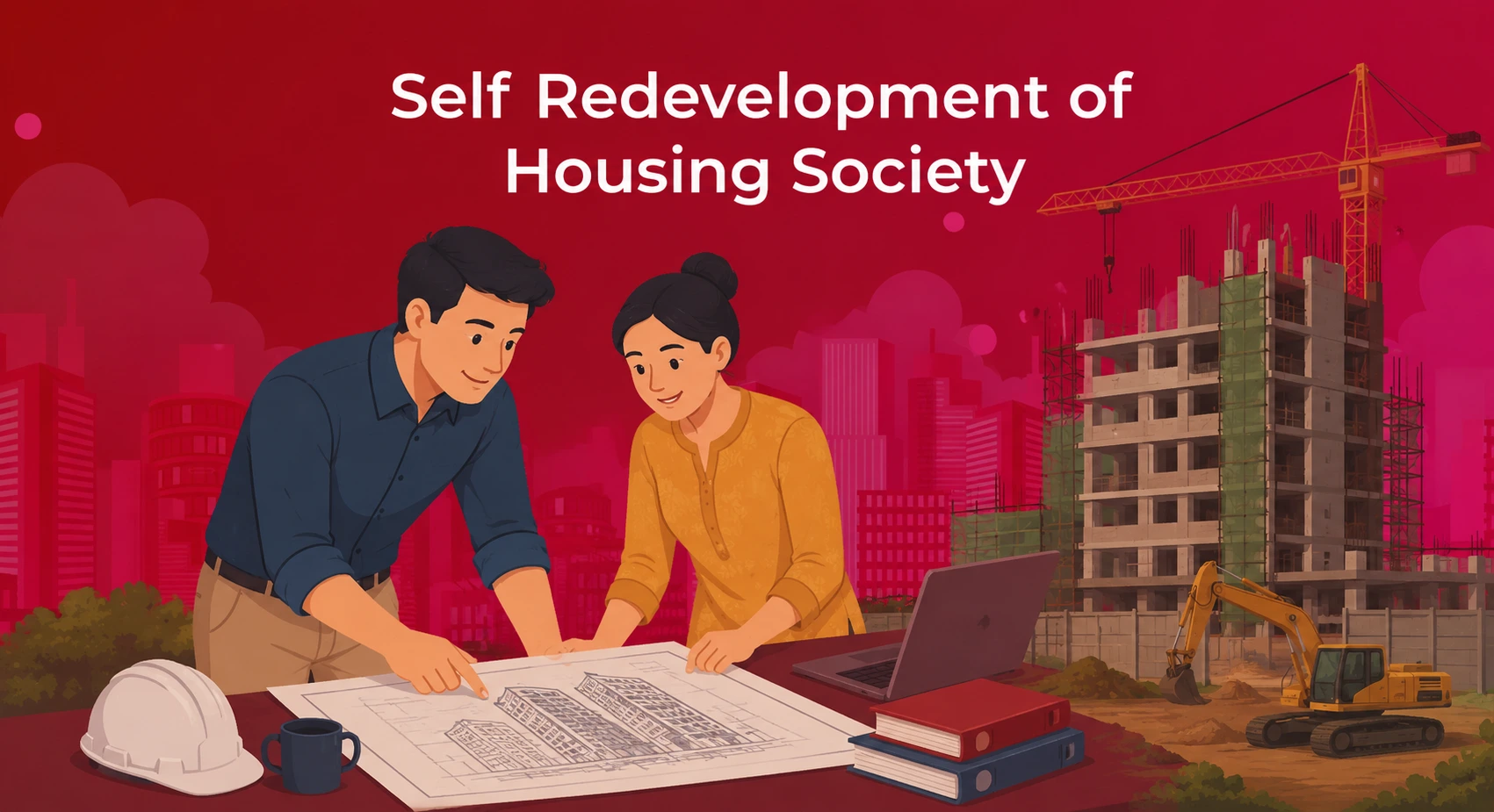


Many cooperative housing societies are reaching a stage where repairs are no longer enough and redevelopment is the only practical way forward. In many societies self redevelopment is now being explored, where the members take over the planning, financing and rebuilding of their own property rather than handing the project over to private developers. This approach offers greater control and the possibility of higher financial returns, but also comes with additional responsibilities. This blog covers what self redevelopment is, how the process works, the rules you need to know, and the pros and cons of doing it, as well as how it compares to the traditional builder-led model.

What Is Self Redevelopment of Housing Society?
Self redevelopment of housing society means the members take up the task of redeveloping their own block on their own, instead of giving the project to a private developer. A society has its own project management consultant, architect and contractor and has total control over funds, approvals and construction.
This is different from the usual builder-led model, where a developer funds and executes the project in exchange for a share of the extra flats. In this model, the society keeps all the extra saleable area and any profit from selling it in the open market. Members typically also end up with a larger carpet area in the new building, since there is no developer margin to account for.
Many old buildings in Indian cities, especially Mumbai and Pune, are more than 30 years old and need this kind of rebuild. That is one reason this route has moved from a lesser-known option to a mainstream option for cooperative housing societies. Some residents still call it self development of housing society, though the underlying idea stays the same either way.
Why Are More Societies Choosing Self Redevelopment?
Societies are opting for self redevelopment mainly to protect their own interests during a rebuild. A few real reasons keep coming up when committees discuss this route:
- Full control over design and pace: The society decides layouts, material quality, and construction timelines instead of accepting a builder's plan.
- Higher financial returns: Extra flats built using available Floor Space Index (FSI) are sold by the society itself, so the profit goes into the society corpus rather than a builder's account.
- Government backing: State policies now offer additional FSI and subsidised loan interest rates to registered societies that choose this path.
- Better transparency: Since the managing committee reports directly to members, there is less scope for hidden costs or quality shortcuts.
None of this means this route is free of effort. It simply shifts the reward, and the responsibility, back to the society.
The Self Redevelopment Process: Step-by-Step Guide
The self redevelopment process follows a fairly consistent sequence across most Indian states, though exact consent percentages and timelines vary by local cooperative rules.
1. Form a redevelopment committee
Elect a small group of trusted members to lead daily coordination, so decisions don’t get delayed in large group discussions.
2. Run a feasibility check
Hire an architect or project management consultant (PMC) to assess the plot, available FSI, structural condition, and rough project cost.
3. Secure member consent
Call a Special General Body Meeting and pass a formal resolution. Depending on the state, written consent from 51 to 75% of members is usually needed to start, though full backing matters later for financing.
4. Confirm the conveyance deed
Make sure the land title is clearly registered in the society's name before any bank agrees to lend against it.
5. Appoint professionals
Bring in a PMC, structural engineer, legal advisor, and architect to handle technical work and compliance.
6. Arrange financing
Apply for a dedicated construction loan through a cooperative or commercial bank that offers this kind of financing.
7. Get municipal approvals
Submit building plans to get the Intimation of Disapproval (IOD) and Commencement Certificate (CC) from local authorities.
8. Relocate members temporarily
Arrange transit rent or alternate housing while the old structure is demolished and the new one is built.
9. Execute and hand over
Tender the construction contract, monitor progress through the PMC, and obtain the Occupancy Certificate (OC) before handing keys back to members.
Read also: What is Occupancy Certificate
Self Redevelopment Rules Every Society Should Know
Self redevelopment rules are largely set by state cooperative departments, and they cover consent, meetings, and compliance:
- Consent threshold: Written approval from 51 to 75% of members is typically required to pass the initial resolution, depending on the state act.
- Recorded meetings: Special General Body Meetings must often be video recorded, with formal notice sent to the registrar.
- Committee role: The managing committee executes decisions; it does not override what members have approved.
- RERA registration: If any extra flats are sold on the open market, the project usually needs registration under the state RERA authority.
- Time limits: Construction is generally expected to finish within a set window, often around three years, from the date of final approval.
Knowing these self redevelopment rules early helps a committee plan realistic timelines instead of getting caught off guard mid-project.
Read also: New Rules for Redevelopment of Cooperative Housing Society
Latest GR on Self Redevelopment
The foundational policy behind self redevelopment in Maharashtra goes back to the Government Resolution dated 13 September 2019. Since then, follow-up orders have refined the framework, including the creation of a dedicated Self and Cluster Redevelopment Authority to fast-track delayed projects and clear approvals within a set time window. These updates also touch on leasehold clearances and single-window processing, which matters if your society is tracking the latest GR on self redevelopment before starting paperwork.
Disadvantages of Self Redevelopment
It is worth being honest about the disadvantages of self redevelopment before a society commits to this route.
- Financial risk sits with members: Instead of a developer funding the project, the society borrows directly, and members may need to offer personal guarantees.
- It demands real time and effort: Committee members must coordinate with architects, banks, and contractors alongside their regular jobs, which is a heavy ask.
- Internal disagreements can stall progress: Without a single decision-maker like a builder, disputes over layouts or leadership trust can delay or even derail a project.
- Limited professional experience: Few residents have construction or real estate backgrounds, so even with a PMC on board, overall direction can be difficult.
- Market risk on unsold flats: If the extra saleable flats do not sell well, the society absorbs that shortfall directly instead of a builder.
These are not reasons to avoid this option outright, but they explain why careful planning and professional support matter so much.
Self Redevelopment vs Builder Led Redevelopment
Committees often ask which route actually works out better. Here is a simple way to look at it:
| Factor | Self Redevelopment | Builder-Led Redevelopment |
| Who funds the project | The society, through bank loans | The private developer |
| Who keeps extra flat profits | The society corpus | The developer |
| Decision making | Members and committee | Mostly the developer |
| Effort required from residents | High, ongoing coordination | Low, developer manages it |
| Speed of approvals | Depends on the committee | Often faster with an experienced developer |
Neither option is universally better. A well organised society with strong professional help can gain significantly from doing it themselves, while a smaller or less active society may find a trusted developer easier to work with.
Procedure for Self Redevelopment: Documents and Approvals
The procedure for self redevelopment depends heavily on paperwork being in order from day one. Before construction can begin, a society typically needs:
- A clear, registered conveyance deed in the society's name
- A feasibility report from a qualified architect or PMC
- A general body resolution with the required member consent
- Loan sanction letters from a cooperative or commercial bank
- Municipal approvals, including the IOD and Commencement Certificate
- RERA registration, if open market flats will be sold
Following this self redevelopment procedure in order, rather than skipping steps to save time, is usually what keeps a project on schedule.
Simplify Society Communication with NoBrokerHood Digitised Communication Platform
Self redevelopment involves hundreds of decisions, from sharing project updates and announcing General Body Meetings to collecting member feedback. When communication happens across calls, WhatsApp groups, and paper notices, important information can easily be missed.
NoBrokerHood helps societies keep everyone on the same page through its announcements and community communication features. Managing committees can share meeting notices, project milestones, approval updates, and important reminders with all members from a single platform.
This makes the redevelopment process more organised by:
- Keeping every member informed about key project updates
- Sharing AGM and Special General Body Meeting notices quickly
- Using polls to gather resident opinions on non-statutory decisions, such as preferred meeting timings or amenities, before formal discussions
- Reducing confusion caused by scattered communication
- Giving residents one place to refer to official announcements
While formal resolutions must always follow the process laid down under the applicable Cooperative Societies Act and the society's bylaws, better communication and early member participation can help redevelopment projects move forward with greater clarity and fewer misunderstandings.
