





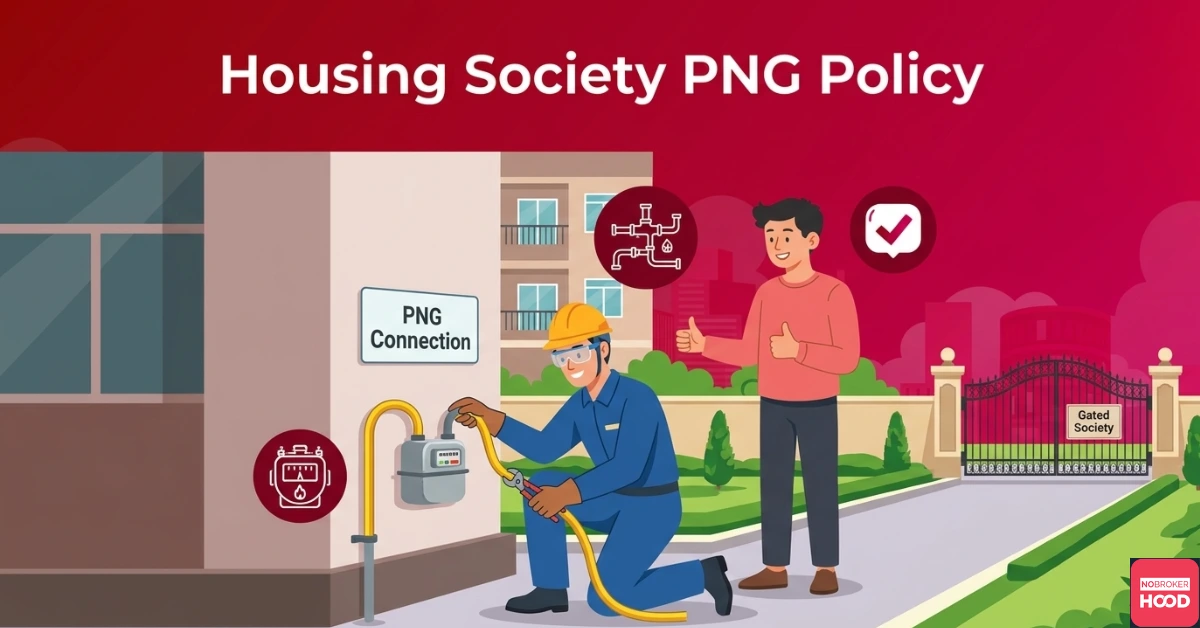


Many housing societies in India are currently facing confusion due to LPG shortages, delayed cylinder deliveries, and rising safety concerns. Residents are unsure whether their society can allow or block Piped Natural Gas connections. Under the March 2026 government order, the housing society PNG policy clearly states that societies cannot deny PNG installations. Approval must be given within three working days, or it is considered automatically approved. This move is aimed at ensuring faster access to cleaner and more reliable gas connections for all residents.

What Is the Housing Society PNG Policy?
The housing society PNG policy is a government directive that ensures residents get access to Piped Natural Gas without unnecessary delays from societies or RWAs. It clearly states that societies cannot block or delay PNG pipeline installations.
The aim is simple. Make clean fuel easily available and reduce dependence on LPG cylinders. With rising urban demand and recent supply issues, this policy ensures smoother infrastructure rollout across residential communities.
Why was the Housing Society PNG Policy Introduced?
The shift towards PNG did not happen suddenly. It is part of a larger effort to improve energy access and safety in residential communities.
Here’s why the housing society PNG policy became necessary:
- Frequent LPG supply issues in urban areas
- Safety concerns with cylinder storage and handling
- Delays caused by society's approvals
- Need for a continuous and cleaner fuel supply
PNG offers a more stable system, and the policy ensures that administrative delays do not slow down its adoption.
Read also: Facility Management Services in Societies
Why the PNG Policy Matters Right Now in India?
India has recently seen LPG supply disruptions in several cities. Many households faced delays of days or even weeks for cylinder delivery. This created inconvenience, especially in large apartment complexes.
The housing society PNG policy directly addresses this issue by pushing faster adoption of PNG connections. PNG offers a continuous gas supply through pipelines, which removes dependency on cylinder logistics. For example, in many urban areas, societies that delayed PNG installations are now struggling with both LPG shortages and resident complaints. This policy helps avoid such situations.
Key Rules Under Housing Society PNG Policy
Here are the most important rules every resident and society should know:
- Approval within 3 days: Societies must approve PNG installation requests within three working days.
- Deemed approval: If no response is given, permission is automatically considered approved.
- No rejection allowed: Societies cannot deny installation without valid technical reasons.
- Mandatory switch: In notified areas, residents must move from LPG to PNG within three months.
- Quick connection timelines: Once approved, installations are expected to be completed within 48 hours.
- Access must be provided: Societies must allow entry to authorised PNG providers.
- Exception rule: Only if technically infeasible, a valid certification can stop installation.
These rules make the housing society PNG policy very clear and strict for implementation.
Approval Deadline and Deemed Permission
One of the most important parts of the housing society PNG policy is the strict approval timeline. Societies must grant permission within three working days of receiving a request. If they fail to respond, the approval is automatically considered granted. This rule prevents unnecessary delays and ensures that residents are not dependent on committee decisions for essential services.
Mandatory Switch from LPG to PNG
The policy also introduces a shift from LPG to PNG in notified areas. Households are expected to switch within three months once PNG is available. If a society blocks installation, it risks losing LPG supply access for the entire community. This makes the transition unavoidable in many cases and encourages faster adoption of PNG.
What This PNG Policy Means for Residents
For residents, the housing society PNG policy brings both clarity and convenience.
Here’s how it impacts daily life:
- No need to depend on society approvals for gas connections
- Continuous gas supply without cylinder booking
- Improved safety with reduced storage risks
- Faster installation timelines
Practical Tips for Residents:
- Apply early once PNG is available in your area
- Check if your society has already received a request
- Coordinate with neighbours for smoother implementation
- Stay informed about timelines and notices
This policy gives residents more control over essential services.
What Societies and RWAs Must Do
The housing society PNG policy clearly defines the responsibilities of RWAs and managing committees. Societies now have a more active role to play. Ignoring or delaying decisions is no longer an option.
Responsibilities include:
- Approving PNG requests within three working days
- Allow right-of-way for pipeline installation
- Coordinate with authorised gas agencies
- Allowing pipeline access in common areas
- Informing residents about the installation timelines and updates
- Ensuring safety compliance during installation
- Avoid unnecessary objections or delays
Simple tip:
Create a clear communication plan. Inform residents through notice boards or apps so everyone is aware of timelines and work schedules.
Failure to comply can result in authorities proceeding with installation through public notices. This shifts the role of societies from decision-makers to facilitators.
Can Housing Society Refuse PNG Installation?
A common question today is, can housing society refuse PNG connections? The answer is no. Under the March 2026 government order, societies and RWAs cannot block or delay PNG installation without a valid technical reason.
If a society ignores or blocks the request, there can be serious consequences:
- Public notices may be issued by authorities
- Installation can proceed without society's approval
- LPG supply may be discontinued within three months
- Residents can raise complaints against society
If a society does not respond within three working days, the request is automatically treated as approved. This means residents do not have to depend entirely on committee decisions anymore. The housing society PNG policy makes it clear that access to essential infrastructure like PNG cannot be restricted. The goal is to ensure every household has a safe and continuous gas supply without unnecessary delays.
Read also: Guide to Cooperative Housing Society Insurance
Benefits of Switching from LPG to PNG
Moving to PNG has several advantages for residents:
- Continuous supply: No waiting for cylinder delivery
- Better safety: Lower risk of leakage and explosion
- Convenience: No storage or handling of cylinders
- Cost efficiency: Meter-based billing can be more transparent
- Environment-friendly: Cleaner fuel compared to LPG
With these benefits, the housing society PNG policy supports both convenience and sustainability.
Read also: What is Considered Emergency Maintenance in an Apartment?
Practical Steps for Residents to Get PNG Installed
If your society has not yet acted, here’s what you can do:
- Submit a request: Raise a formal request to your society or RWA
- Follow up within 3 days: Track approval timelines as per policy
- Contact PNG provider: Reach out to authorised companies in your area
- Inform other residents: Collective action often speeds up decisions
- Document communication: Keep records of requests and responses
- Escalate if needed: Approach local authorities if there is no response
These small steps help residents actively benefit from the housing society PNG policy.
Real Also: Boom Barrier Installation
PNG Gas Connection Documents Required for Housing Society
Getting a PNG connection in a housing society needs few documents from the resident and the society. Keeping them ready speeds up approval and installation.
Documents required from residents:
- Application form: Filled and signed PNG registration form from the gas provider
- Identity proof: Aadhaar card, PAN card, passport or voter ID
- Address proof: Electricity bill, Aadhaar card, rent agreement (if tenant) or property tax receipt
- Ownership or tenancy proof: Sale deed, society share certificate, allotment letter or a valid rent agreement
- Passport-size photographs: Usually one or two
- Existing LPG details: LPG consumer number and connection details, if the provider asks for them
- Landlord’s NOC: Required if you are a tenant
Documents required from the society or RWA:
- Society NOC or permission letter: Approval for pipeline installation, which is deemed granted if the society does not respond within 3 working days
- Society registration certificate: Proof that the society is registered
- Managing committee authorisation: A resolution or authority letter signed by the committee
- Building plan or layout: require building plan or layout to plan the pipeline route and riser positions
- Access permission: For laying pipes through common areas, shafts and the basement
Challenges Societies May Face
While the housing society PNG policy simplifies approvals, some challenges may still come up:
- Infrastructure adjustments within older buildings
- Concerns about pipeline safety
- Temporary disruption during installation
- Lack of awareness among residents
To manage these, societies should focus on communication and planning rather than resistance.
Read also: Emergency Response Team
How NoBrokerHood Helps Societies Manage PNG Implementation Smoothly
With the new housing society PNG policy making approvals time-bound and mandatory, societies need efficient systems to handle requests, communication, and documentation. NoBrokerHood is a society maintenance app that helps RWAs and managing committees manage PNG installations in a structured, transparent, and compliant way.
| NoBrokerHood Feature | How It Helps with PNG Policy Implementation |
| Notice Board & Broadcasts | Instantly inform residents about PNG availability, timelines, and installation schedules. |
| Helpdesk & Ticketing | Residents can raise PNG installation requests and track approval status digitally. |
| Approval Workflows | Ensure requests are reviewed and approved within the 3-day deadline to avoid deemed approval. |
| Document Management | Store approvals, NOCs (if any), vendor details, and safety certifications securely. |
| Vendor Management | Coordinate with authorised PNG providers and track installation progress. |
| Communication Tools | Send real-time updates about pipeline work, disruptions, and safety guidelines. |
| Resident Database | Identify flats requesting PNG and plan installations block-wise for efficiency. |
| Audit Trails | Maintain records of approvals and communications for compliance and dispute resolution. |
By digitising request handling, approvals, and communication, NoBrokerHood helps societies comply with the PNG policy while ensuring a smooth and well-coordinated transition from LPG to piped gas systems.
All Solutions by NoBrokerHood:
