






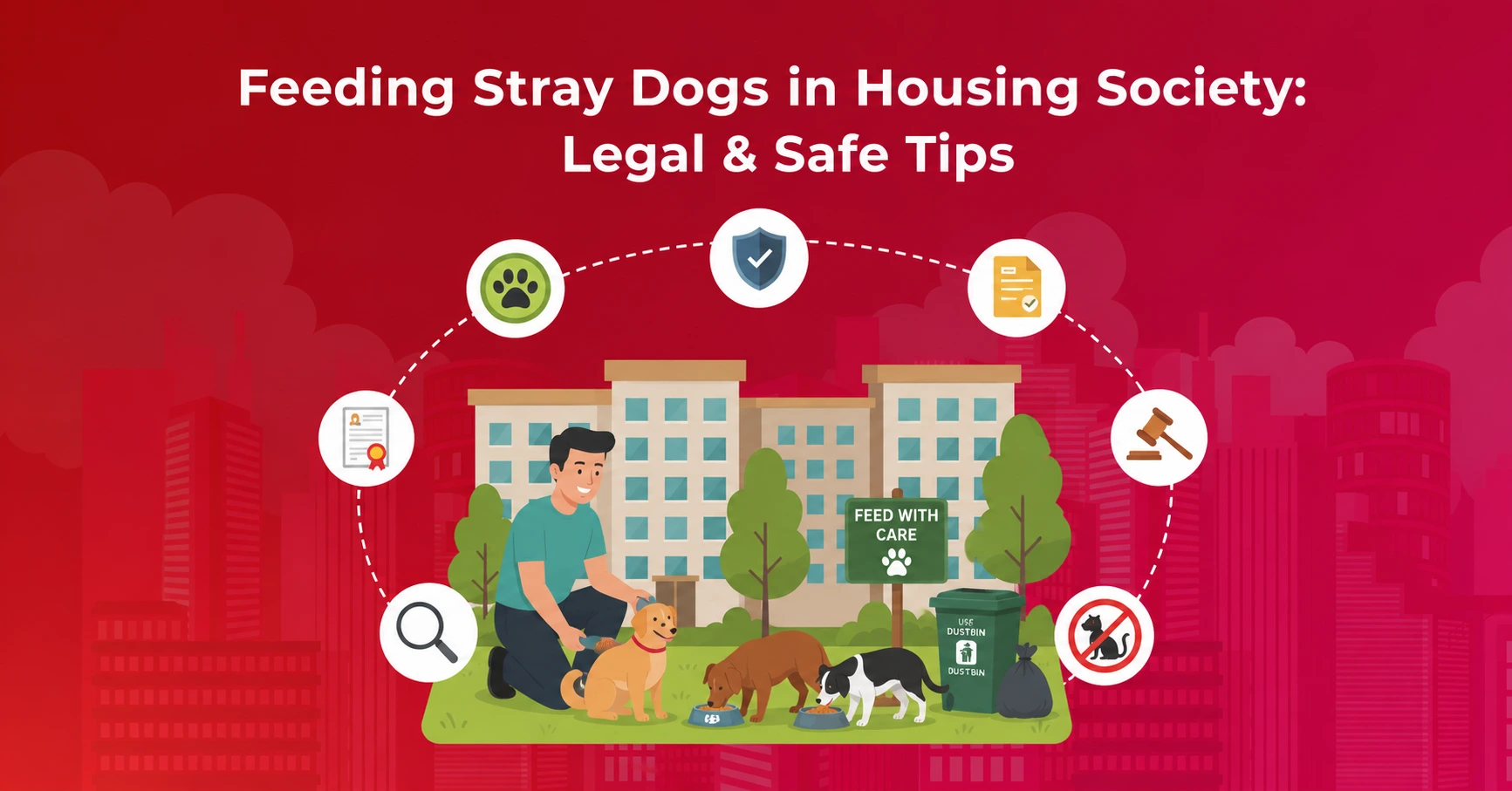


Knowing the rules for stray dogs in society matters for both feeders and housing society committees. Disputes over feeding, relocation, and resident safety are common in many communities, often because people are unaware of what the law actually permits. While Indian law protects community dogs and recognises the rights of residents to feed them, housing societies also have a role in ensuring safety and cleanliness. This guide walks you through the rules for stray dogs in society, what societies can and cannot do, how to feed safely, and what the courts have said on the matter, so both feeders and residents know where they stand.

What Housing Societies Can and Cannot Do?
The rules for stray dogs in society clearly define what a housing society can regulate and what it cannot. While RWAs can take reasonable steps to maintain safety and cleanliness, they cannot override the legal protections granted to community dogs or the rights of residents who feed them. Here's a quick breakdown:
- No Bans: RWAs cannot pass blanket bans on feeding stray dogs or force pets out of common areas.
- No Relocation: Moving or dumping stray dogs outside the society is illegal under the Animal Birth Control Rules.
- Regulation is Allowed: Societies can set reasonable times and designate specific spots for feeding.
- No Harassment: Threatening or penalising animal feeders is a criminal offense.
In other words, a society's job is to manage how feeding happens, not whether it happens at all. Committees that try to stop feeding altogether, or that dump dogs outside the gate to "solve" the problem, are acting outside the law and can be reported to the local Animal Welfare Board or the police.
Feeding Stray Dogs in Housing Society: Safety Rules and Best Practices
Once a society accepts that feeding cannot be banned, the next step is agreeing on a few ground rules that work for both feeders and residents.
- Designated Spots: Feed dogs away from children's play areas, entry gates, and walking paths.
- Cleanliness: Feeders must clean up leftover food and provide clean water in bowls.
- Vaccination and Sterilisation: Feeders and societies should work together to get local dogs vaccinated against rabies and neutered through municipal programs.
Read also: Apartment Pet Laws in India
Choose the Appropriate Feeding Locations
The spot you pick to feed stray dogs makes a big difference. Your housing society should mark these areas:
- Away from where children play, entry/exit points, and staircases
- Not close to areas where senior citizens spend time
- Clear of public streets, pedestrian paths, or common passages
- Best spots are near boundary walls or quiet areas people don't use much
- Areas with signs that show feeding times
| Suggested Feeding Location | Reason |
| Away from children's play areas, entry/exit points & stairs | To enhance safety and avoid blocking access |
| Not near where seniors congregate | To keep their comfort and avoid disturbances |
| Away from public streets, footpaths or public thoroughfare | To avoid traffic disruption or disturbances to pedestrian traffic |
| On boundaries walls or areas that are quiet or not in use | To minimise conflicts and allow dogs to eat undisturbed |
| Indicated areas that have sign boards indicating feeding times | To notify residents and avoid individuals feeding at different times |
Select Appropriate Feeding Times
Getting the timing right plays a crucial role in feeding stray dogs in housing society:
- Early morning and late evening work best
- Skip feeding between 11:30 pm and 5:00 am
- Pick times that work around children's and seniors' schedules
- Stick to your schedule so dogs know what to expect
Maintain Proper Food and Water Guidelines
- Set out clean water in sturdy bowls, especially during summer
- Give them healthy food instead of leftovers or stale items
- Avoid raw or uncooked meat
- Consider putting water bowls outside society gates for all strays
- Add ice cubes to water bowls in summer to help dogs stay cool
Practice Responsible Feeding Etiquette
You need to keep things clean as a feeder:
- Clean up well after feeding to avoid mess
- Use proper containers instead of newspapers since they have toxic ink
- Stay calm around dogs and step back after placing their food
- Put on masks and gloves while feeding, and clean your hands before and after
Keep in mind that you can report to the District Society for Prevention of Cruelty to Animals (DSPCA) if your society doesn't provide feeding areas. The best way forward is to work together and create feeding rules that look after both animal welfare and community needs.
Legal Protection for Residents Who Feed Stray Dogs
Part of understanding the rules for stray dogs in society is knowing that feeders themselves are protected. No RWA can restrict a resident from Feeding Stray Dogs altogether. A Ministry of Public Grievances notification, along with an Animal Welfare Board of India advisory, states plainly that feeders cannot be harassed for carrying out this activity. The Board also issues feeder ID cards, which offer an added layer of protection if a dispute arises with the committee or with other residents.
Read more: Know Your Rights as a Pet Owner Residing in a Gated Community
Sterilisation and Vaccination Rules for Community Dogs
Under the Animal Birth Control Rules, dogs picked up for sterilisation must be:
- Sterilised through accepted medical procedures
- Vaccinated against rabies at regular intervals
- Returned to the exact area they were picked up from
- Allowed to live in their natural environment afterward
It's specifically illegal for a society, RWA, or individual resident to move a stray dog out of its territory. Sterilisation and vaccination remain the only legal tools for controlling the stray population and limiting the spread of rabies. Following this process consistently is what actually keeps both residents and dogs safer over time, rather than one-off removals that just push the problem elsewhere.
Read also: Top 5 Apartment Friendly Dog Breeds
Building Harmony Between Feeders and Residents
Disputes between feeders and other residents are common, but following the rules for stray dogs in society consistently is often more effective than taking a one-sided approach. The Animal Birth Control Rules, 2023, require every local body to constitute an Animal Welfare Committee comprising seven members to handle such disputes. When a complaint is raised, the committee is expected to visit the society, hear both sides, and issue its decision within 15 days of being formed. Either party can appeal the decision if they are not satisfied.
While the law protects the rights of residents to feed community dogs, it also expects feeders and housing societies to cooperate. Neither a municipal corporation nor an RWA can prohibit designated feeding zones altogether. In return, feeders should follow the agreed feeding times, use designated spots, and keep the area clean to avoid inconvenience to other residents. Many societies have successfully reduced conflicts by adopting simple measures such as:
- Running awareness sessions on responsible stray dog management
- Holding regular meetings where feeders and concerned residents can discuss issues
- Drafting feeding protocols that balance animal welfare with resident comfort
- Inviting local animal welfare organisations to guide the management committee
- Creating WhatsApp groups for better coordination between feeders and residents
- Organising community awareness drives that encourage cooperation
Article 51A(g) of the Constitution of India also places a duty on every citizen to show compassion for living creatures. When societies combine this constitutional responsibility with clear communication and practical guidelines, residents and community dogs can coexist peacefully without unnecessary conflict.
Supreme Court Judgement on Feeding Stray Dogs in Gated Communities
The Supreme Court of India has consistently upheld the right to feed stray dogs in gated communities and housing societies. Through the supreme court judgement on stray dogs feeding in gated community housing society, the Court has reinforced that animals have a fundamental right to food, shelter, and a life free from cruelty under the Prevention of Cruelty to Animals Act, 1960. It has made clear that no RWA or housing society can ban feeding, harass feeders, or relocate stray dogs from their territory. The only legally permitted method to manage stray dog populations is sterilization and vaccination under the Animal Birth Control Rules, 2023.
What This Means for RWAs and Residents?
- No RWA or housing society can legally ban the feeding of stray dogs on their premises.
- Stray dogs cannot be relocated or removed from their territory by any society or individual.
- Harassment of residents who feed stray dogs is unlawful and can lead to legal consequences.
- The Animal Welfare Board of India issues feeder ID cards to protect residents from harassment in gated communities.
- Housing societies are required to designate proper feeding zones rather than prohibiting feeding altogether.
- Societies must collaborate with residents and animal welfare organisations to create a balanced approach that protects both community welfare and animal rights.
Clearer Society Communication with NoBrokerHood
Disagreements over stray dogs often escalate because residents, feeders, and managing committees are not working with the same information. A new feeding schedule, designated feeding area, or vaccination drive may not reach everyone, leading to unnecessary misunderstandings.
NoBrokerHood helps make these conversations more organised through its community communication tools. Managing committees can share official notices, feeding guidelines, awareness updates, and meeting announcements with all residents from a single platform.
How this helps the community:
- Feeding schedules and designated zones can be communicated clearly to everyone
- Residents receive updates on vaccination and sterilisation drives
- Committees can announce meetings or awareness sessions before introducing new guidelines
- Important notices remain accessible for residents to refer to later, reducing confusion and repeated questions
When everyone has access to the same information, discussions become more constructive, making it easier for societies to balance resident concerns with animal welfare.
