





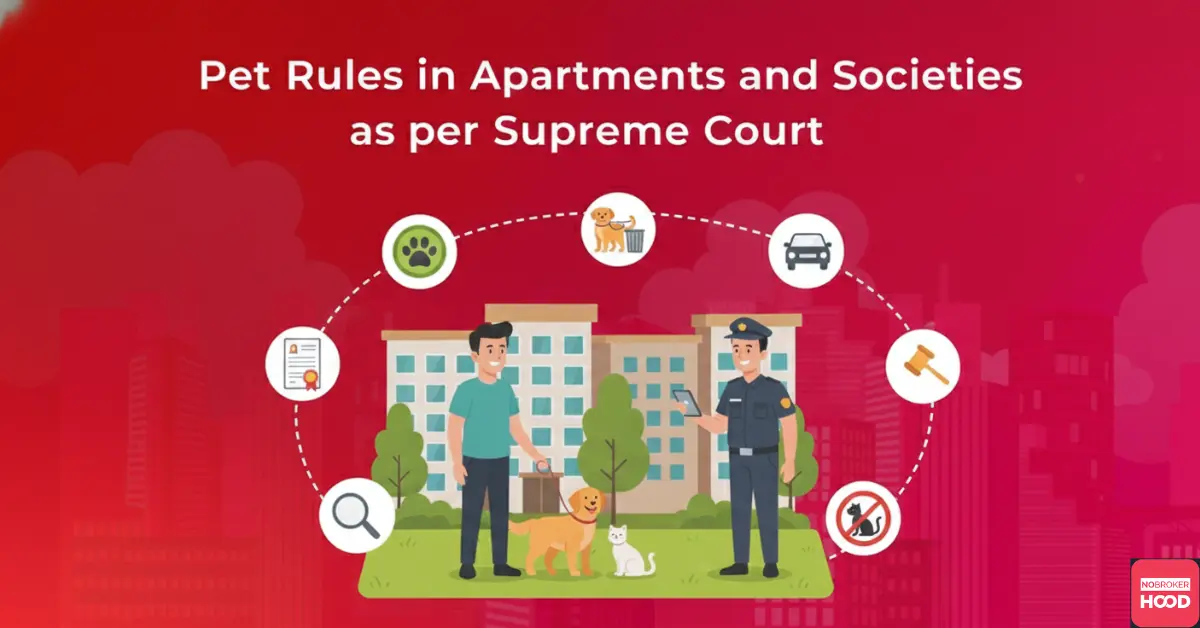


Being a pet parent in a gated community can be challenging, especially when it imposes varying dog rules. Pet owners often face pressure to give up their dogs. However, Supreme Court judgement on pets in apartments and animal welfare laws clearly protect the right to own pets. To ensure peaceful coexistence, the government has issued clear rules for pets in apartments and housing societies that balance pet owners’ rights with community safety and hygiene. Importantly, RWAs and AOAs cannot ban pets, even through the society bylaws. Understanding these laws helps pet owners assert their rights while acting responsibly.

Read More: Top 5 Apartment-Friendly Dog Breeds
Rules for Pets in Apartments
- Article 51A (g) of the Indian Constitution states that every Indian citizen must protect and have compassion for all living creatures.
- If any pets or dogs are not allowed in apartments, it is a direct violation of the Constitution of India.
- Section 11(3) of the Prevention of Cruelty to Animals Act, 1960 stresses the duty of every citizen to show kindness and compassion towards every living creature.
- Laws for dogs in India must be followed by the management committee, residents and pet owners.
Pet Laws for Apartments in India
In India, pet ownership is a legally protected right. While Resident Welfare Associations (RWAs) can regulate common areas to maintain hygiene and safety, they have zero legal authority to ban pets or discriminate against pet owners.
Key Legal Rights (AWBI Guidelines)
- Bans are Invalid: Under the Prevention of Cruelty to Animals Act, 1960, housing societies cannot ban pets even if a majority of residents vote for it.
- No Breed or Size Limits: RWAs cannot ban dogs based on their size or breed (e.g., prohibiting large breeds like Labradors).
- Access to Lifts and Parks: Pets cannot be barred from elevators, parks, or common areas. Levying extra "pet maintenance fees" is strictly illegal.
- Barking is Permitted: Barking is a dog’s natural form of expression. Occasional or natural barking is not legal ground for eviction or fines.
| What RWAs Can Enforce | What RWAs Cannot Do |
| Mandatory leashing in all common areas. | Force muzzles on non-aggressive dogs. |
| Asking for vaccination & registration logs. | Ban tenants with pets or force them to vacate. |
| Designating walking tracks or time slots. | Restrict pet owners to service lifts only. |
Laws for Dogs in India (Pet & Community Dogs)
Central Indian legislation strictly protects both companion dogs and community (stray) dogs, making harassment, relocation, or harm a punishable criminal offense.
- Protection from Harm: Section 325 of the Bharatiya Nyaya Sanhita (BNS) penalizes the killing, poisoning, or maiming of any animal with steep fines and up to 5 years in prison.
- No Chaining or Neglect: Section 11 of the Prevention of Cruelty to Animals Act makes it a crime to beat, starve, abandon, or keep a dog tied up on a short chain for long periods.
- No Relocation of Strays: Under the Animal Birth Control (ABC) Rules, it is illegal for RWAs or residents to displace street dogs. Local authorities can only pick them up for sterilization and vaccination, and they must return them to the exact same spot.
- Right to Feed: Citizens have a legal right to feed street dogs. Under the ABC Rules for pet dogs in society, RWAs must designate fixed, clean feeding spots away from children's play areas and common entrances.
- Civic Duty: To prevent societal disputes, pet parents are expected to clean up after their dogs using poop scoops, maintain up-to-date vaccinations, and manage separation anxiety to minimise excessive barking.
Rules for Pets in Apartments Issued by the Animal Welfare Board of India
The rules for dog owners in India are issued by the Animal Welfare Board of India:
Rules for dog owners in India:
- Pets are family, and when they constantly feel rushed, they must be protected and cared for, not left behind.
- Barking is a natural, instinctive behaviour in dogs and should be understood and tolerated. However, pet owners also have the responsibility to manage excessive barking, especially at night, since uncontrolled barking can lead to problems for others.
- Pets must be maintained cleanly and kept healthy. The pet owners must vaccinate their pets for the safety of others.
- There is no guarantee that pet waste is always cleaned up during walks, so RWAs should provide gated dog zones or designated pet corners for dogs to relieve themselves and for proper waste disposal.
- Pets cannot be restricted from using elevators or parks, and residents cannot be charged extra for owning a pet.
- For everyone’s safety, pets must be kept on a leash in society areas; however, RWAs cannot enforce the use of muzzles.
- Pet owners benefit from not being charged extra fees for having pets in society.
- Discrimination on pet breed or size is illegal.
- Pets are valued members of the family, and when they pass away, their mortal remains must be treated with dignity and respect, not abandoned.
- Residents may feed stray cats and dogs, but not litter, and not feed dogs in front of other residents’ living areas.
Read also: Feeding Street Dogs in Housing Society
Role of Apartment Management Committee
The residents must adhere to the pet rules in apartments and make sure:
- Bylaws banning pets should not be created, even with majority consent, because they might cause conflicts among residents.
- Do not create bylaws that can be an inconvenience to pet owners in a society, such as disallowing the use of a lift, etc.
- Keep a record of vaccination and sterilisation.
- Designate pet spots for walks, defecation, etc.
- The management committee can impose fines if pet owners are found neglecting the pet rules in apartments or if found creating a nuisance to other residents.
- Create awareness among other residents and educate them to respect pet rules in apartments and pet owners fairly, without discrimination. Make sure they don’t provoke a pet.
Read More: Society pets finally get an identity! Here’s how the Pet Management feature helps
Guidelines for Pet Owners Living in Apartments
As much as it is the responsibility of the management committee to adhere to the rules for pet owners in apartments, pet owners are equally responsible for taking care of their pets and making sure they do not cause any inconvenience to others in society. Therefore, the following are the guidelines for pet owners living in apartments.
- Timely vaccination is mandatory, and make sure the renewal is done every year.
- Train your pets to be obedient and behave when they are being taken for walks or to play in the society premises. Toilet training is very important. While dogs can be trained to answer nature’s call in the washroom, cats can have a litter tray.
- Always carry a scooper while walking around the premises.
- Keep your pets clean and maintain hygiene.
- Always keep your dog on a leash when taking them on walks. A muzzle is not compulsory.
- Never leave your pets unattended and unsupervised in the society complex.
- Give your dog ample exercise and playtime for a healthy lifestyle.
RWA Rules for Pet Dogs in Society
Dogs are the most commonly targeted pets in apartment disputes. However, rules for pet dogs in housing societies must be non-discriminatory.
What RWAs Can Regulate?
- Leash usage in common areas
- Action against specific aggressive behaviour
- Pets must be regularly vaccinated, especially against rabies
- The municipal registration records of pets
What RWAs Cannot Do?
- Pet restrictions in apartments based on breed or size
- Label certain breeds as “dangerous” without evidence
- Force dog owners to vacate the premises
Overall, RWAs can enforce reasonable rules for safety, hygiene and responsible pet ownership, but they cannot discriminate against dogs based on breed or size. Pet owners must also follow these rules and ensure their pets do not cause avoidable inconvenience to others.
Rules on Pets in Apartments for Residents
Balancing community living with animal welfare requires clear boundaries. In India, the law protects your right to keep companion animals, but Resident Welfare Associations (RWAs) can enforce reasonable regulations to maintain safety and hygiene.
Pet Policy in Apartments - What Residents Need to Know
Based on Animal Welfare Board of India (AWBI) guidelines, here is a quick breakdown of dog rules in society:
- Bans Are Illegal: RWAs cannot ban pets or force pet owners to vacate, even if the society passes a unanimous majority vote.
- No Breed/Size Limits: Societies cannot restrict dogs based on their size or breed.
- Equal Access: Pets cannot be barred from regular lifts, corridors, or parks. RWAs are not allowed to charge extra "pet fees."
- Mandatory Leashing: Owners must keep dogs on a leash at all times while in common areas like lobbies, parking lots, and gardens.
- Vaccination Proof: The society can legally request up-to-date anti-rabies vaccination logs and municipal pet registrations.
- Hygiene Control: Pet parents are responsible for cleaning up after their animals. RWAs can designate specific walking paths or defecation zones.
Street Dog Policy: Under the Animal Birth Control (ABC) Rules, stray dogs cannot be relocated or driven out of a society. Instead, RWAs must work with resident feeders to set up designated, clean feeding spots away from main gates and play areas.
Streamline Your Society Management with NoBrokerHood's Dedicated Pet Management Feature
Maintaining a harmonious gated community while complying with complex apartment pet laws doesn't have to be a source of resident friction. The NoBrokerHood Society Management System bridges the gap between pet parents and Management Committees by digitalizing pet policies, standardizing rules, and ensuring seamless compliance directly through a unified community platform.
- Digital Pet Registration: Streamline community onboarding by allowing pet owners to easily log their pet's profile, size, and details directly within the app.
- Automated Vaccination Tracking: Help Management Committees maintain statutory health records by tracking and sending automated reminders for mandatory annual rabies shots and municipal renewals.
- Transparent Grievance Redressal: Replace bitter WhatsApp arguments with an impartial, localized ticketing system to resolve noise, hygiene, or leash complaints objectively.
- Designated Zone & Rule Broadcasting: Instantly notify the entire society about demarcated pet corners, walking tracks, or updated community guidelines to cultivate a respectful, pet-friendly environment.
