Car Parking Space Size and Measurements in Housing Societies
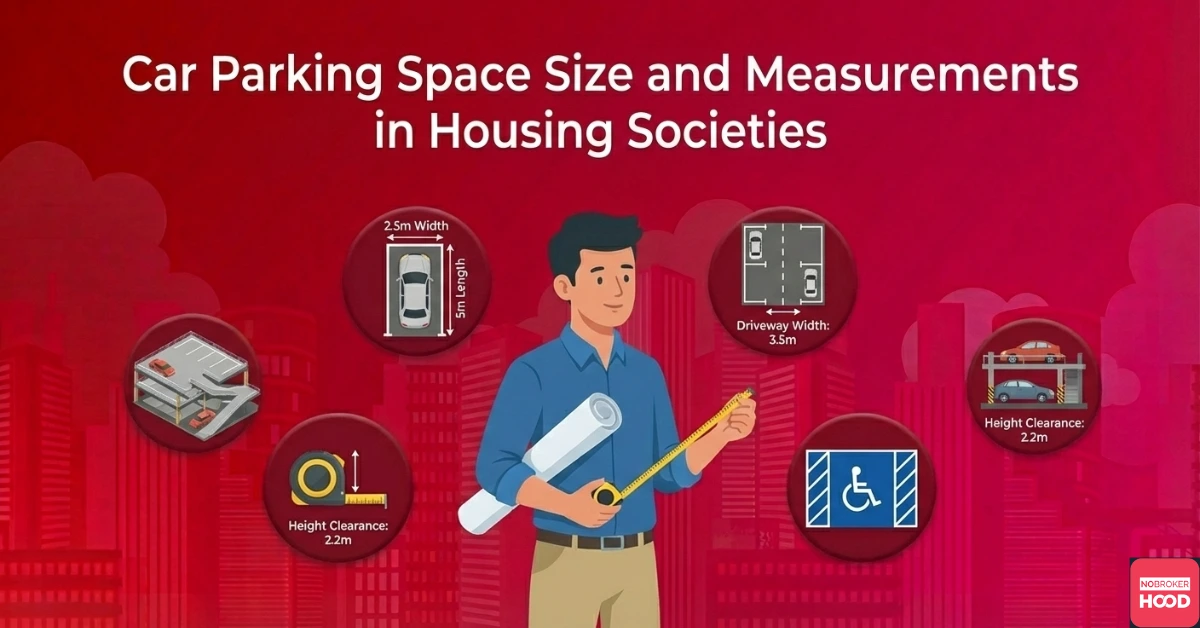
In India, the basic car parking space size is usually 2.5 meters wide and 5 meters long for residential buildings. However, many housing societies now plan slightly larger spaces, around 3 meters by 5.5 meters, for improved comfort, smoother movement, and accommodating larger vehicles. These car parking measurements are not just technical numbers. They directly affect parking comfort, vehicle movement, and shared space harmony in Indian residential societies.
Why Car Parking Space Size Matters in Indian Gated Societies?
In most residential societies, parking is one of the most discussed topics during meetings. A poorly planned car parking space size can lead to blocked driveways, scratched vehicles, and frequent resident disputes.
Parking size matters because:
- Cars in India are getting wider and taller
- More households now own SUVs and compact SUVs
- Basement and stilt parking areas have limited turning space
- Visitors and delivery vehicles need clear access
When parking spaces follow standard dimensions, residents find it easier to park, open doors, and move vehicles without stress. For societies, it also means better traffic flow, fewer complaints, and efficient use of the available land.
Standard Car Parking Measurements in India
Across most Indian cities, standard car parking dimensions follow national guidelines like IRC and NBC, along with local municipal bylaws.
For residential use, the commonly accepted standard is:
- Width: 2.5 meters (8.2 feet)
- Length: 5 meters (16.4 feet)
- Area: Around 12.5 square meters
This size works for most hatchbacks and sedans. However, it is often tight for SUVs, especially when doors need to open fully or when pillars are nearby.
Minimum Car Parking Size as per Codes
Indian building guidelines specify a minimum car parking size to ensure safe vehicle movement.
- National Building Code minimum: Around 13.75 sq m (approx. 148 sq ft) for residential four-wheelers
- Municipal norms: Often allow 2.5m x 5m as the minimum
- Reduced sizes: Some cities permit 2.3m x 4.5m for up to 50 per cent of parking slots
Some states, such as Maharashtra, allow up to 50 per cent of parking spaces to be slightly smaller at 2.3m x 4.5m, under specific development rules. These minimum car parking size rules help balance land usage with basic usability.
Read also: Co-operative Housing Society Parking Rules in Maharashtra
Comfortable Car Parking Sizes
While minimum sizes meet regulations, they do not always meet daily comfort needs. Many modern residential projects now use larger car parking measurements during planning or redevelopment.
Recommended sizes include:
- 3m x 5.5m for comfortable residential parking
- 3m x 6m for SUVs and larger vehicles
- Extra buffer space near walls, lifts, or columns
The car parking dimensions are designed to fit most vehicles while allowing basic door opening and manoeuvring. These car parking space sizes are often reviewed by architects, builders, and resident welfare associations.
Read also: Parking Allotment Rules for Builder Under RERA
Standard Car Parking Dimensions in Meters and Feet
Understanding standard car parking dimensions in meters and feet helps residents visualise space better.
| Parking Type | Standard Car Parking Dimensions in Meters | Standard Car Parking Dimensions in Feet |
| Standard Residential | 2.5m x 5.0m | 8.2ft x 16.4ft |
| Comfortable Residential | 3.0m x 5.5m | 10ft x 18ft |
| SUV / Large Car | 3.0m x 6.0m | 10ft x 20ft |
| Compact Car (Limited Use) | 2.3m x 4.5m | 7.5ft x 14.8ft |
These standard parking space sizes are designed to balance space efficiency and vehicle usability.
Standard Parking Space Size by Layout Type
The parking layout also affects the amount of usable space.
| Layout Type | Standard Car Parking Dimensions in Meters | Typical Use |
| Perpendicular (90°) | 2.5m x 5.0m | Most residential societies |
| Parallel Parking | 2.0m x 6.0m | On-street or narrow lanes |
| Disabled Parking | 3.6m x 5.0m | Accessibility zones |
| Two-Wheeler Parking | 1.25 sq m minimum | Scooters and bikes |
Choosing the right standard car parking dimensions based on layout reduces congestion and improves safety.
Special Parking Requirements in Housing Societies
Apart from regular car slots, housing societies need to plan for different user needs.
Important considerations include:
- Disabled parking: Wider bays for wheelchair access
- Visitor parking: Clearly marked and easy to access
- Electric vehicle parking: Space for charging points
- Two-wheeler zones: Separate from car pathways
Ignoring these needs often leads to misuse of regular car parking space size and internal disputes.
Driveway, Aisle Width, and Headroom Guidelines
Parking space alone is not enough. Supporting dimensions are equally important.
Recommended standards:
- One-way driveway: Minimum 3 meters
- Two-way driveway: Minimum 6 meters
- Turning radius: Adequate space near ramps
- Headroom: At least 2.2 meters in basements or stilt parking
Proper driveway planning ensures that car parking measurements actually work in real-life conditions.
Local Bylaws and Regional Variations in India
Parking rules in housing society vary across India. Car parking measurements can vary based on city-level development control rules.
Examples:
- Maharashtra UDCPR allows reduced parking sizes under conditions
- CMDA norms in Tamil Nadu specify minimum areas
- Metro cities may mandate visitor parking ratios
Housing societies should always check local bylaws before redesigning parking areas or reallocating spaces.
Common Parking Problems Residents Face
Even when parking exists, poor planning causes daily frustration.
Common issues include:
- Tight car parking space size for SUVs
- Blocked access due to poor aisle width
- Visitor cars occupying resident slots
- Confusion during festivals or events
Most of these problems arise not from lack of space, but from unclear rules and unmanaged layouts.
Read also: 7 Core Parking Problems for Apartment Societies and Solutions
How Housing Societies Can Plan Better Parking?
Better parking management starts with simple steps.
Housing Societies can:
- Measure existing car parking dimensions in meters accurately
- Re-mark lines for better visibility
- Assign slots based on vehicle size
- Create clear visitor parking rules
- Use digital systems for monitoring
Transparent planning builds trust and reduces recurring complaints.
Fully-Automated Parking Management by NoBrokerHood
As parking demand increases in residential societies, clear car parking measurements and car parking space size planning become essential for smooth daily operations. Fully-automated parking management system by NoBrokerHood supports housing societies by adding visibility, control, and accountability to how parking spaces are used and managed.
| Aspect | How NoBrokerHood Helps Residential Societies |
| Purpose | Helps housing societies manage increasing parking demand as vehicle ownership rises in Indian cities |
| Parking Visibility | Shows real-time parking slot availability to residents through a mobile app |
| Resident Convenience | Allows residents to pre-book parking slots for guests, reducing confusion and parking conflicts |
| Visitor Parking Management | Issues time-bound visitor parking access and maintains clear entry and exit records |
| Entry & Exit Tracking | Digitally records vehicle entry and exit details, replacing manual parking registers |
| Security Support | Integrates CCTV-based monitoring to maintain visual records in parking areas |
| Support for Security Staff | Simplifies access control and monitoring without increasing on-ground workload |
| Centralised Oversight | Enables management committees to monitor parking usage from a single dashboard |
| Data & Insights | Provides usage patterns that help housing societies plan parking allocation and peak-hour management |
| Scalability | Supports both single-level and multi-level parking layouts as housing societies grow |
| Community Impact | Reduces parking disputes, improves order, and supports long-term parking planning |
All Solutions by NoBrokerHood:
FAQs
The standard parking space size in India is usually 2.5 meters wide and 5 meters long. This size suits most hatchbacks and sedans, but may feel tight for larger vehicles.
The minimum car parking size is around 12.5 to 13.75 square meters for four-wheelers. Exact limits depend on local municipal and state regulations.
Yes, SUVs usually need larger car parking measurements, ideally around 3m x 6m, to allow proper door opening and easier movement.
Yes, standard car parking dimensions can vary based on city or state development rules, so local bylaws should always be checked.
One-way driveways should be at least 3 meters wide, while two-way aisles should be around 6 meters for smooth vehicle movement.