






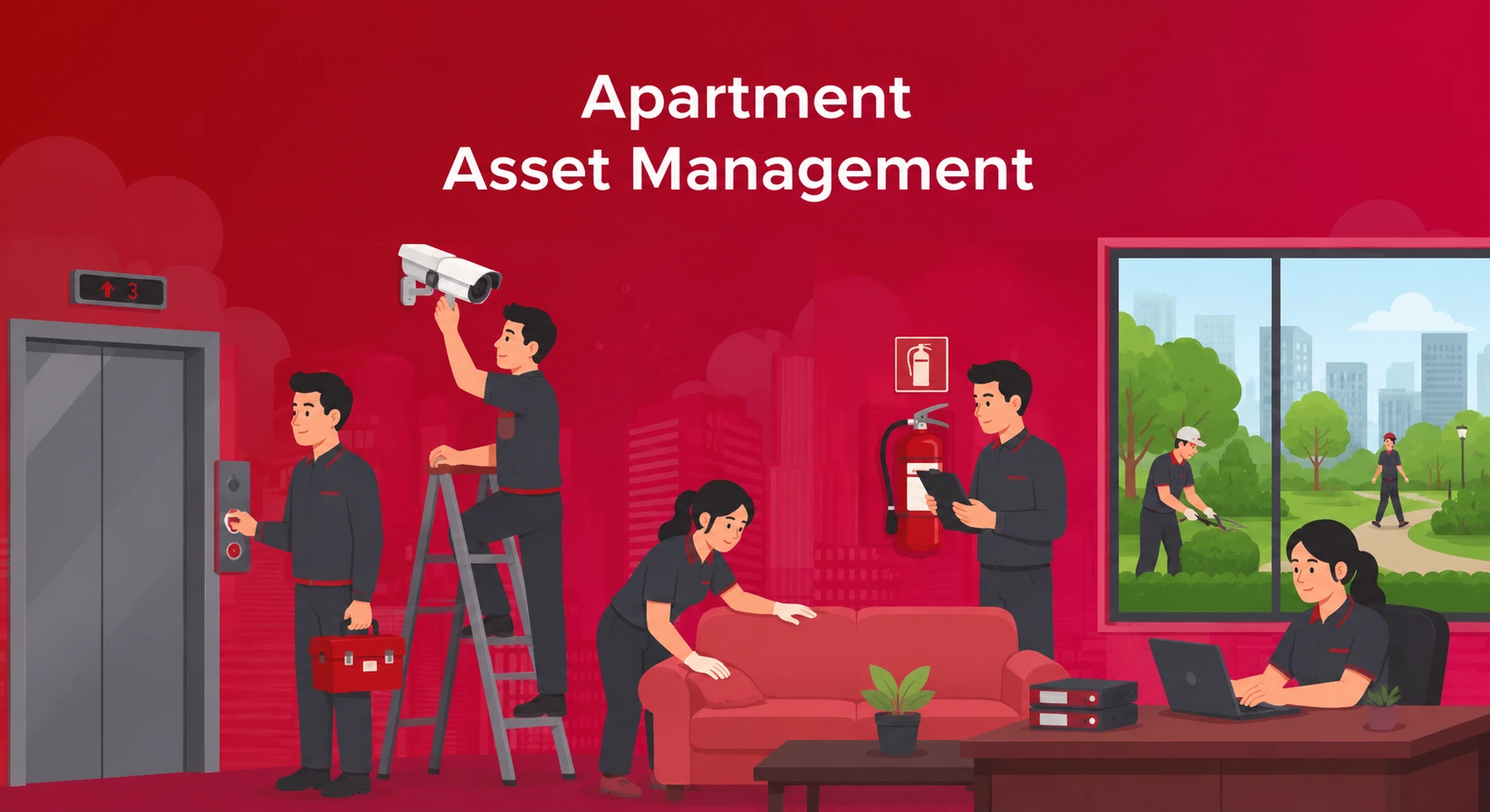


Apartment asset management is the process of planning, maintaining, monitoring and improving the common assets of a residential apartment or housing society. It helps societies to reduce maintenance costs, increase the lifespan of common facilities, improve the satisfaction of residents and protect the long-term value of the property through preventive maintenance, financial planning and digital asset tracking. This guide explains the steps that any committee can take in order to maintain their assets.

What Is Apartment Asset Management?
Maintenance doesn’t begin when something breaks. The lift breaks down, the water pump breaks down, or a CCTV camera goes offline. The managing committee calls a technician, fixes the problem, and life goes back to normal. This reactive approach often leads to more costs, a higher volume of complaints and surprise maintenance bills.
Apartment asset management takes a different approach. Instead of waiting for problems, it focuses on planning, tracking, maintaining, and improving every shared asset throughout its lifecycle. In a housing society, these assets include:
- Elevators
- Water pumps
- Backup generators
- Sewage Treatment Plants (STPs)
- Clubhouses
- Children's play areas
- Swimming pools
- CCTV systems
- Fire safety equipment
- Solar panels
- Security gates
- Parking infrastructure
All assets have a purchase price, maintenance schedule, life expectancy, warranty and replacement schedule. These details, when kept in check, enable societies to take informed decisions and not be reactive in emergencies. A good apartment asset management strategy consists of maintenance planning, budgeting, inspections, vendor coordination and digital record-keeping to ensure that all shared facilities are functional, safe and cost-effective.
Why Apartment Asset Management Matters for Every Society?
A society is only as good as its shared facilities. If the lift breaks down every month or the water tank leaks, residents feel it immediately, and property value can quietly drop over time.
Good apartment asset management helps a society in a few clear ways:
- It extends the working life of costly equipment like generators and lifts.
- It reduces sudden, heavy repair bills that get passed on to residents.
- It keeps common areas safe and functional for daily use.
- It builds resident trust because spending and maintenance records stay transparent.
- It protects the resale value of every flat in the complex.
Community asset management works on the same principle at a slightly broader level. It covers not just the physical infrastructure but also the funds, vendor contracts, and even the volunteer effort that keeps a society running smoothly.
Apartment Asset Management vs Property Management
Many people use these terms interchangeably, but they serve different purposes.
| Apartment Asset Management | Property Management |
| Focuses on long-term value | Focuses on daily operations |
| Plans capital improvements | Handles resident requests |
| Improves Net Operating Income (NOI) | Collects maintenance charges |
| Tracks asset lifecycle | Coordinates daily maintenance |
| Creates replacement budgets | Supervises housekeeping and security |
| Analyses operating costs | Manages vendors on a daily basis |
Property management ensures the society runs smoothly every day. It involves housekeeping, security staff, complaint resolution, visitor management, and routine maintenance.
How Do Their Responsibilities Differ?
Property management ensures the society runs smoothly every day. It covers routine operations such as housekeeping, security, visitor management, complaint resolution, and coordinating regular maintenance activities.
Apartment asset management, on the other hand, takes a long-term approach. It focuses on preserving and improving the value of shared infrastructure by making strategic decisions that benefit the community over time.
It addresses questions such as:
- Should society replace ageing elevators now or after three years?
- Is the current Annual Maintenance Contract delivering value?
- Can preventive servicing reduce repair costs?
- Should the committee invest in solar energy to reduce electricity expenses?
- Is the sinking fund in a society sufficient for future infrastructure replacement?
By answering these questions early, societies can improve financial planning while maintaining better living standards.
What Are Community Assets in a Housing Society?
Community assets are the shared resources that belong to all residents collectively rather than to any one household. They are funded, used, and maintained together, which is exactly why apartment asset management exists in the first place.
In a typical Indian housing society, these assets fall into a few broad buckets. Some are physical, like buildings and parking lots. Some are financial, like the sinking fund. Others are social, like the managing committee or resident WhatsApp groups that keep everyone informed.
Types of Community Assets Residents Should Know
Understanding the types of community assets makes it easier to decide what needs attention first. Broadly, they include:
- Physical and recreational assets: clubhouses, swimming pools, gyms, gardens, and children's play areas.
- Utility and infrastructure assets: lifts, water tanks, sewage treatment plants (STP), DG sets, and CCTV networks.
- Financial assets: the sinking fund, reserve fund, and maintenance collections held in trust for the society.
- Social and institutional assets: the managing committee, sub-committees, resident groups, and society bylaws.
- Digital assets: society management apps, digital notice boards, and online payment systems.
Each type needs a slightly different approach. Physical assets need scheduled servicing, financial assets need careful budgeting, and social assets need active participation from residents.
Common Examples of Community Assets
If the categories above still feel abstract, here are some everyday examples of community assets found in most Indian societies:
- Elevators and escalators
- Backup power generators
- Overhead and underground water tanks
- Security systems including CCTV cameras and intercoms
- Clubhouse furniture and indoor game equipment
- Rooftop solar panels
- Landscaped gardens and walking tracks
- Fire safety equipment and extinguishers
These examples of community assets often represent a significant share of a society's total investment, which is another reason regular tracking is worth the effort.
What Happens When You Ignore Apartment Asset Management?
Skipping proper apartment asset management rarely saves money in the long run. A lift that misses its scheduled service is far more likely to face a costly breakdown mid-year. A generator that has not been checked before monsoon season may fail exactly when it is needed most.
The consequences of poor asset management go beyond repair bills. It can lead to safety risks, unhappy residents and arguments during committee handovers when records are missing or incomplete. We know that societies that properly track their assets tend to spend less overall, just because they catch small problems before they become large problems.
There is also a resale angle that many residents overlook. Buyers walking through a society normally make their decision within the first few minutes, based on the condition of the lobby, lifts and gardens. Even with well-maintained flats, a community with a reputation for broken equipment or unresolved complaints can have slower resale cycles and lower offers. Consistent apartment asset management protects this collective reputation as much as it protects the equipment itself.
How to Build a Simple Apartment Asset Management Plan?
Setting up apartment asset management does not need to be complicated. Most societies can get started with five practical steps.
1. Create an asset inventory
List every major asset the society owns, along with its category, brand, purchase date, warranty status, and expected lifespan. This becomes the foundation for everything else.
2. Separate preventive and corrective maintenance
Preventive maintenance means scheduled check-ups, such as monthly lift servicing or quarterly STP cleaning. Corrective maintenance is the reactive repair work done after something breaks. Leaning more on preventive maintenance usually keeps costs lower.
Read More: Preventive Plan Maintenance with NoBrokerHood
3. Track AMCs and vendor contracts
Annual Maintenance Contracts for lifts, DG sets, and other heavy equipment should be renewed on time and reviewed each year. Keep a verified list of vendors for landscaping, pest control, and general upkeep.
4. Plan the budget and sinking fund
A portion of monthly maintenance collections should go into a sinking fund reserved for major repairs or replacements, such as repainting the building or rewiring common areas. This avoids sudden, heavy charges on residents.
5. Digitise records where possible
Manual registers are prone to errors and get lost during committee transitions. Digital tools help committees log assets, set maintenance reminders, and let residents report issues like a broken gate or a flickering street lamp without waiting for the next meeting.
Everyday Tips Residents and Committees Can Follow
Apartment asset management works best when residents and committees share the responsibility. A few simple habits go a long way:
- Report damaged common equipment as soon as it is noticed, rather than waiting for someone else to flag it.
- Attend committee meetings where budgets for maintenance and vendor decisions are made.
- Request a copy of the AMC schedule so residents know what was serviced and when.
- Ask the committee to provide a simple maintenance calendar for common amenities.
- Do not misuse common facilities such as the gym or clubhouse, as all repairs are equally shared by everyone.
- Make a note of common problems that may keep coming up, such as an elevator that keeps stopping frequently, to bring them up formally rather than informally.
- Volunteer for maintenance or facility subcommittees when possible, as these committees determine how the annual budget will be spent.
- A society where people are kept informed, and committees are organised generally has lower emergency repair costs and fewer disputes over money. Small regular habits are essential more than occasional big clean-up drives.
Preventive Asset Maintenance with NoBrokerHood
Keeping track of every lift, water pump, generator, or fire safety system in a housing society is not easy. Service dates, AMC renewals, and maintenance records often end up spread across files, spreadsheets, or passed on from one committee member to another. Over time, important maintenance tasks can be missed.
NoBrokerHood’s Preventive Plan Maintenance (PPM) feature helps societies stay organised by keeping all the asset-related information in one place. Committees can schedule routine servicing, record completed maintenance, and get reminders for upcoming tasks, making it easier to stay ahead of repairs instead of reacting after a breakdown.
With a more organised maintenance process, societies can:
- Keep all asset and maintenance records together
- Schedule regular servicing for common facilities
- Receive timely reminders for upcoming maintenance
- Maintain a clear history of completed work for future reference
When routine maintenance is planned and tracked properly, shared facilities remain in better condition, unexpected breakdowns become less frequent, and committees can manage society assets with greater confidence.
All Solutions by NoBrokerHood:
