





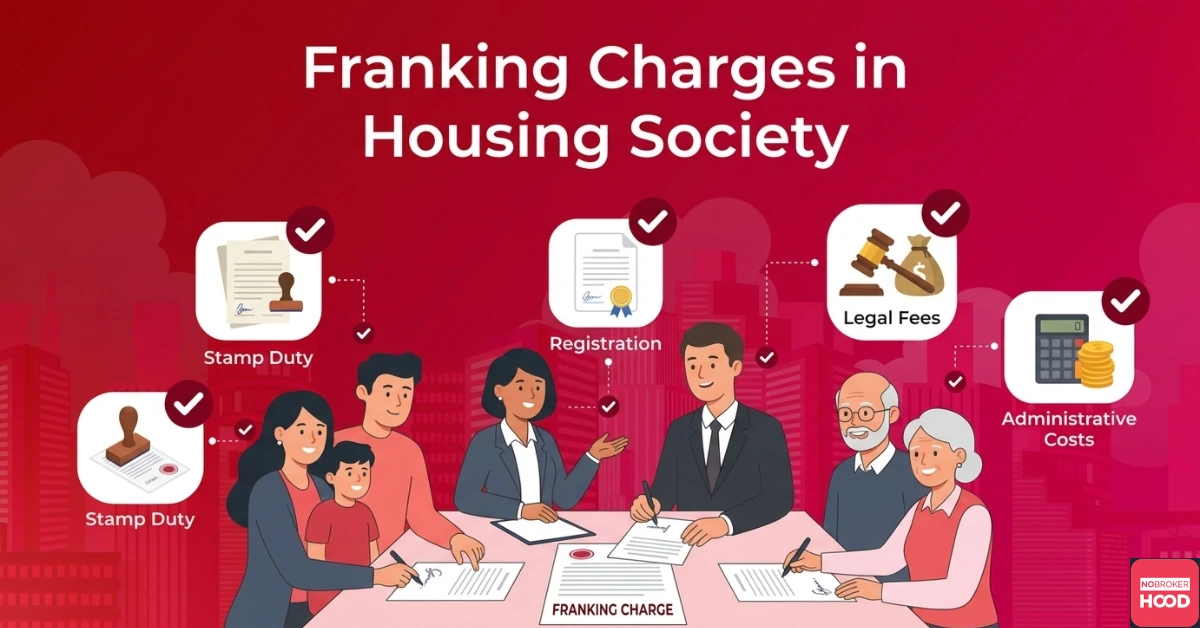


Purchasing a property in India is a long process. While validating the purchase and securing a home loan is one aspect of the process, the other is paying all the taxes and miscellaneous charges to the government and related authorities. Among these additional charges, the point of discussion in this blog is franking charges related to the properties. While it is one of the most important points of a property purchase, not a lot of people are aware of it and often overlook it. As a result, they sometimes face unnecessary challenges during the process. So, let’s demystify this concept and understand what it is.

What is Franking Charges?
Franking charges mean an additional amount levied to stamp your property documents, indicating that the necessary stamp duty has been paid. This process involves contacting your bank, from where you are taking the home loan, any franking agency, or relevant government offices, to pay the charges and get the stamp.
Now, this stamp acts as proof of payment of stamp duty. It means the property transaction is legal, and all the property-related papers are also valid.
Relevance of Franking Charges in Housing Societies
In the context of housing societies, franking charges are highly relevant. It ensures that all the property transactions are legally binding and valid. Whether it is a sale of a property or simply leasing and renting a property, franking helps verify these transactions and provides the needed sense of security and legitimacy.
Therefore, for property buyers of housing societies, understanding franking charges is important to ensure a smooth property ownership experience.
Also Check: Non-Occupancy Charges in Society
How are Franking Charges Calculated?
Franking charges are calculated as a small percentage of the total property value, usually between 0.1% to 0.2%, and vary from state to state. In most cases, they are included as part of the stamp duty, so buyers do not need to pay them separately. For example, if stamp duty is 8% and franking charges are 0.1%, the actual stamp duty payable becomes 7.9%. Before buying a property, always check whether franking charges are calculated independently or adjusted against stamp duty to avoid any surprise costs.
Franking Charges Calculation Based on Property Value
| Property Value | Franking Charge Rate | Franking Charges Payable |
|---|---|---|
| Rs. 40 Lakh | 0.1% | Rs. 4,000 |
| Rs. 60 Lakh | 0.2% | Rs. 12,000 |
| Rs. 80 Lakh | 0.1% | Rs. 8,000 |
| Rs. 1 Crore | 0.2% | Rs. 20,000 |
Also Check: Apartment Maintenance Charges Calculation
Are Franking Charges Included in Stamp Duty During Apartments Registration?
Yes, franking charges are generally considered part of the stamp duty payment for apartment registration. Franking is simply a method used to indicate that the required stamp duty on a property document has been paid.
However, the treatment of franking charges can vary by state. In many cases, the amount paid for franking is adjusted against the total stamp duty payable. Some banks or authorised franking agents may also charge a small processing or service fee separately.
For apartment buyers, franking charges are commonly applicable during:
- Sale agreement registration
- Flat resale transactions
- Leave and license agreements
- Conveyance-related documentation
Before registering an apartment, it is advisable to confirm:
- Whether franking is accepted in your state
- If the franking amount is included in the final stamp duty calculation
- Any additional service fees charged by the bank or agent
In most apartment transactions, franking itself is not an extra tax beyond stamp duty, but there may be minor administrative charges associated with the process.
Process of Franking in Housing Societies
The process of franking in Indian housing societies includes the following steps
Step 1: To commence this process, you first need to get hold of all the original property papers
Step 2: Next, you need to check whether you have to pay additional franking charges or along with the stamp duty
Step 3: Once you are confirmed, you need to contact a bank or an authorised agency that renders this service
Step 4: Once you are there, complete the paperwork and pay the charges
Step 5: The concerned agency or bank will then stamp the document and give you a receipt for the payment of these charges, and you are done
What is Franking of Documents?
Franking of documents is the process of stamping legal or financial papers to confirm that the required stamp duty has been paid to the government. Instead of using traditional stamp paper, an authorised bank or franking centre prints a special stamp (called a franking impression) on the document. This mark serves as official proof that the document is legally valid and ready for execution or registration.
In India, franking is commonly used in property transactions, home loan agreements, lease deeds, and other important legal paperwork. It helps prevent fraud, ensures compliance with state laws, and provides authenticity to the document.
Franking of Documents: Key Features
- It is proof of stamp duty payment
- Done through authorised banks or franking agencies
- Used for property and loan-related documents
- Faster and often more convenient than stamped paper
Required before document registration in many cases
Common Documents Requiring Franking Stamp Paper
Franking is typically required for legal and financial documents related to property and loan transactions. It serves as proof that the applicable stamp duty has been paid, making the documents legally valid and enforceable. Before registration or submission to a bank, these documents usually need to be properly franked.
The Franking stamp papers are required for the following documents:
- Sale agreement
- Lease deed
- Transfer of membership
- Loan agreements
- Other important documents
Online Franking: How to Pay Franking Charges?
Now, there are mainly two ways of paying the Online franking charges and offline. In the case of online, you can simply opt for NEFT or other fund transfer processes to complete the transaction. On the other hand, for offline transactions, you can use cheques, demand drafts, and cash to complete the process.
Steps for Online Franking
- Visit the authorised bank or state e-franking portal
- Fill in the required property or loan document details
- Pay the applicable stamp duty and franking charges online
- Download or collect the digitally franked receipt
- Submit the franked document during registration or loan processing
Online franking helps save time, reduces paperwork, and minimises the need to visit government offices physically.
Offline Method to Pay Franking Charges
For the offline transactions, you can visit an authorised bank branch or franking centre and pay using:
- Cheques
- Demand drafts
- Cash (where permitted)
After payment, the bank or authorised agency will physically frank (stamp) your documents and provide an official receipt.
Also Check: How to Pay Society Maintenance Bill Online
Exemptions and Concessions on Franking Charges
The exemptions and concessions on franking charges are a matter of the state government. Therefore, it is difficult to list down a set of areas where they will be applicable as they will vary from one state to another.
However, some common areas where exemptions and concessions on franking charges can be witnessed include
- First-time homebuyers
- Women homebuyers
- Agricultural land
- Property for charitable or non-profit organisations
- Properties purchased by senior citizens
Impact of Franking Charges for Home Loan and Property Transactions
The impact of franking charges on property transactions in housing societies is significant. Firstly, it validates any property dealings within the society and ensures everything is in order. Moreover, it maintains transparency and lowers the risk of fraud and disputes.
Secondly, the franking charges also drive up property prices. Even though the percentage in discussion is small, it still has an important impact on the overall price of the property. So, as a prospective buyer, you need to consider these charges while budgeting for the property purchase.
When it comes to franking charges for home loans, borrowers should note that these charges apply to loan agreements and related legal documents submitted to the bank. Banks usually insist on franking the home loan agreement to confirm that the applicable stamp duty has been paid, making the loan legally enforceable.
Typical Franking Charges for Home Loan
The franking charges for a home loan generally depend on the state and the loan amount. However, the common range is:
- Usually, around 0.1% to 0.2% of the loan or agreement value
- May be adjusted against stamp duty in some states
- Can be subject to minimum or maximum caps depending on local rules
For example, if your home loan agreement value is ₹50 lakh and the franking rate is 0.1%, the franking charge would be ₹5,000.
How NoBrokerHood Helps Manage Franking Charges in Housing Society Management
In modern housing society management, handling documentation and franking charges can be time-consuming and prone to errors. NoBrokerHood simplifies this process by digitising requests, tracking payments, and ensuring compliance with local regulations. Through its integrated system, societies can manage franking-related workflows transparently, reduce manual paperwork, and provide residents with a smooth and efficient experience.
| Feature | How NoBrokerHood Helps | Benefit for Housing Societies |
|---|---|---|
| Digital Request Management | Residents can submit franking-related requests through the app | Eliminates manual paperwork |
| Payment Tracking | Tracks franking fees and payment status in real time | Improves financial transparency |
| Document Management | Securely stores agreements and stamped documents | Easy retrieval and compliance |
| Automated Notifications | Sends alerts for pending approvals or payments | Reduces delays and follow-ups |
| Admin Dashboard | Society admins can monitor all franking activities | Better control and oversight |
| Compliance Support | Helps maintain proper records for legal purposes | Minimises legal risks |
| Resident Convenience | Online process reduces the need for physical visits | Enhances resident experience |
All Solutions by NoBrokerHood:
