What is Plinth area? Meaning and Calculation
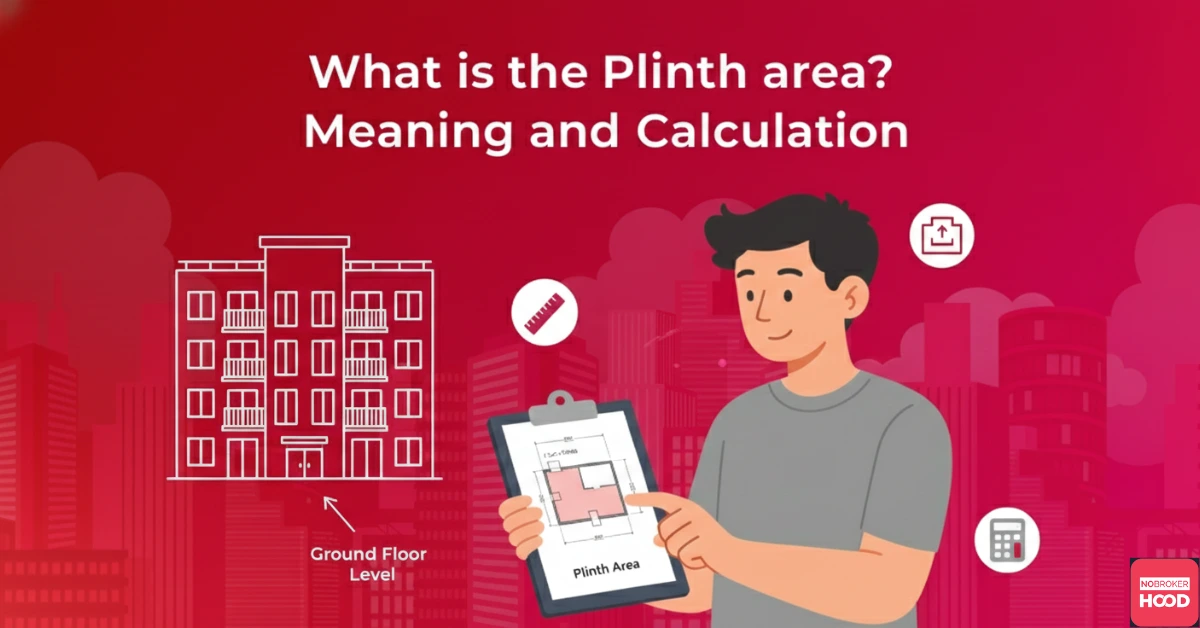
When navigating the complex world of real estate, a clear understanding of property measurements is paramount. So, having an in-depth knowledge of the plinth area is crucial, as it plays a pivotal role in the real estate domain. However, people often misunderstand this term. Thus, this guide aims to simplify the concept, explain the relationship of plinth area and built up area, and its significance in property-related matters and the meaning of Plinth Area.
What is Plinth Area – Meaning
Plinth area refers to the entire floor space of a building, measured at the ground level of any basement. This encompasses not only the interior floor space but also the area occupied by the building’s structural components, such as internal and external walls.
Understanding the plinth area’s meaning is important because it serves as a basic parameter for various property-related calculations and assessments. However, you should remember that features like an open terrace, lobby, and garden are not included while calculating the plinth area. Also doing a structural audit is a crucial step towards safety.
Plinth Area vs Built Up Area Same?
A short answer to this question is yes. The terms built up area and plinth area are often used interchangeably in the real estate industry. Both terms define the same thing, the total covered area of a building, encompassing both the internal floor space and the area occupied by walls.
It is essential to distinguish these terms from carpet area, which exclusively refers to the usable floor space within the walls, excluding the thickness of the walls. A clear comprehension of these terms is vital for accurate property valuation, taxation, and legal documentation.
Also Check: Benefits of Society Management App
Plinth Area vs Carpet Area Definitions
Plinth area measures the total covered area at the floor level, including external and internal walls, staircases, and utility ducts for overall construction assessment. In contrast, carpet area focuses solely on the net usable interior space, like rooms, kitchen, and bathrooms that a carpet can cover, excluding wall thicknesses and balconies.
Plinth Area vs Carpet Area Comparison
| Aspect | Plinth Area | Carpet Area |
| Coverage | Full floor footprint with walls | Usable rooms only, no walls |
| Exclusions | Open courtyards outside | Balconies, ducts, external walls |
| Ratio to Each | 100% base | 50-65% of the plinth |
| Primary Use | Building estimation | Buyer pricing, livable space |
Also Check: Society Transfer Charges
Plinth Area of Building: Significance
The plinth area is pivotal in several aspects of property ownership and transactions. By referring to the points below, you can learn better:
Property Valuation
One of the primary determinants of property value is the plinth area or built up area. A larger plinth area generally corresponds to a higher property value, assuming other factors remain constant.
Property Taxation
Various property tax assessments are done based on a property’s plinth area. It helps local authorities often to calculate the property tax liability.
Adherence to Building Regulations
Building permits and other regulatory approvals frequently have stipulations regarding the maximum plinth area allowed for a property. Complying with these regulations is essential to avoid legal complexities.
Home Loans
Financial institutions consider the plinth area as a key factor while assessing your loan eligibility and determining the loan amount. So, if your house has a larger plinth area, you are more likely to get a higher loan amount.
How to Calculate Plinth Area of a Building?
Determining the plinth area of a building might seem complex, but it can be calculated using relatively simple methods.
You can use the following plinth area formula for calculation:
Plinth Area = Carpet Area + Area of Walls
However, calculating the exact area of your home’s walls can be extremely time-consuming. Thus, a commonly used methodology is to add 10-20% of the carpet area to the carpet area to find an approximate plinth area. This method generally provides a reasonable estimation for residential properties that have regular shapes.
But for precise calculations of plinth area, you must measure the length and thickness of each wall individually and sum up the total area. This method will provide you with an accurate number, but it will require more time and effort.
Also Check: Housing Society Management Software Investment Guide
Plinth Area Formula and Calculation Method
If you want to calculate your home’s plinth area, you can follow the steps below:
Step 1: Measure the outer length and breadth of the building at the plinth level from the outside walls. For rectangular buildings, multiply the length by the width. If the building has an irregular shape, divide it into simple rectangles or triangles and add their areas.
Step 2: Measure the width and length of every room and sum them up to find the total internal area. After this, determine the thickness of all internal and external walls and add it to the total area. Also include internal features such as staircases, and deduct any open wells or courtyards inside the building.
Step 3: Lastly, multiply it by the total number of floors.
Formulas by Shape
- Rectangular: Plinth Area = Length × Breadth
- Circular: Area = π × Radius × Radius
- Approximate: Carpet area + 10-20% for walls (common for homes)
Example Calculation
For a 50 ft x 40 ft house: 50 × 40 = 2000 sq ft, plus internal stairs (say 100 sq ft) = 2100 sq ft total plinth area. Use this for construction costing by multiplying by the rate per sq ft.
However, to simplify the calculation process, you can use online plinth area calculators as well. By putting in the necessary information, you can find out your house’s plinth area.
Also Check: Property Management Budget Planning Explained
Factors Affecting Plinth Area of Residential Buildings
There are several elements that can influence the plinth area of your house. You can check the following points to develop a better understanding of these factors:
Number of Floors
A multi-storey building naturally has a larger plinth area than a single-floored building, as it covers more ground area.
Wall Thickness
Buildings with thicker walls have a larger plinth area compared to those with thinner walls as it is included in the calculation of plinth area.
Building Shape
Irregularly shaped buildings often have a larger built-in area than rectangular or square buildings due to the additional area covered by the walls
Plinth Area Rates of Residential Buildings
Plinth area rates for residential buildings in India provide rough construction cost estimates per square meter, updated annually by CPWD and state PWDs. For 2025-2026, CPWD rates for standard residential (RCC framed, floor height 3.35m) are around ₹19,000/sqm (~₹1,765/sq ft).
Rate Breakdown
Base rates vary by structure and height: ₹15,200/sqm for lower floors (2.90m height), with extras like ₹580/sqm per additional storey over six. These cover civil works; add for electrical/plumbing.
CPWD Residential Rates (2026)
| Type/Floor Height | Rate per Sqm (₹) | Extras |
| 3.35m Height | 19,000 | Base RCC residential |
| 2.90m Height | 15,000-15,200 | Lower ceiling |
| +1 Storey > 6 | +560-580 | Up to 12 storeys |
| Higher Plinth | +270 per 0.3m | Ground floor only |
Usage Notes
Multiply plinth area by rate for preliminary budgets, adjusting for location via cost indices (e.g., Delhi 103% over base). Private residential often ranges from ₹1,500 to ₹3,000/sq ft based on finishes.
Simplify Society Management with NoBrokerHood
NoBrokerHood streamlines society management by digitising billing, security, communication, and accounting on a single platform. It reduces manual effort, improves transparency, and makes daily operations smoother for RWAs and residents.
| Area | Traditional Society Management | With NoBrokerHood |
| Visitor Management | Manual entry in registers, security dependency | App-based visitor entry with OTP, instant resident alerts |
| Maintenance Billing | Paper bills, manual calculations, follow-ups | Automated maintenance invoices and online payments |
| Accounting & Audits | Excel sheets, error-prone records | Built-in accounting with reports and audit-ready data |
| Communication | Notice boards, WhatsApp chaos | Centralised announcements and resident communication |
| Complaints & Requests | Verbal complaints, no tracking | Ticket-based issue tracking with status updates |
| Security | Limited monitoring | Integrated security features with digital logs |
| Amenity Booking | Manual registers, conflicts | Online booking of amenities with real-time availability |
| Vendor Management | Phone calls and manual coordination | Digital vendor records and service tracking |
| Data Storage | Physical files, risk of loss | Secure cloud-based document storage |
| Transparency | Limited visibility for residents | Real-time access to bills, notices, and reports |
All Solutions by NoBrokerHood:
FAQs
No, a building’s built-in area and plinth area are the same.
You can add 10% to 20% to your home’s carpet area to find an estimated plinth area of your home. However, to get an accurate result, you have to find out the thickness of the wall and add it to the carpet area. The sum of these two elements will give you an accurate built-in area.
While calculating the plinth area, you need to include the total wall areas, duct for air conditioners, inner shafts, the thickness of the wall, and internal and external staircases.
You should not include an open terrace, garden or lobby while calculating the built-in area.
A building’s carpet area represents its total usable area, whereas the plinth area is the sum of carpet area and wall area.
Total covered ground floor space within outer walls, including internal/external walls, stairs, ducts, excludes open terraces, gardens.
Plinth Area = Carpet Area + Area of Walls; or add 10-20% to carpet area for quick residential building estimates.
₹1,500-₹3,000 per sq ft across India (2026); varies by location, materials multiply by plinth area for total construction cost.