



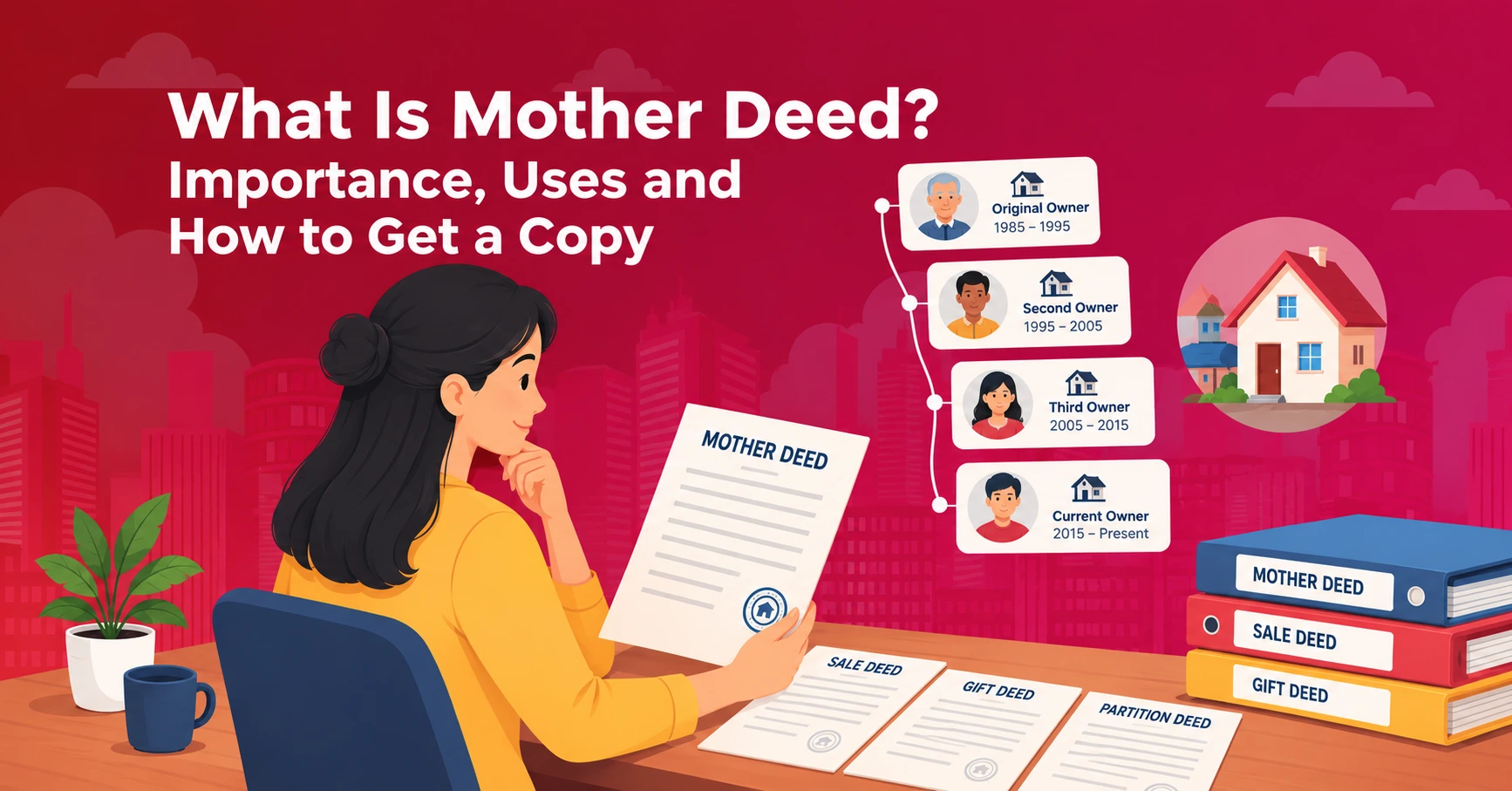


Mother Deed is a vital property document that gives a record of the ownership of the land upon which the apartment or housing society is located. It serves to help the buyers, flat owners, and society members check the title of the property before taking any legal or financial actions. This blog explains what a mother deed is, what the document consists of, and the difference between a mother deed and a sale deed. It also discusses why residents need a mother deed and how to secure the document for your housing society.

What Is Mother Deed in an Apartment or Society?
The mother deed is also called the parent deed or origin deed. It is not always titled “mother deed.” It can be a sale deed, gift deed, partition deed, a government grant, or an allotment letter from a development authority. In Bengaluru, for example, the allotment letter for a BDA site is treated as the mother deed.
For a society, it shows how the builder or landowner acquired the land the buildings stand on. It also shows that nobody has encroached on that land and that no dispute is pending.
For you as a flat owner, the picture is slightly different. Your sale deed covers your unit and your undivided share of land (UDS). The mother deed is the paper that proves the builder was allowed to sell that share to you.
What Details Are Included in a Mother Deed?
A standard mother deed or its bundle of linked papers records:
| Key Detail | Description |
| Ownership Trail | Every earlier owner, and how the property moved from one to the next through sale, gift, inheritance or partition |
| Property Description | Property boundaries, survey numbers, total land area, and location. |
| Encumbrance Status | Whether the land was ever mortgaged or carried a loan. |
| Approvals and Conversions | Land-use changes, such as conversion from agricultural to residential use, and municipal permissions. |
Mother Deed vs Sale Deed: What Is the Difference?
Most buyers mix these two up, so here is the short version.
| Mother deed | Sale deed | |
| Purpose | Shows how ownership began | Transfers ownership in one transaction |
| When it is created | At the start of the property’s recorded history | Each time the property is sold |
| Number | One per property | Many over the years |
| Where it sits in the paperwork | The first document in the property’s history | One of many documents that come after it |
| What it connects | Shows how the land first came to a private owner | Connects the previous owner to the next owner |
Picture the papers for a flat laid out in date order. The mother deed is the first page. Each sale deed after it is another page, and each one names the person who sold and the person who bought. A lawyer reads from the first page to your sale deed and checks that every seller was the buyer on the page before. If one page is missing, the lawyer cannot say who truly owned the flat at that point.
Those papers only prove who owns your flat. The building and the land under it need a separate document, the conveyance deed. It transfers the land and common areas from the builder to the society or RWA. Without one, owners can face trouble with redevelopment, bank finance and resale.
Why Do Residents Need the Mother Deed?
There are four situations where a resident, a buyer or a society committee will be asked for the mother deed. They are:
- Home loans: banks check it during legal verification, and many ask for it on loans above ₹25 lakh.
- Resale: the buyer’s lawyer will trace the title back to the mother deed. The lawyer also needs your sale deed to check that the last transfer was made properly.
- Conveyance: the builder needs it to hand over land and common areas to the society or Resident Welfare Associations.
- Mutation: municipal records are often updated using the title chain, so the mother deed may be asked for.
What Are the Risks of a Missing or Incomplete Mother Deed?
Property lawyers in Karnataka list a few problems again and again:
- A missing link between two owners
- Sales made through an unverified power of attorney
- Survey numbers that do not match across documents
- An original that was lost and never replaced
Any one of these can stall a loan, block registration or end up in court. An encumbrance certificate will not fix a defective root title, because it only shows mortgages and registered dealings.
How to Get a Copy of the Mother Deed in India
- Ask the builder, the original landowner or the society office first. They often hold the original.
- Note the property address, survey number and the name of an earlier owner.
- Apply for a certified copy at the jurisdictional Sub-Registrar’s Office.
- Check your state’s land record portal, since many states have digitised older records.
- Give the papers to a property lawyer to read the full chain.
Most lawyers and banks trace about 30 years. Some cases, such as agricultural land, need longer.
Tips for Housing Societies to Store Property Documents
- Make a list of every title document the society holds, and who holds the original.
- Scan each one and store the copies where at least two committee members can reach them.
- Check the conveyance deed status at the next housing society AGM and record it in the minutes.
- Replace any lost document through the Sub-Registrar’s Office early, not when a sale is pending.
- Hand the list to each new committee at the changeover.
Make Housing Society Management Easier with NoBrokerHood Society Management System
A housing society has more to manage than maintenance payments. Committee members also handle resident complaints, security, announcements and paperwork. Important property documents, such as the mother deed and conveyance deed, need proper storage so they can be located when required.
NoBrokerHood helps committees handle these responsibilities through a single platform. It brings everyday society activities into one place, reducing the need to manage every task through separate registers and records.
Some useful features include:
- Accounting: Record maintenance collections, vendor payments and society expenses.
- Document Management: Keep important society papers organised digitally for easier reference.
- Complaint Tracking: Record resident complaints and follow up until they are addressed.
- Resident Communication: Share notices, meeting updates and other announcements.
- Visitor Management: Record visitor entries and help security staff manage entry to the premises.
These tools can make routine work easier for committee members and help keep society records in order.
