





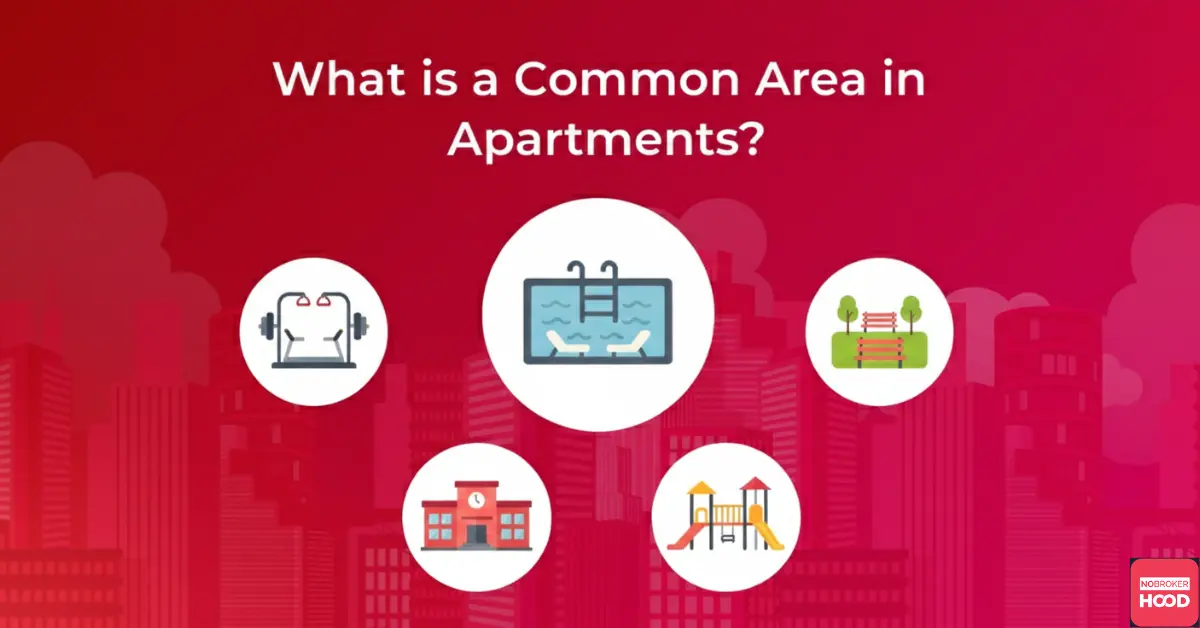


Buying a property, especially an apartment, means not just acquiring a private living space within the boundary of four walls, but also having access to the common area. The common area in apartments refers to the place that is accessible to every resident. As per the real estate property law, it is referred to as ‘an area that is open for use by more than one individual. Now, understanding what constitutes the common areas in an apartment, its significance and its impact on the living experience is important for any apartment owner. So, read on to explore this concept in detail.

Definition of Common Area in Apartments
Common area in apartments refers to the areas that are not part of the individual flats. So, these areas are open for all the residents, and all the owners are equally responsible for the maintenance of these spaces. So, here are the examples of common areas in apartment buildings:
- Lobby and reception
- Hallways and corridors
- Staircases
- Elevators
- Gardens, lawns, and parks
- Swimming pools and gyms
- Community halls and banquet halls
- Terrace
- Utility areas
Now, let’s understand why common areas in apartment buildings are important and necessary for every apartment complex.
Also Read: Common Area Maintenance (CAM) Charges in Apartments
Importance of Common Area in Apartments
The common area in apartments has a crucial role to play in improving its appearance and functionality. It also helps to elevate the living experience of the residents. So, here are some of the crucial points related to this:
Improves social interaction
Common areas in apartment buildings are places that help to improve social interaction between residents and foster a community spirit.
Promotes recreational activities
Common areas in apartments also play a vital role in organising various functions within the housing society. Starting from pujas to new year night celebrations, everything can be organised in these areas. Also, personal functions like weddings, birthdays, anniversaries, etc., can be planned in such areas.
Better aesthetics
Common areas in apartments, like gardens and lawns, when well-decorated improves the aesthetic appeal of the society. With beautiful trees and water bodies, they create a more pleasant living experience.
Enhances security
Buildings with dedicated fire exit and evacuation meeting points add an extra layer of security. So, common areas in apartments like these are important to elevate the sense of security in a complex.
Increase the value of the property
Buildings and residential complexes with well-designed common areas attract buyers easily. Also, properties like these fetch a higher market value, helping you get a better return on your investment.
Also read: Essential Guide to Society Maintenance Charges
What Are The Apartment Common Area Rules and Regulations?
Now, the answer to this question will vary from one society to another. Usually, every residential complex sets its own common area rules and regulations in apartments that residents have to follow. This set of norms mostly includes usage and maintenance-related regulations.
Having said that, here are some pointers that you need to keep in mind as a resident or housing society administrator:
Maintenance of the common area in apartments
The maintenance of the common area in apartments is the responsibility of every resident. Since this space is used by everyone, they must contribute to managing the upkeep of the place. Now, keeping this in mind, housing societies have created maintenance funds, where they put money periodically that takes care of the costs required to look after this space.
Using the common room/community hall/banquet hall
Today, every housing complex has a community hall that they can use for different functions. Now, in some cases, the housing society decides to charge a small fee as rent for the space, which they use for different purposes. But that must be implemented after a consensus from every resident.
The common area cannot be converted
In terms of common area rules and regulations in apartments, it is important to note that this space cannot be converted into anything else. So, under no circumstances can this place be used for official or personal purposes permanently. Residents can use the space temporarily, but they need to vacate it right after.
The terrace is for all
The roof of the apartment buildings remains under the ownership of the residents. Therefore, stopping someone from accessing it is an illegal practice. As per the floor area ratio, the terrace of the building is not included in the measurement of the flats, hence, they cannot be sold separately. However, if the terrace space is not part of a community area, then it remains private and can be sold separately.
Access to the common area in apartments is transferable
Access to the common areas in the housing societies is transferable through the lease and sale of the property. However, the new resident must take care of the maintenance charge of the space.
Parting Thoughts
The common area in apartments is an integral part of the residential society. Therefore, proper maintenance and respectful usage of the space are important to ensure a harmonious and hygienic environment. However, with NoBrokerHood, society administrators can now streamline the upkeep and surveillance of the common area. Through this app, societies can maintain visitor records, keep tabs on the security, schedule maintenance and payment of utility and establish seamless communication, leading to a better living experience for the residents.
Also read: How to Reduce Society Maintenance Cost?
Common Area Rules for Tenants
Tenants are generally allowed to use common areas like lobbies, corridors, lifts, and amenities such as the clubhouse or gym, but they must follow the same society bylaws as owners. Rules typically restrict personal storage or parking in shared spaces, require noise control during designated quiet hours, and mandate that maintenance charges (which fund the upkeep of common areas) are paid on time, usually by the owner unless otherwise agreed in the lease. Tenants may also need prior permission or registration with the RWA/society office to access certain facilities like the clubhouse or swimming pool, and any damage caused to common property can result in penalties charged to the tenant or owner.
How to Calculate Common Area in Apartment?
Common area is calculated as the difference between the super built-up area and the built-up area of an apartment. In simple terms:
Common Area = Super Built-up Area − Built-up Area
Where:
- Built-up Area = Carpet Area + area of walls (both internal and external) + balconies/utility areas
- Super Built-up Area = Built-up Area + proportionate share of common areas (lobbies, staircases, lifts, corridors, clubhouse, gym, garden, etc.)
Step-by-step calculation:
- Find the Carpet Area - the actual usable floor space within the walls of your unit.
- Add wall thickness to get the Built-up Area (usually 10-15% more than carpet area).
- Determine the loading factor applied by the builder (typically 20–35%, varies by project and amenities offered).
- Apply the formula:
Super Built-up Area = Built-up Area + (Built-up Area × Loading Factor) - Subtract Built-up Area from Super Built-up Area to get your share of the Common Area.
Example:
If a flat has a Built-up Area of 1,000 sq. ft. and the builder applies a 30% loading factor:
- Super Built-up Area = 1,000 + (1,000 × 0.30) = 1,300 sq. ft.
- Common Area = 1,300 − 1,000 = 300 sq. ft.
Who Pays for Common Area Maintenance?
All apartment owners pay common area maintenance charges proportionally, regardless of flat usage or occupancy.
Owners bear 100% responsibility from the possession date, even for vacant flats. RERA mandates contributions to maintain shared spaces like lobbies, lifts, corridors, parking, and amenities. Tenants typically reimburse owners via rent agreements.
Payment Breakdown
| Payer Type | Responsibility |
| Owners | Mandatory even for the unused flats |
| Tenants | Reimburse owner (contractual) |
| Builder | Unsold inventory only |
| Society | Collects & manages funds |
Also Read: Guide to Automated Society Maintenance Bill
How NoBrokerHood Helps with Common Area Management
NoBrokerHood simplifies common area management in apartments by clearly defining shared spaces and automating their maintenance tracking. Using housing society accounting software, it ensures transparent expense allocation, rule enforcement, and hassle-free management for RWAs and residents.
| Aspect | How NoBrokerHood Helps |
| Common Area Identification | Digitally records and defines all common areas like lifts, corridors, parking, gardens, and amenities for easy reference |
| Expense Tracking | Uses housing society accounting software to track common area maintenance costs separately and accurately |
| Fair Maintenance Billing | Automatically splits common area expenses among residents as per society bylaws, avoiding disputes. Residents can also pay maintenance charges through the app for quick and hassle-free payments. |
| Transparency for Residents | Residents can view common area expenses, bills, and usage details in real time via the app |
| Vendor & Service Management | Manages vendors for cleaning, security, lifts, and other common area services in one dashboard |
| Compliance & Record Keeping | Maintains digital records for audits, RWA compliance, and future reference |
| Dispute Reduction | Clear visibility of common area rules and expenses helps reduce conflicts among residents |
All Solutions by NoBrokerHood:
