


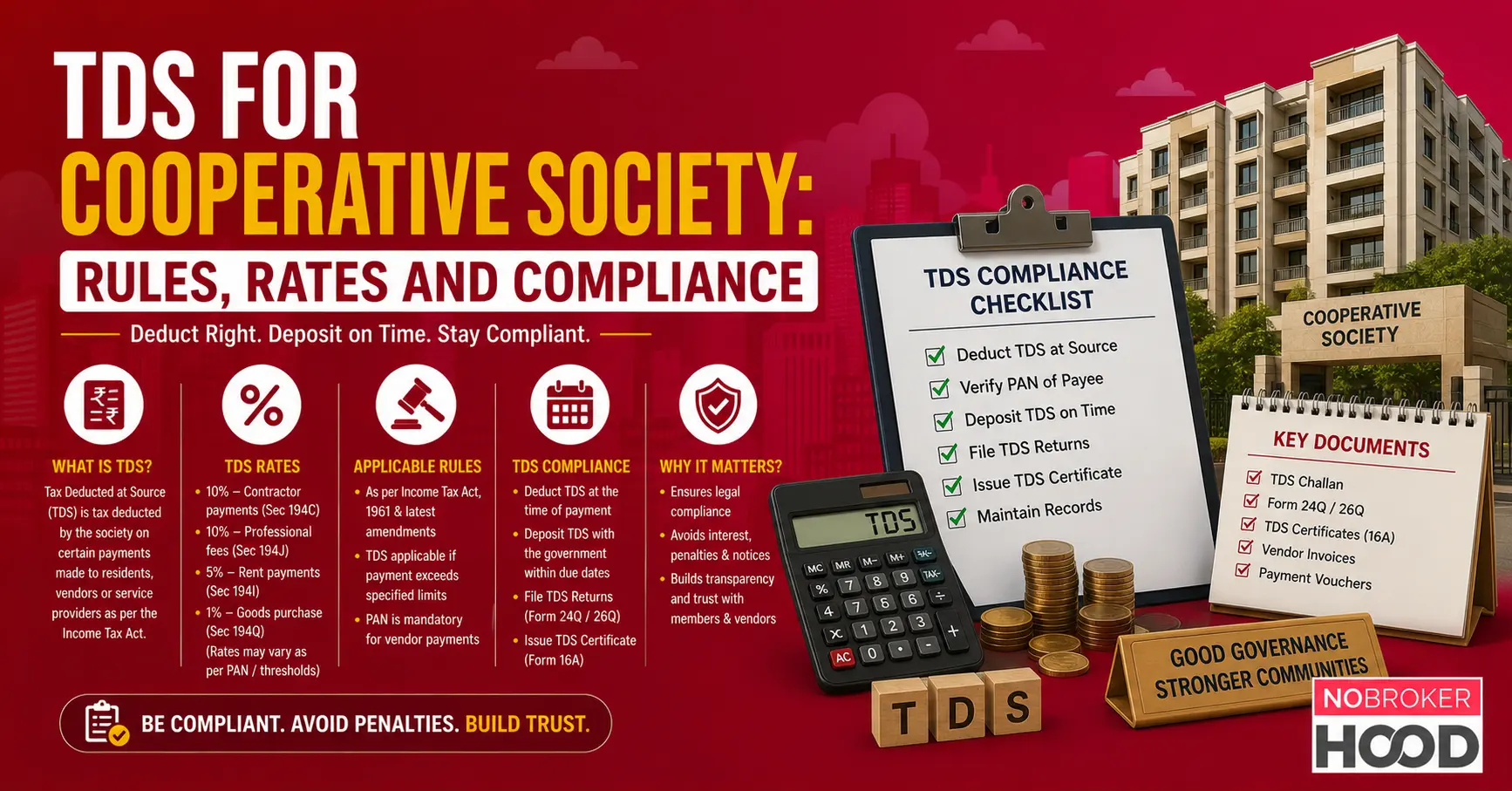


Tax Deducted at Source (TDS) is a system by the Income Tax Department that collects tax at the time of payment, with a small portion deducted upfront and deposited with the government. Housing societies, including RWAs and Co-operative Housing Societies, now have TDS compliance as a regular responsibility, since many payments to contractors, security staff, maintenance teams, and auditors are subject to it. For management committees, understanding these rules helps avoid penalties and legal issues while showing financial transparency. With large monthly collections and expenses, TDS for Cooperative Society is as essential as routine operations.

What is TDS in Cooperative Society?
In the context of Cooperative Society, TDS means deducting a certain percentage of tax from payments before releasing them to vendors or professionals. The deducted amount is then deposited with the government on behalf of the recipient.
For example, if a society pays an architect ₹50,000, it must deduct 10% (₹5,000) as TDS and pay the balance ₹45,000.
TDS applicability in housing societies arises when payments for services such as security, maintenance, or professional fees exceed the threshold limits specified under the Income Tax Act.
Is TDS Applicability for Co operative Society?
Yes, TDS applies to co-operative societies. As per separate legal entities, they must deduct tax when paying contractors, professionals, landlords, or salaried staff above the prescribed limits. Common sections include 194C for contractors, 194J for professional fees, 194I for rent, and 192 for salaries. The society must also obtain a TAN, deposit the deducted tax with the government on time, and file quarterly TDS returns.
Why is TDS Applicable to Cooperative Society?
Cooperative Society are treated as separate legal entities under the law. This means they have similar tax obligations as companies or associations.
- Legal obligation – The Income Tax Act requires societies to deduct TDS on specific types of payments.
- Threshold limits – If a contractor’s bill exceeds ₹30,000 in a single instance or ₹1,00,000 in a year, TDS becomes mandatory. Similarly, rent exceeding ₹2,40,000 annually requires TDS deduction.
- Audit Requirement – If a society's annual receipts exceed ₹50 lakh, it is subject to tax audit, further emphasising the importance of TDS compliance.
- Penalties – Non-compliance attracts interest, penalties, and disallowance of expenses while computing taxable income, which can increase the financial burden on members.
Read Also: Co-operative Society Accounting
Co operative Housing Society TDS Rate
Different sections of the Income Tax Act define where TDS applies to societies:
| Section | Covers | Rate | Threshold |
| 194C – Contractor Payments | Repairs, painting, civil works, lift maintenance, security, and housekeeping. | 1% (individual/HUF), 2% (firm/company) | ₹30,000 per contract or ₹1,00,000 annually |
| 194J – Professional and Technical Fees | Payments to auditors, architects, lawyers, consultants, and for technical services. | 10% | ₹30,000 annually |
| 194I – Rent | Payments for renting halls, parking areas, or premises. | 10% | ₹2,40,000 annually |
| 192 – Salaries | If the society employs staff directly. | Based on the employee’s income slab. | N/A |
These TDS provisions for housing societies help ensure all payments comply with legal and tax obligations.
Read Also: Guide on Income Tax for Housing Society
TDS Applicability on Housing Societies
A society is required to deduct TDS whenever payments to vendors, contractors, or professionals cross the limits prescribed under the Income Tax Act. This usually happens in the following cases:
- Vendor payments exceeding threshold: If a contractor is paid more than ₹30,000 in a single bill or over ₹1,00,000 in a year, the society must deduct TDS under Section 194C.
- Annual service contracts: Payments to agencies providing ongoing services such as cleaning, security, or landscaping often exceed these limits, making TDS deduction mandatory.
- Professional fees: If the society pays more than ₹30,000 annually to auditors, architects, or consultants, TDS has to be deducted under Section 194J.
Case studies:
- Lift Maintenance Contractor: Suppose a society pays ₹1,20,000 annually for elevator servicing. Since the annual amount exceeds ₹1,00,000, TDS under Section 194C must be deducted.
- Security Agency Payments: If the security agency is paid ₹40,000 per month (₹4,80,000 annually), the society has to deduct TDS each month before making the payment.
- Auditor’s Fee: When an auditor’s annual fee is ₹50,000, TDS under Section 194J becomes applicable since it crosses the threshold.
TDS Rules for Cooperative Society
The TDS rules for the housing society must be followed carefully to avoid penalties. Here are the key points every management committee should know:
- PAN requirement – Deductee’s PAN must be obtained; otherwise, TDS is deducted at a higher rate.
- Deposit timelines – TDS has to be deposited with the government by the 7th of the following month.
- Quarterly filing – Societies must file TDS returns every quarter (Form 24Q for salaries, Form 26Q for non-salary).
- Certificates – TDS certificates (Form 16/16A) must be issued to vendors or professionals as proof of deduction.
- Records – Maintain challans, ledgers, and vendor details for smooth audits and compliance checks.
Exemptions & Special Considerations
Not all transactions attract TDS. The key exemptions are:
- Small societies – If annual receipts are below ₹50 lakh, TDS compliance may not be mandatory.
- Low-value payments – No deduction if payments are within the threshold limits.
- Government bodies – Payments made to municipal corporations or government departments are exempt from this requirement.
- GST impact – TDS is generally calculated on the base amount (excluding GST).
Consequences of Non-Compliance
The consequences of ignoring TDS are:
- Interest – 1% per month for non-deduction, 1.5% per month for late deposit.
- Penalty – It is equal to the amount of TDS not deducted or deposited.
- Late filing fee – ₹200 per day under Section 234E until returns are filed.
- Expense disallowance – 30% of the expense is disallowed when computing taxable income, increasing society’s tax burden.
Best Practices for Cooperative Society
To stay compliant and avoid financial stress, societies can adopt these measures:
- Maintain an updated vendor list with PAN and GST details.
- Regularly track and review payments to identify when thresholds are crossed.
- Use accounting software to simplify TDS calculations and deposits.
- Consulting a chartered accountant or tax expert to ensure your housing society stays compliant with TDS rules.
Building a Culture of Compliance
TDS may seem like an added burden for housing societies, but it is a legal duty that ensures transparency and proper tax collection. Knowing the right sections, limits, and compliance rules helps societies stay penalty-free and earn members’ trust.
In the long run, treating TDS as part of responsible governance not only safeguards society legally but also strengthens its financial credibility.
Read Also: TDS on Society Maintenance Charges
Simplify TDS for Cooperative Society with NoBrokerHood’s Society Accounting Software
Tracking vendor payments, thresholds, PAN details and challans by hand is where most committees slip up. NoBrokerHood’s Society Accounting Software keeps your society’s books organised in one place, so TDS deductions and filings are easier to manage and audit-ready.
- Digital vendor and expense records: keep every contractor, auditor and service payment in one ledger so you can see when thresholds are crossed
- Automated maintenance billing and digital invoices: no manual entries to reconcile at year-end
- Real-time financial reports: share clear statements with members and your CA before TDS return deadlines
- Audit-ready accounts: challans, ledgers and payment history stay organised and easy to retrieve
- Transparency for residents: members can see where their maintenance money goes, which builds trust in the committee
All Solutions By NoBrokerHood
